
Is America Softening on Iranian Enrichment?
Is America Softening on Iranian Enrichment?
Donald Trump’s desire to be a peacemaker is hitting hard reality on multiple fronts. Our feature story this morning is about Russia and Ukraine, where Vladimir Putin has proved he doesn’t want peace with Ukraine—he wants to conquer Ukraine. And in the Middle East, two situations give us pause about Trump’s peace policy. First, Iran:

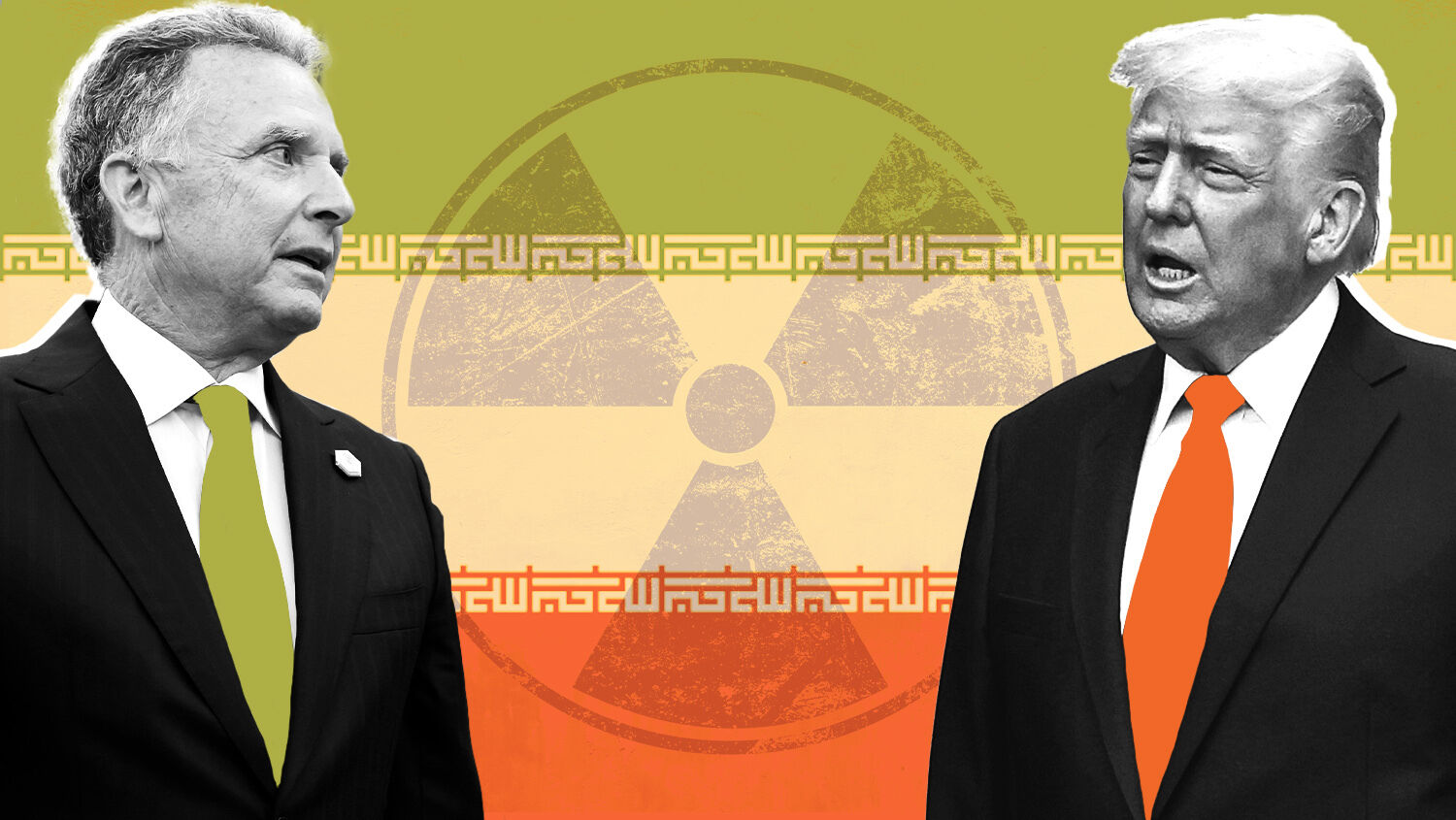
Is the U.S. OK with Iran enriching uranium, or not? In public, the Trump administration says absolutely not. But what are they telling the Iranians behind closed doors?
- Barak Ravid of Axios reported that, on Saturday, Envoy Steve Witkoff presented a proposal allowing Iran to continue limited low-level uranium enrichment for civilian purposes. The proposal does not demand that Iran fully dismantle its nuclear facilities, but it imposes certain conditions. This approach mirrors aspects of the 2015 jcpoa, which Trump withdrew from in 2018.
- The same day, President Trump responded to the report by posting on Truth Social, “WE WILL NOT ALLOW ANY ENRICHMENT OF URANIUM!”
- Weeks ago, Witkoff had suggested the U.S. might accept limited enrichment, similar to the 2015 deal. He later hardened his stance, declaring no enrichment capability would be allowed. His reported proposal on Saturday, however, indicates flexibility.
- This is all against the backdrop of Trump cautioning Benjamin Netanyahu against striking Iranian nuclear facilities so as not to derail talks.
Is the Ravid report trustworthy? In the past, the Biden administration used Ravid to push out intelligence leaks in its favor; one can’t take everything he writes at face value. In this case, though, his report is probably accurate.
Regarding Iran, there is currently a cold war within the U.S. intelligence establishment that goes all the way up to the White House. Some believe Iran can only be stopped by force. Others believe all things can be solved by negotiations (if the Israelis are sidelined from the discussion). It is likely that the realists are funneling the plans to Ravid in order to sabotage the talks.
In reality, what Witkoff and the Iranians are negotiating, and what Ravid received, is most likely an “interim deal.” An interim deal is the deal before the deal. It is not the last word. And between Trump and Iran, there is an impasse:
- Trump’s end goal is to deny Iran nuclear enrichment inside Iran.
- Iran has consistently said enrichment is a nonnegotiable right under the Nuclear Non-Proliferation Treaty and rejected demands to cease it entirely.
Between these two incongruent positions, Trump is likely to concede; Iran will never do so. Its nuclear ambitions remain strong, as evidenced by the amount of uranium enriched to just below the nuclear level (read this morning’s In Brief). Nuclear negotiations will not deter it from its goal.
The Iranians want to keep negotiating, to delay, to obfuscate, and to play on Trump’s aversion to not start new wars and become a peacemaker. They want to use the promise of a deal to get Trump to deny Israel the opportunity to destroy Iran’s nuclear weapons program.
Will Trump be played by the mullahs? The fact the Iranians have strung Witkoff along so far is not a good sign.
Similar Trumpian credulity looks like it’s playing out with Syria:
What red line? President Trump has given his blessing for thousands of foreign fighters affiliated with Hayat Tahrir al-Sham (hts) to join the new Syrian military.
- U.S. Special Envoy to Syria Thomas Barrack told Reuters “there is an understanding” that the U.S. would allow these groups into the government as long as there is “transparency” with the process.
hts overthrew the dictatorship of Bashar Assad late last year but is a listed terrorist organization by many Western governments. Trump previously said the U.S.’s condition to normalize relations with the new Syrian regime under President Ahmed al-Sharaa was for these fighters to leave Syria. Now he is apparently willing to ignore his own red line.
In Syria’s 13-year civil war, many radicals from across the Muslim world entered the country to fight the Assad regime. These include many Uyghur Muslims from China belonging to the Turkistan Islamic Party, recognized as a terrorist group by China. According to Syrian officials speaking with Reuters, “[S]ome 3,500 foreign fighters, mainly Uyghurs from China and neighboring countries, would join a newly formed unit, the 84th Syrian Army division, which would also include Syrians.”
These fighters belong to what was until recently widely accepted by the international community as a terrorist organization. They are not even Syrian; they came to Syria because of their belief in spreading Islamism by the sword around the world. That the Syrian government would want these figures in its army should show the U.S. that, at the very least, Sharaa is not the champion of democracy he claims to be. As we wrote last month in “Making Friends With Al Qaeda,” America warms up to the new Syrian regime to its own peril.
The Dutch government seems set to collapse after fringe-right leader Geert Wilders pulled his party out of the governing coalition. It’s the latest crisis of leadership in a continent drifting toward shipwreck.
Wilders came in first place in the November 2023 elections, but with a mere 24 percent of the vote. With his record of condemning Islam and migration, he couldn’t get a majority in parliament to support him as leader. So instead he and three other parties got behind Dick Schoof, the technocratic prime minister whom Dutch voters never chose.
In coalition, Wilders hasn’t been able to enact the crackdown on migrants he promised voters and was thus losing support. So he gave the government an ultimatum: Halt all new applications for asylum, stop asylum seekers bringing in family members, send Syrian refugees home—or I’m leaving. Now he’s left. He’s hoping that holding to his principles will pay off for him at the polls, even if he does take the blame for bringing down the government.
Without Wilders, the coalition has no majority. They could try to form a new left-right coalition, or remain as a minority government, but the likeliest outcome is fresh elections.
However, even with a new vote, the Dutch will probably face the same dilemma: a left-right coalition that pleases no one, or a compromise with the fringe right that holds views the establishment considers unacceptable.
If Wilders succeeds in making this vote a referendum on migration, he could do very well. In just over a decade, he has gone from being a fringe figure, ostracized and even banned from Britain because of his outspokenness (he called Islam an “ideology of a retarded culture” and the Koran “a fascist book which incites hatred and killing”), to being the Netherlands’ most powerful politician.
Europe is changing fast, and that change is causing major problems for Europe’s democracy:
- Yesterday we wrote you about the Polish election that left the nation divided between a mainstream prime minister and fringe-right president.
- The same division just brought down the Dutch government.
- Portugal just held its third election in three years.
- Germany is led by two parties that received some of their worst-ever results but remain in power only because of the splintered coalition landscape.
- France’s parliament has become completely nonfunctional as the nation drifts toward a pension crisis, divided between the far left, mainstream and far right.
In a dangerous world, European democracy is in crisis. Bible prophecy tells us the end result: a Europe led by a strongman and the end of its postwar experiment with democracy.
Liberals are crazy: After their historical loss in the 2024 U.S. presidential election, Democratic donors are considering a $20 million “strategic plan” called “Speaking With American Men” to find out why young men are drawn to conservative politics. These donors could save a lot of money by just reading Nate Silver’s latest blog post.
The June 2 edition of “Silver Bulletin” shows how Democrats have turned themselves into the party of the neurotic, the unstable and the miserable.
- Relying on Pew Research and Conservative Election Study data, Silver highlights how among voters who report poor mental health, liberals outnumber conservatives 45 percent to 19 percent.
- Meanwhile, among voters who report excellent mental health, conservatives outnumber liberals 51 percent to 20 percent.
- Half of liberal women between 18 and 29 have had a doctor or health-care provider tell them they have a mental health condition, compared to only a third of liberal men.
The View cohost Joy Behar responded to these findings by snapping that Democrats should write off men anyway as they are a waste of money. This response provides further anecdotal evidence that the Democratic Party has indeed become the party of bitter, angry women.
Isaiah 3:12 describes a society in which children “oppress” and women “rule.” Men, fathers and husbands aren’t even mentioned. Lack of male leadership is a curse on America today that is especially prevalent among the woke left. The reason Democrats push insane policies is that they are indeed insane.
IN OTHER NEWS
China shares an advanced laser defense system with Russia, our In Brief reports. The relationship between the two Asian giants continues to strengthen.
Meanwhile, a separate Asian cooperation: Japan and the Philippines worked out the initial steps of a defense cooperation deal to counter Chinese aggression, Cliff Lilangan reports. In the end, prophecy shows that these relationships will all align in a single Asian alliance.


