

The Week in Review
Middle East
Israel is concerned about unprecedented joint military exercises that were held by Turkey and Syria this week. The drills were held Monday through Wednesday along Turkey and Syria’s common border. Turkish and Syrian officials also signed an agreement for cooperation in the defense industry. Turkey is Israel’s closest Muslim ally, but relations between the two countries are becoming increasingly strained. These most recent military exercises with Syria show that Turkey is not a reliable ally for Israel. For more, see our March 2009 Trumpet article “The Israel-Turkey Alliance Is a Trap.”
Four Lebanese generals held since 2005 for their alleged involvement in the assassination plot that killed Lebanon’s former Prime Minister Rafik Hariri were released from prison Wednesday upon orders from the UN-backed international tribunal investigating the case. This is quite a victory for both Syria and Hezbollah, the political force that has gained from the intimidation of the Lebanese opposition. But the release of these four key figures, allegedly because of insufficient evidence, apparently isn’t their only victory. A Stratfor source reports that a number of Syrian officers who would potentially be called on to testify before the tribunal have disappeared, allegedly fleeing to Qatar where they were given fake IDs. Additionally, a witness recently arrested in Dubai may be handed over to Syria. Together, these developments mean the tribunal will “effectively be paralyzed,” says Stratfor (April 30). The assassination of the anti-Syrian Hariri four years ago was a message to Lebanese leaders that they must cooperate with Syria or else suffer the consequences. In the end, it appears Syria has achieved its goals—thwarting the tribunal that would prosecute those responsible for Hariri’s assassination, and preserving its hold on Lebanon—without giving up anything.
Pakistani troops conducted a limited offensive this week aimed at preventing the spread of the Taliban’s control beyond the Swat district in the North-West Frontier Province. While Islamabad realizes it needs to draw the line somewhere, it may not have the capability to do so and, moreover, it realizes that much of the population supports calls for Islamic law to be enforced. This, says Stratfor, may mean the Pakistani government will end up attempting to reach a power-sharing deal with pragmatic elements of the Taliban.
Europe
Unemployment in Spain was 17.4 percent during the first quarter of 2009, according to official statistics published April 24. Spain, a eurozone country, has been badly hit by the economic crisis. Watch for it to become more desperate for outside help.
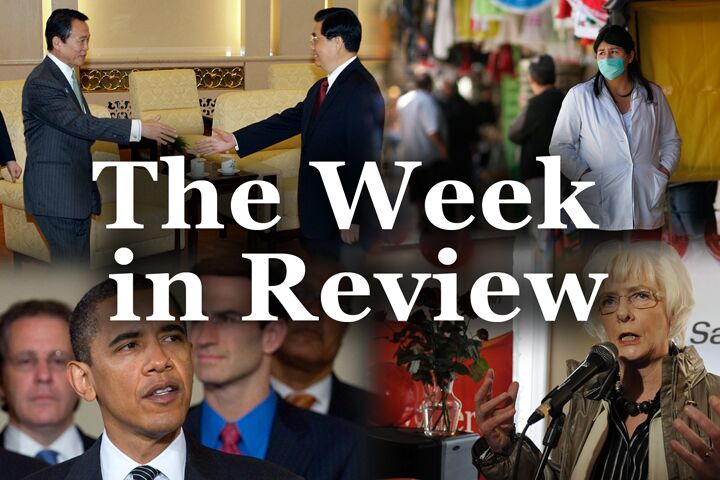
European Union advocate Johanna Sigurdardottir won Iceland’s elections April 26. As Iceland’s new prime minister, Sigurdardottir has promised to pursue EU membership, and plans to hold a referendum on the issue within 18 months. The EU’s popularity has increase dramatically in Iceland since the beginning of the financial crisis. The number of people wanting to join the eurozone rose from 36 percent in January 2007 to nearly 70 percent in October 2008. Watch for the European Union to use the financial crisis to increase its economic power worldwide.
Plans to revise the EU’s working time bill failed this week as members of the European Parliament gave up trying to reach an agreement after late-night negotiations on Monday. This legislation forces workers to work less than 48 hours in a week. Currently, workers in Britain and some other EU member states can opt out. The Trumpet has been closely watching attempts to amend the bill, as the Catholic Church has tried to use its influence to change the law so that it mandates a Sunday rest day for all. Expect the Vatican to continue its efforts through other means. For more information, see our February 2009 Trumpet article “The Battle for Sunday.”
Asia
Russia and China have announced a new era of military cooperation as part of a growing “strategic partnership.” On Tuesday, Russian Defense Minister Anatoly Serdyukov, during a meeting with his Chinese counterpart, Liang Guanglie, announced that Russia and China would hold up to 25 joint military maneuvers this year. This year is the 60th anniversary of the establishment of diplomatic relations between Russia and China. Representatives of both nations are using this milestone as an opportunity to draw the two countries closer together. A major joint Russian-Chinese “anti-terrorist” exercise called “Peace Mission 2009” had already been scheduled for this summer. Russia and China held their first set of war games in 2005. These were also labeled anti-terrorist exercises, but in reality were far more than that. They involved over 10,000 troops, warships and airplanes. Experts believe they may have been a trial run for a joint Russia-China invasion of Taiwan, or for supporting a Central Asian government against an American-backed insurgency. Watch for Russia-China military cooperation to increase. As the world gets more dangerous and as national ambitions grow, these two nations, which are natural allies, will start to pool their resources to expand their security and military reach. For more information, see our booklet Russia and China in Prophecy.
Japanese Prime Minister Taro Aso met with Chinese President Hu Jintao on Thursday to discuss Sino-Japanese cooperation regarding the world economic crisis. “It’s extremely important that Japan and China, the world’s second- and third-largest economies, keep in step with each other,” he said during statements about tackling global economic problems. Earlier in the day, Aso floated the idea of a bilateral free-trade deal between Japan and Chine in a wide-ranging speech he gave to a group of business leaders from both countries. As the American economy weakens, Japan is increasingly looking to China as its primary trade partner. Last August, China officially overtook America as the top destination for Japanese exports. It is important to watch Japanese politics, whatever course they might take. Sooner or later—more probably sooner—this movement inside Japan that demands the tempering of relations with America in favor of relations with Asian states will become full-blown reality. When this occurs, the U.S. will lose one of its most valued allies.
Latin America, Africa
From an economic standpoint, swine flu has struck at the worst possible moment for Mexico. Previous to the outbreak, we speculated that Mexico could collapse in 2009 or 2010 because of its floundering economy, debilitating drug war and collapsing oil revenues. Now a possible pandemic has originated inside Mexico, causing its domestic economy to tank even further. Due to presidential decree all non-essential government agencies and private businesses have been ordered to cease operations until May 6 to combat the spread of the virus—in essence, Mexico is shut down. Even prior to the presidential order, the mayor of Mexico City estimated it is losing $88 million per day as locals avoid contact with businesses. Tourism accounts for 8 percent of Mexico’s gross domestic product, but right now, people are leaving, and no one is planning a visit anytime soon. “The hope was that the economy would stabilize in the second quarter and then improve,” said Latin American equity strategist Damian Fraser at financial services company ubs, “but it looks like swine flu will at best postpone a recovery to the second half of the year.” The transformation for Mexico City is stark; as bbc put it, “What was once one of the noisiest, dirtiest, busiest places in the world has become strangely sterile—a quiet city, where many people wear masks outdoors, and most don’t go out” (April 30).
South Africa released its election results on April 25, and the African National Congress party (anc) won 65.9 percent of the vote—a clear majority, but not the two thirds required to make changes to the country’s Constitution. The anc will continue as the dominant force both politically and legislatively, and will easily appoint Jacob Zuma as president on May 9. For more on where South Africa is headed under his leadership, read our March 2008 Trumpet article “Don’t Expect Jacob Zuma to Fix South Africa.”
Anglo-America
A divided U.S. Congress signed off on President Barack Obama’s $3.6 trillion budget Wednesday night. All Republicans in both houses and more than 20 Democrats voted against the plan, which includes a provision that aims to transform health care by expanding government subsidies. The president’s budget aims to cut the deficit from an expected $1.2 trillion in 2009 to $523 billion in 2014, but launches the national debt from $11.2 trillion to $17 trillion.
Also on Wednesday, the House approved a Democrat bill to enhance the federal government’s authority to prosecute “bias-motivated violence.” Some politicians are worried that the liberal agenda is now running wild in the capital. House Minority Leader John Boehner described the legislation on “hate crimes” as charging someone “for what we think they were thinking.” Others warn that the bill is basically a gag order for religious figures who criticize homosexuality. “The left is in the midst of doing everything they’ve ever wanted to do over the last 30 years,” Boehner said. “This is their big opportunity, and they are trying to move all of it—at once.” The bill now goes to the Senate.
Chrysler became the first “Big Three” automaker to announce it is going into bankruptcy this week after a deal between the company, its creditors and the federal government fell through. President Obama preceded the news by saying, “For too long Chrysler moved too slowly to adapt to the future,” and announcing that the government had organized a deal to keep the bankrupt company afloat by loaning it up to $8 billion and merging it with Italian automaker Fiat. The Associated Press reported that the federal government would also guarantee the warranty on Chrysler vehicles. The deal also includes replacing the company’s board of directors. So far, the federal government has given Chrysler and General Motors over $17 billion to save them from collapsing. As part of the Chrysler bankruptcy, the government will likely lose much of the $4 billion it loaned the company at the end of 2007. Detroit papers reported that three Detroit plants would be shut down by the end of 2010, plus three more U.S. plants. On Thursday, Chrysler workers at two Detroit plants left their assembly lines because suppliers had stopped shipping them parts out of fear they would not be paid.
The New Hampshire Senate voted to legalize homosexual “marriage” on Wednesday—perhaps the last major hurdle for the state to become the fifth state in the union to allow homosexual couples to wed. The bill now needs to pass in the House and governor’s office. The House is dominated by liberals, who were awarded a majority vote in the legislature in 2006 for the first time in over a century.
Britain has ended its combat operations in Iraq. British troops began pulling out of Basra on Thursday, where they have fought an unpopular battle that cost 179 British lives. “Today marks the closing chapter of the combat mission in Iraq,” Prime Minister Gordon Brown said.


