Trump Trashing Trade With Mexico, Canada?
Trump Trashing Trade With Mexico, Canada?
Good morning!
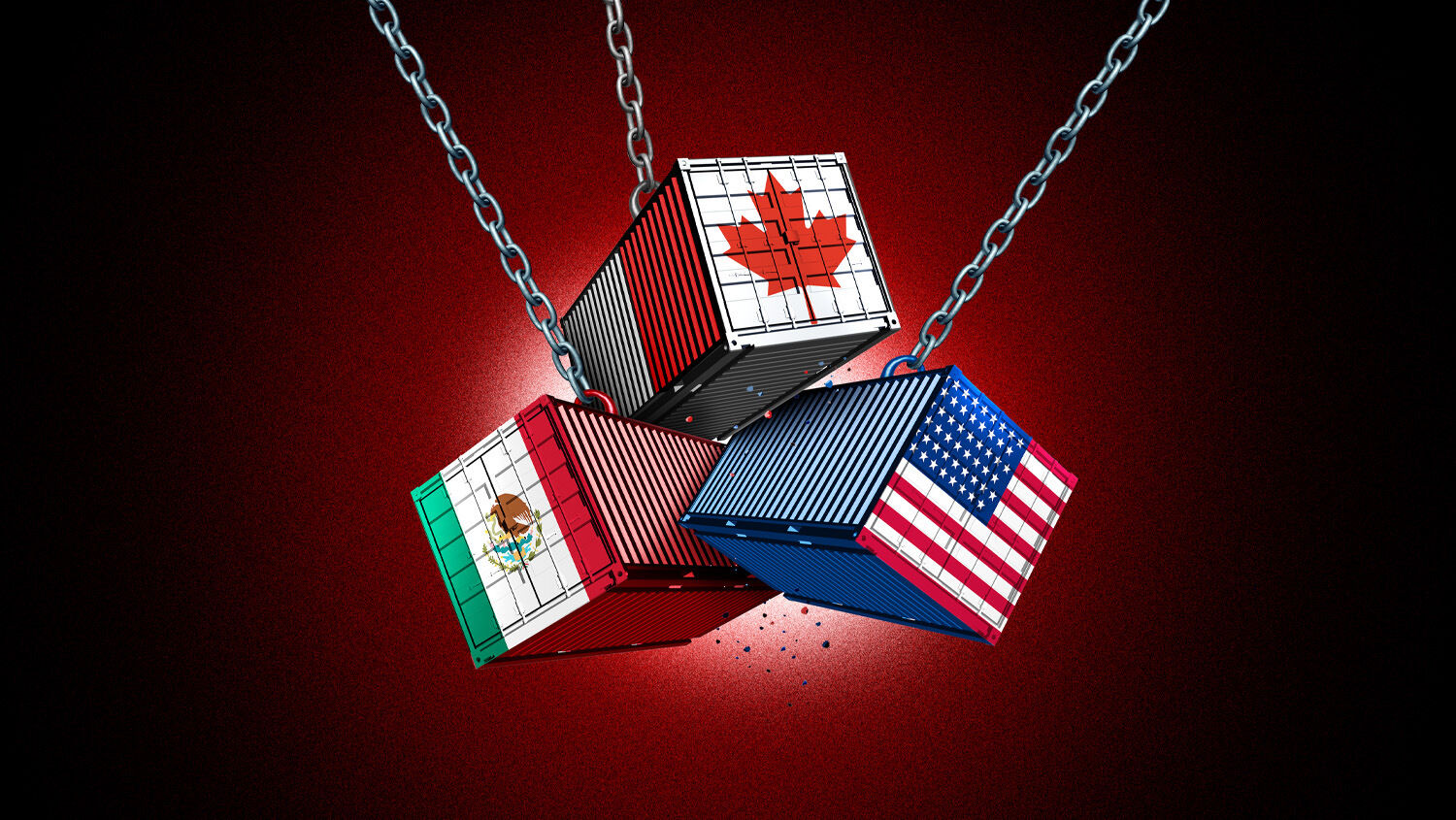
America just told its two closest neighbors it doesn’t need them. In the Oval Office yesterday, President Trump said he is “not looking to renew” the U.S.-Mexico-Canada Agreement, the trade pact he himself negotiated and implemented in 2020, ahead of its July 1 review.
- “We don’t need anything Canada has, we don’t need anything that Mexico has,” he said, “but they need everything that we have.”
This deal governs some $2 trillion in annual trade with the nation’s two largest trade partners. It won’t go away overnight; it technically runs to 2036. However, any nation can leave on six months’ notice, and the president pointedly declined to rule that out.
- This signals the poor condition of the U.S.’s formerly strong alliances with its neighbors and the increasing isolation of the world’s most powerful economy.
Canada has spent the past year hitching itself to Europe.
- Last June, Prime Minister Mark Carney signed a security and defense partnership with the EU, opening up North America to Europe’s $1.3 trillion rearmament program.
- In February, Canada became the first non-European nation to join the EU’s joint defense procurement initiative. The aim, Canadian officials openly say, is to reduce reliance on and vulnerability to the U.S.
- Last month, Carney became the first non-European to attend the European Political Community Summit, where he called Canada “the most European of non-European countries.” He said, “It is my strong personal view that the international order will be rebuilt, but it will be rebuilt out of Europe.” If only he knew.
Mexico is taking a similar path.
- Last month, President Claudia Sheinbaum signed a modernized trade agreement with the EU, the first in over a decade. European Council President António Costa called it “a true geopolitical statement.”
- Meanwhile, Sheinbaum vowed that Mexican officials indicted by U.S. prosecutors on drug charges will never face American courts. She snapped back at Trump’s talk of striking the cartels with, “It’s not going to happen.”
America’s own hand is pushing its neighbors into Europe’s economic orbit. Prophecy is quite clear why this is troubling.
- Europe is prophesied to become the world’s dominant economy, positioning itself at the heart of a prophesied “mart of nations,” a global trade bloc that will shut America out.
- The Bible warned that if we disbelieved and disobeyed the God who gave us our incredible blessings, America would be besieged “in all thy gates, until thy high and fenced walls come down, wherein thou trustedst, throughout all thy land” (Deuteronomy 28:52). Mexico will likely play a key role in this economic siege. As the Plain Truth stated in May 1962, “the United States is going to be left out in the cold as two gigantic trade blocs, Europe and Latin America, mesh together and begin calling the shots in world commerce.”
- Canada will face its own reckoning for sidling up to Europe. Mark Carney will come to regret his decision when his most European country of non-European countries falls victim to the last resurrection of the Holy Roman Empire.
Mr. Flurry’s article “America Is Being Besieged Economically” explains these trends in Bible prophecy and shows the hope beyond the bad news.
Iran War Update
- United States President Donald Trump claimed on Truth Social today that the U.S. “will be hitting Iran … very hard tonight.” He also claimed that “in the not too distant future, we will be taking Kharg Island, and other oil infrastructure points, and assume total control of their oil and gas markets, much like we have with Venezuela ….” This reflects the aggressive tactics of his initial strikes beginning on February 28, but he has made similar threats over the ensuing 15 weeks and declined to follow through.
- For the fourth time since the April 7 ceasefire, the U.S. has struck Iran. After an Iranian drone crashed into a U.S. attack helicopter on Monday, the U.S. struck various Iranian military sites on Tuesday and Wednesday and launched 49 cruise missiles today. Iran has retaliated by targeting U.S. 5th Fleet Headquarters and other American assets in Bahrain, Jordan and Kuwait.
Healey Resignation Shows Britain Is Broke and Defenseless
Britain is vulnerable because the government is not spending enough on its military, Defense Minister John Healey said as he handed in his resignation today.
He told Prime Minister Keir Starmer, “[Y]ou have been unable, and the Treasury has been unwilling, to commit the resources that the nation needs to defend the country at this time of rising threats.”
Britain is running out of money: Britain’s tax burden is at the highest level since the immediate aftermath of World War ii—and still rising.
- Roughly one quarter of total government spending goes to pensions and benefits. “Every meeting I have is ‘who can we tax in order to pay benefits to others,’” wrote disgraced Labour grandee Lord Peter Mandelson in a leaked text.
- Almost 10 percent of the budget goes to pay interest on the national debt.
- That leaves little money for defense spending.
Britain’s government is probably close to the maximum revenue it can get from taxation. It can, of course, raise taxes further, but this would harm the economy even more and actually reduce total tax revenue.
- More spending on defense, then, would have to come from cuts to other parts of the budget—and the government has consistently ruled out cuts to pensions and other welfare benefits, including such wastage as providing free cars to disabled people.
Britain will probably have a new prime minister in a few weeks. Challenges to Starmer’s leadership have been paused while Manchester Mayor Andy Burnham runs for Parliament. After his by-election on June 18, a leadership challenge will be held.
- Healey is widely respected in the Labour Party, as a principled, long-standing M.P. who has not aligned himself with any of Labour’s major factions. His resignation makes it even less likely that Starmer will survive.
Ousting Starmer won’t solve Britain’s economic problems. Nationwide sin is at the root of out-of-control spending, which leaves no money for keeping the country safe. Learn more in “Britain’s Economy Is a Sick Joke.”
Police Chief: DOJ Actively Protected Epstein
The police chief who oversaw the investigation leading to Jeffrey Epstein’s 2006 arrest told the Miami Herald that state and federal authorities worked against him and the victims.
- As officers tried to bring Epstein to justice for rape and other sex crimes against children, former Palm Beach Police Chief Michael Reiter says, “[t]his case, in many respects, felt like the people who work for our government were working more for Epstein than they were working for the victims and protecting the public.”
Reiter said he informed Palm Beach County State Attorney Barry Krischer that the Palm Beach Police Department was building a sexual battery case against a wealthy resident who was raping teenage girls, and Krischer supported the investigation.
- Epstein then hired a powerhouse legal team led by Alan Dershowitz and some of the most aggressive lawyers in America. They launched a scorched-earth attack on the girls and their families. Krischer then pressured Reiter to drop the case.
When Reiter realized state authorities could not be convinced to continue the case, he referred it to the fbi.
- Federal prosecutors took over in 2007, but the lead prosecutor, Marie Villafaña, ran into similar resistance. The Herald reports, “Her supervisors expressed doubts about a successful prosecution, once again noting that the girls had committed prostitution.”
- Villafaña told Reiter she believed that Epstein’s team had “unparalleled access to the decision-makers at the Justice Department” because her bosses began negotiating a secret plea deal with Epstein almost as soon as the fbi took over the case.
Epstein and his lawyers worked with the Department of Justice, which oversees the fbi, to negotiate a deal in which Epstein pleaded guilty to only one count of felony solicitation of prostitution and one count of procurement of a minor for prostitution.
- He was allowed to serve his sentence in a local county jail rather than a state prison. He was also granted a work release in which a private driver picked him up daily from jail and transported him to his high-rise office for much of the day.
- A 2018 Miami Herald investigative series exposed the sham behind this sweetheart deal, prompting President Donald Trump’s Justice Department to revisit the case and eventually charge Epstein with sex trafficking of minors in 2019.
The fact that Epstein remained a wealthy, well-connected businessman for the 13 years between his 2006 arrest and his 2019 arrest is a damning indictment that the legal system indeed protected him.
“Though Epstein is now dead, revelations keep emerging about how many extremely rich, extremely powerful, extremely well-known people continued to associate with him after his 2008 conviction,” Stephen Flurry wrote in “The Problem Is Far Bigger Than Epstein.” “It is a stomach-churning topic to look into, but Americans have to see the spiritual sickness that has beset their nation if they are to stand a chance of turning it around.”
Epstein was able to abuse so many victims for so long only because hundreds of other powerful and connected people in America enabled and protected him. Evil in America is definitely a problem far bigger than Epstein.
Canada Seeks to Ban Children From Social Media
Canada’s House of Commons introduced a bill yesterday that would force companies to block children under age 16 from accessing their social media platforms or artificial intelligence chatbots.
- Culture Minister Marc Miller correctly said these tools “do not support healthy childhood development and have become a source of anxiety, isolation, depression and a range of other mental health challenges for many young Canadians.”
Trouble is, it’s one thing for a parent to protect his child from the very real dangers of social media—it’s a different matter when a government attempts to do the same.
Miller promised, “This legislation will provide a safer environment for young Canadians and empower them to connect in-person, build friendships, focus in school, and learn real-world skills so they can thrive.”
But will it? A couple of potential problems:
- The government plans to grant exceptions to companies that commit to meeting specific safety standards. In other words, those that gain the government’s favor can win exemptions while their competitors will not. X, which is known for refusing to censor content critical of governments, may be at a disadvantage, while Facebook and TikTok, which are equally or even more harmful to children, may be exempt.
- How do you enforce the ban? Miller says he doesn’t know yet. Will people have to upload IDs that will jeopardize their social media anonymity? If so, the government could more easily target its critics. Increasing Canada’s already extensive surveillance of its citizens and curtailment of their freedoms could be the most significant effect of such a law.
Anytime the government steps in as the parent, problems result, and things get messy.
IN OTHER NEWS
North Korea plans to build more nuclear weapons: North Korean dictator Kim Jong-un inspected a new facility in Yongbyon on June 3 that could increase the nation’s nuclear enrichment capabilities by 75 percent, the Wall Street Journal reported yesterday. The article cited the Stockholm International Peace Research Institute as estimating North Korea’s current stock of nuclear warheads at around 60, with “material to make at least 90 more.” North Korea’s growing nuclear arsenal will complement the mass-destructive capabilities of a rising Asian alliance prophesied in the Bible.
German AI-robot start-up wins funding from U.S. tech giants: Neura Robotics, a German firm, raised up to $1.4 billion in its latest funding round from investors including Amazon, Bosch and Nvidia, Germany’s Bild reported yesterday. The company has an order backlog of $1 billion for its AI-powered humanoid robots designed to perform tasks currently done by humans. It intends to scale production to millions of units by 2030 and to position Europe as a competitor to the U.S. and China in this sector. The Bible warns that a technologically powerful Germany will use its abilities for war.
Europe proposes rearming even faster: European Parliament and member state representatives reached a provisional agreement to automatically authorize defense readiness projects if regulators do not block them within 102 working days, Germany’s nTV reported Wednesday. The proposal is part of a larger package to reduce regulation on military projects. This is the same bloc that will not only approve and develop deadly hardware but also use it to “make war.”
Lithuanian military orders vehicles from Germany: Lithuania placed a $1.2 billion order for military vehicles from Mercedes-Benz, the Lithuanian Defense Ministry announced yesterday. The ministry called the purchase “one of the largest investments” in its logistical capabilities. The Baltic nation will use European Union loans to help fund the purchase, and deliveries are expected between 2026 and 2032. This order is an example of Russia scaring its European neighbors into rapidly arming, with help from Germany. The Bible warned that Russia would propel Europe to rearm.
Nine in 10 Europeans don’t trust America: Just 11 percent of Europeans view the United States as an ally, according to a European Council on Foreign Relations survey published yesterday. This marks a 50 percent decline since November 2024 to an all-time low. Among 19,481 respondents across 15 European nations, the survey also found that a majority did not believe America would defend them in the event of an attack. European hostility to the U.S. was foretold in Bible prophecy.
Inflation spikes to three-year high on rising fuel prices: The U.S. annual inflation rate jumped to 4.2 percent in May, according to the latest Bureau of Labor Statistics report, published yesterday. This is the highest official inflation rate since April 2023. Core inflation, which excludes volatile food and energy prices, rose slightly to 2.9 percent. This indicates that energy shortages, due primarily to Iran successfully blocking the Strait of Hormuz, are the main cause of the increase. U.S. gasoline prices have risen 30 to 44 percent year-over-year, with the national average at approximately $4.15 per gallon, and diesel is up about 50 percent to $5.21 per gallon. Commercial trucks transport virtually all goods—multiple times—consumed by Americans, including more than 70 percent of U.S. food and agricultural products. Fuel prices could surge even further in the coming months as inventories fall to critical lows.