

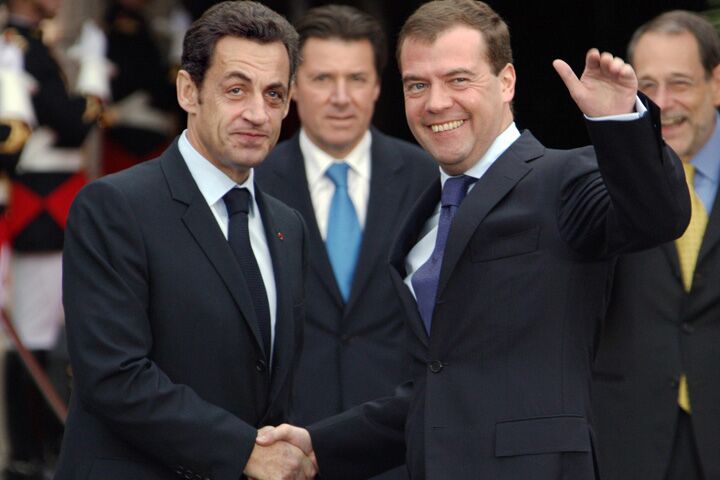
EU-Russia Summit Signals Warming Relations
Russia and the European Union agreed to resume partnership and cooperation talks at a half-day summit on Friday, signaling a thaw in tensions that have existed between the two powers since the Georgia war in August.
TheTrumpet.com has closely monitored Germany’s relationship with Russia in the wake of Moscow’s invasion of Georgia. Berlin’s reaction to Russia’s assault on Georgia was significant for a number of reasons, including the fact that rather than drive a wedge between Russia and Germany, the event appeared to strengthen the Russo-German relationship.
Germany’s response to Russia’s belligerence, however, was, for the most part, quite different than how other European states reacted. Instead of condemning, reprimanding and shunning Moscow, as the EU and most European states did to one degree or another, the Germans responded initially with relative silence, and then with calculated gestures of reconciliation and warmth.
On August 20, Stratfor reported:
… Berlin is now reassessing its allegiances to Washington and nato, which would keep the country locked into the policies it made as an occupied state. Or Germany could act like its own state and create its own security guarantee with Russia—something that would rip nato apart. … Stratfor sources in Moscow have said that Medvedev has offered Merkel a security pact for their two countries.
Germany’s decision to pursue a closer relationship with Moscow put the EU and other European states in an awkward bind. Germany is Europe’s largest and most influential state. Neither the EU nor any other European nation could effectively penalize Russia without its efforts being undermined by the warmth flowing from Germany. Plus, although European states couldn’t ever publicly admit it, Germany’s reaction to Russia made sense; not only did it make sense strategically not to provoke the newly emboldened Russian state, it was also politically and economically expedient not to provoke its largest energy supplier and a primary trade partner.
So, it comes as no surprise to read of the success of Friday’s EU-Russia summit in Nice, France. Spiegel Online reports (emphasis ours):
The extent of the harmony seen on Friday was rare: EU leaders and Russian President Medvedev agreed to new talks in Nice about political and economic partnership between Moscow and Europe. There was even talk of a “pan-European security pact.”
Suddenly the barriers that had been piling up in recent months between the East and West seemed to be a lot lower. French President Nicolas Sarkozy, whose country currently holds the rotating presidency of the European Union, and his colleague from Moscow, Dmitry Medvedev, cleared the political hurdles at the EU-Russia summit in Nice on Friday with surprising ease—setting a new tone in difficult relations between unequal neighbors.
Among the decisions made Friday, it was agreed that European-Russian negotiations on a new Partnership and Cooperation Agreement, which was suspended after Russia’s invasion of Georgia, will now start again, possibly as early as December 2, and that Russia and Europe, as Medvedev put it, would “speak with a single voice” at the world financial summit in Washington the following day.
That Europe is now on friendly terms with Russia is deeply significant. More significant, however, is that Europe simply followedGermany’s lead in embracing Moscow.


