

Russia Checks Europe’s Expansion
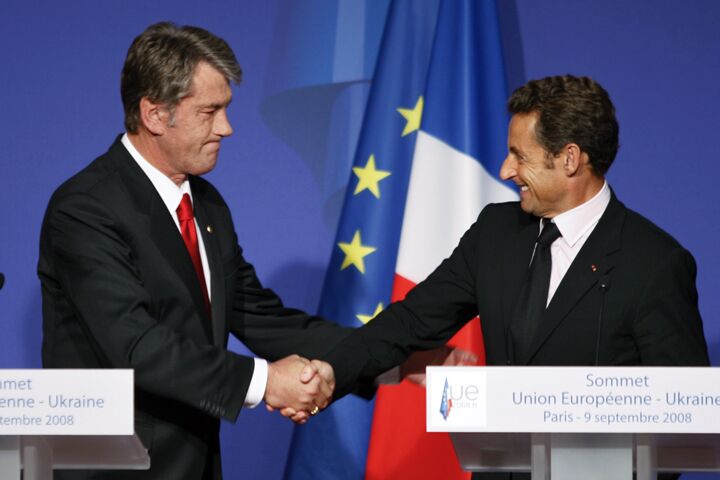
Weak. That is the only way to describe the European Union’s behavior during its annual summit with Ukraine in Paris on September 9. The result of the meeting was an agreement to sign a future “Association Agreement,” which gave Ukraine enhanced status with the EU but included nothing about the possibility of Ukraine’s membership in the bloc.
The new treaty, which will be signed in 2009 or 2010 and is to be the foundation of EU-Ukraine relations for the next decade, “neither opens nor closes any route” to Ukraine’s membership in the EU, according to the summit chairman, French President Nicolas Sarkozy.
All eyes were watching Europe’s handling of the former Soviet state after Russian President Dmitry Medvedev claimed Ukraine as belonging to Russia’s sphere of influence in a Russian television interview on August 31.
The EU is split over Ukraine’s membership, with Germany, Belgium, the Netherlands and Luxembourg blocking EU expansion into former ussr territory. Many other EU members, including Poland and the UK, had pushed for at least recognizing the prospect of Ukraine’s membership in the EU.
In the end, Germany’s camp won out.
Perhaps none was as disappointed as Ukranian President Viktor Yushchenko, who told reporters in Ukraine before leaving for Paris that the EU would sign “a very symbolic document cementing relations.”
Yushchenko received far from that. It was essentially only a promise that Ukraine’s territorial integrity was “non-negotiable.”
Even a quick glance shows Ukraine’s membership bid is a long shot. Ukraine’s own population is divided over the issue, with half the country pro-Russian and about 20 percent ethnic Russians. However, the bigger reason requires one more eastward glance to Russia.
The EU’s empty promises to Ukraine came one day after Sarkozy met with Medvedev. No doubt the summit was on their agenda, and no doubt Medvedev reiterated that Russia has drawn the line—in front of Ukraine. Clearly, the EU does not see Ukraine worth the confrontation with Russia, at least not yet.
In many ways, Eastern Europe is like a chessboard, with Ukraine at its center.
In 1991, following unification of East and West Germany, the Köhl government, supported by the Vatican, opened the game by forcing the breakup of Yugoslavia, isolating Serbia, a staunch ally of Moscow, from Russia. The West followed up by expanding the EU and nato into countries formerly controlled by the ussr.
Not until Russia received its new king, Vladimir Putin, did it gain the strength to finally respond, namely by bringing Georgia, another former Soviet state pushing for Westernization, back into its fold—by force.
For now, it looks like Russia has checked German-led EU ambitions in the East, but this will all change when Europe too receives a new king. With federal elections coming up next year in Germany and the chance of new personalities rising to power, the game could change quickly. For more information on the subject, read “A More Vital Election,” and watch for the EU’s next move.


