

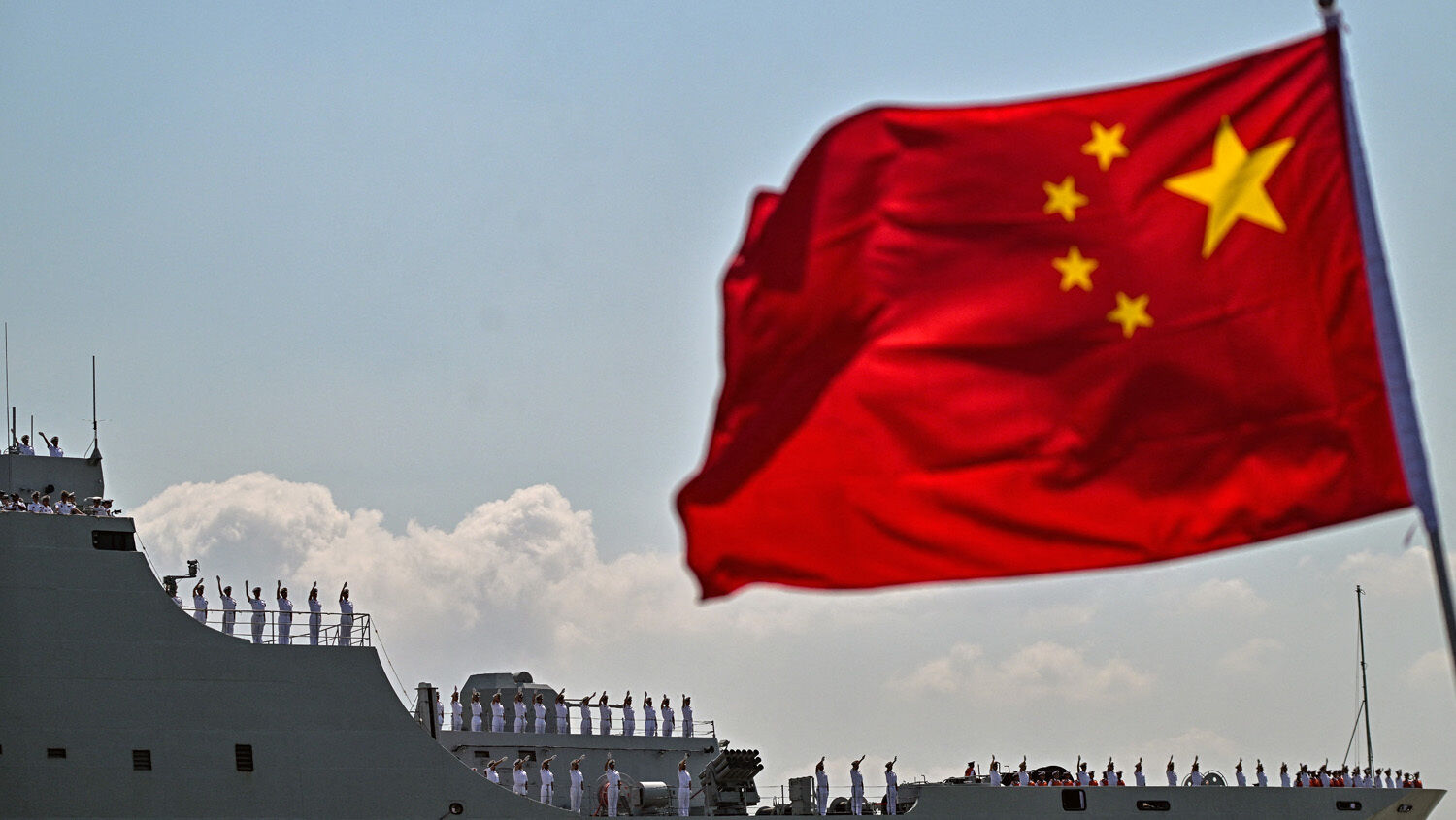
China’s Drive to Dominate the World’s Oceans
China is pursuing one of the most ambitious and rapid peacetime naval expansions in modern history, the Wall Street Journal wrote on November 1.
What makes the effort so formidable is that it extends well beyond building vast fleets of warships. Under General Secretary Xi Jinping, China is assembling an entire maritime empire, combining commercial shipbuilding dominance, overseas port investments, global shipping networks and an expansive fleet of coast guard and fishing vessels. Together, these efforts give China the industrial capacity, logistical infrastructure and maritime reach to challenge the existing balance of power at sea.
“For centuries, China was a continental force,” the analysis states. “Its sudden, historic emergence as one of the world’s top maritime powers is challenging the U.S. on a scale it hasn’t faced since World War ii.”
A Warship-Building Boom
When a little-known Chinese firm bought an unfinished Soviet aircraft carrier, called the Varyag, from Ukraine in 1998, its owners claimed they intended to make it into a floating casino.
But that was a cover story.
The Chinese had never constructed or operated an aircraft carrier, so their naval engineers spent the next several years studying the Varyag. At the same time, Chinese military delegations traveled to the United States to participate in an American program offering tours of aircraft carriers to foreign military officers.
Former U.S. Naval Intelligence Chief Michael Studeman told the Wall Street Journal that the program was meant to demonstrate America’s untouchable naval superiority: “The approach at the time was, if we show them how capable we are, they’ll be intimidated and they won’t ever think that they could challenge us.”
The strategy failed spectacularly, Studeman says, because “all they were doing was learning how we operated carriers so they could operate their own.”
In 2012, China completed the Varyag’s transformation into a functioning aircraft carrier capable of launching warplanes. The vessel entered service in the Chinese Navy as the Liaoning.
In the years since, China has commissioned two other far more formidable, domestically built aircraft carriers, with another nearing completion. These carriers are the centerpieces of a fleet that now numbers more than 400 warships and submarines, making China’s navy the world’s largest by hull count—by a wide margin.
But China’s naval buildup isn’t just about numbers. The People’s Liberation Army Navy (plan) is also becoming increasingly sophisticated and lethal. Its Type 052D guided-missile destroyers and larger Type 055 destroyers are equipped with advanced vertical-launch systems capable of firing a variety of potent weapons, including the YJ-18 supersonic anti-ship cruise missile. These have an estimated range of up to 335 miles and cruise at about 600 mph before accelerating to more than three times the speed of sound in the final approach toward their target.
China has begun equipping its destroyers with the YJ-20, a hypersonic anti-ship missile reportedly capable of striking targets 600 to 900 miles away. These weapons substantially extend China’s ability to threaten enemy naval forces across the Indo-Pacific, including U.S. aircraft carrier groups.
“They’re not building a bunch of little corvettes,” Thomas Shugart, a former U.S. Navy submariner and adjunct senior fellow at the Center for a New American Security, told the Journal. “They’re building a world-class navy.”
The U.S. Navy, meanwhile, has just 291 battle force ships, compared with the plan’s 400, and faces serious obstacles to building more. Years of underinvestment, industrial bottlenecks and aging shipbuilding infrastructure have hampered America’s ability to expand its fleet.
The U.S. still retains important advantages, particularly its quieter, more capable, nuclear-powered attack submarines, its 11 nuclear-powered aircraft carriers and the advanced aircraft they deploy. But as China’s fleet grows larger and its ships become increasingly sophisticated and heavily armed, the balance of naval power is increasingly shifting in China’s favor
Studeman said China has already developed the naval strength to challenge America’s military dominance inside the first island chain—the arc of islands stretching from Japan through Taiwan to the Philippines. He warned: “The Chinese have the ability to not just challenge but potentially defeat big portions of America’s traditional naval force, especially inside the first island chain and even outside the first island chain.”
The Commercial Engine Behind China’s Navy
China’s growing naval power rests on an advantage that extends far beyond its military shipyards. The nation has cultivated a colossal maritime industrial base that serves both economic and military purposes, with commercial shipbuilding helping sustain the infrastructure, workforce, technology and industrial capacity behind China’s expanding navy.
The scale of this base is staggering. China’s shipyards now build more than half of all merchant vessels, and the nation has an overall shipbuilding capacity around 230 times greater than America’s.
This industrial dominance gives China a tremendous advantage in any long-term naval competition. It means the nation isn’t simply building a larger and more lethal navy today. Its vast network of shipyards, suppliers and skilled workers provides the industrial foundation to upgrade, repair and replenish its fleet continually.
China has also spent decades expanding its influence over the world’s ports, shipping routes and maritime trade networks. Chinese companies own, operate or hold stakes in port facilities across virtually every major maritime region, from the Mediterranean and Atlantic coasts of Europe and Africa to the Indian Ocean, the South Pacific and the Western Hemisphere. A 2026 AidData study identified Chinese state-directed financing for projects at 168 ports in 90 countries.
These investments give Beijing commercial footholds, political influence, logistical relationships and potential access to strategic maritime infrastructure on virtually every major shipping route.
The Gray Fleets
Analysts commonly emphasize the fact that China possesses the world’s largest navy. Far less frequently acknowledged is that it also commands the world’s largest coast guard, with approximately 546 vessels, and that these two official maritime forces are heavily reinforced by the world’s largest fishing fleet.
The scale is staggering. China has nearly half a million registered fishing vessels, with more than 17,000 capable of distant-water operations. This is no ordinary commercial fishing fleet. Andrew Erickson of the U.S. Naval War College’s China Maritime Studies Institute explained: “This is in no way a collection of innocent, random, patriotic fishermen. China likes to have that camouflage and likes to mis-portray it in that way, but it is not the case at all.”
Many of these vessels serve as a “maritime militia,” Erickson said. They are “trained, equipped and organized directly by the pla’s [People’s Liberation Army’s] local military commands. It answers to the very top of China’s centralized bureaucracy: Commander in Chief Xi Jinping himself.”
The military value of the fishing fleets is not merely theoretical; it has been demonstrated repeatedly in the South China Sea.
Fishing militia vessels have helped establish and reinforce Chinese outposts at Subi and Mischief reefs. In early 2019, hundreds of Chinese fishing vessels swarmed Pag-asa Island, a Philippine outpost in the Spratly Islands that China seeks control over. In March 2021, approximately 220 Chinese maritime militia vessels moored in line formation at Whitsun Reef, another feature in Philippine waters that China covets. Their operations demonstrated how China can use ostensibly civilian vessels to accomplish military objectives.
‘Steering the World Toward War’
Trumpet editor in chief Gerald Flurry has sounded the alarm about the growing disparity between Chinese and American naval power, particularly in relation to control of the crucial South China Sea. In a July 2016 Trumpet article titled “China Is Steering the World Toward War,” he wrote:
[T]he American military is retreating, and other great powers are coming in to fill the vacuum. … China is intimidating the nations of Southeast Asia into submission to its will. … Everything is headed in the direction of war.
Mr. Flurry emphasized that his understanding of this dynamic is founded on Bible prophecy. In Deuteronomy 28:52, God tells “Israel” that if its people refuse to obey Him, He will transfer control over the world’s strategic maritime lanes and choke points, or “gates,” to their enemies. Mr. Flurry explained that this is “a prophecy for the modern-day descendants of Israel,” which refers to modern America and Britain.
In recent years, China’s buildup of naval power and America’s simultaneous retreat have seen the Chinese take control of much of the South China Sea and many of the sea gates that allow access to it. This is happening in areas that, just a few years ago, were under the control of the U.S. and Britain, which shows that the prophecy in Deuteronomy is being fulfilled.
China’s expanding naval power and the widening gap between Chinese and American sea power could further hasten the fulfillment of these prophecies. To better understand the prophetic significance of China’s rise, order our free booklet Russia and China in Prophecy.


