

China’s Campaign of Maritime Intimidation Is ‘Steering the World Toward War’
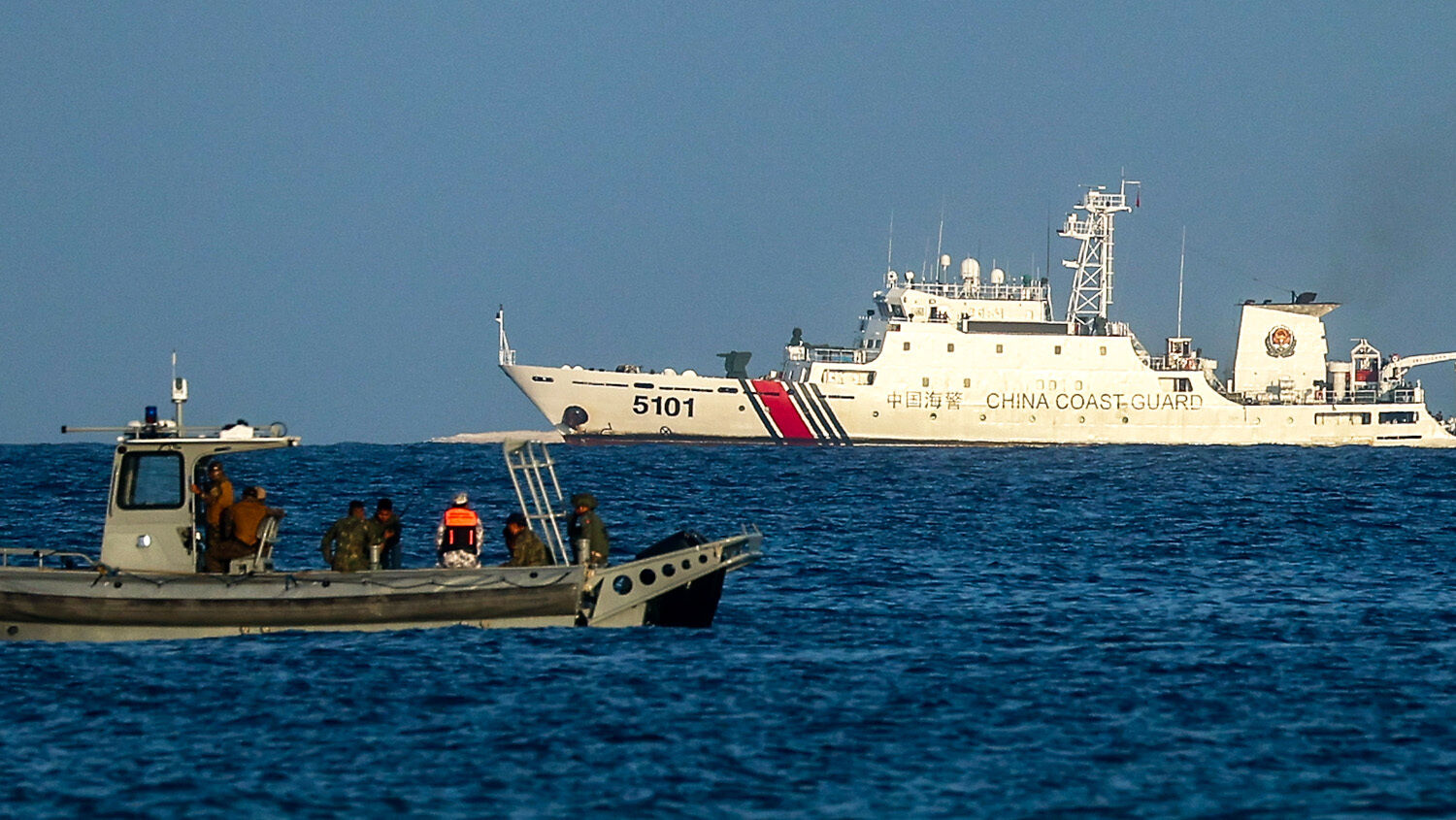
China’s Coast Guard injured a Philippine sailor during a confrontation near Second Thomas Shoal in the Spratly Islands last Monday, underscoring China’s increasingly reckless campaign to dominate a region far outside its jurisdiction.
Second Thomas Shoal, also called Ayungin Shoal, lies about 120 nautical miles from the Philippines. This places it well within the country’s 200-nautical-mile area that the United Nations Convention on the Law of the Sea defines as a nation’s exclusive economic zone (eez). Within an eez, a coastal state has exclusive sovereign rights to explore, exploit and manage natural resources; construct offshore installations; conduct marine scientific research; and regulate certain economic activities.
In 1999, the Philippines reinforced its claim by deliberately grounding the warship brp Sierra Madre on the shoal, turning it into a makeshift military outpost that has allowed Philippine personnel to maintain a permanent presence there ever since.
Most nations recognize and follow the eez framework to determine maritime rights. But the Chinese Communist Party has little regard for international law—except in instances where it might serve Beijing’s strategic interests. China defiantly claims the Spratly Islands and almost all of the South China Sea as its own, and it is increasingly asserting more control over the vast region.
A landmark 2016 ruling by an international tribunal struck down most of China’s sweeping claims in the South China Sea. But rather than retreat, China doubled down, unlawfully militarizing features in the region and becoming even more defiant. Its claims overlap with the eezs of several neighboring nations, including Brunei, Malaysia, the Philippines, Taiwan and Vietnam. But its most intense campaign in recent years has been against the Philippines, a United States treaty ally.
Chinese vessels have repeatedly harassed Philippine personnel with water cannons, lasers and various dangerous maneuvers against Filipino vessels. In one 2024 confrontation at Second Thomas Shoal, a Filipino sailor lost a finger when a Chinese vessel collided with and damaged his boat.
Last week’s incident began when eight Chinese Coast Guard personnel in a high-speed rhib patrol boat approached the Sierra Madre. Philippine sailors approached the vessel on rubber rafts to chase it away from the outpost. The Chinese, according to a statement by the Armed Forces of the Philippines, “reacted violently and aggressively by striking a Philippine Navy personnel on the head with a wooden baton, causing injury and damaging the Navy rubber boat operating within the area where our country enjoys sovereign rights under international law.”
The U.S. State Department condemned what it described as China’s “dangerous and aggressive actions” in the incident.
This week’s incident came just before a series of high-level diplomatic meetings hosted by the Association of Southeast Asian Nations (asean) in Manila, where discussions on easing tensions in the South China Sea are on the agenda.
But we should not expect these discussions to bring peace to this flash point.
Trumpet editor in chief Gerald Flurry wrote in 2016 that China’s takeover of the strategic South China Sea and its bullying of less powerful nations in the region “is steering the world toward war.”
He wrote:
Since Japan’s defeat in World War ii, America has protected this vital trade route and brought peace to this part of the world. Now the American military is retreating, and other great powers are coming in to fill the vacuum. … China is intimidating the nations of Southeast Asia into submission to its will. … Everything is headed in the direction of war.
Mr. Flurry’s understanding of the South China Sea dynamic and what it will lead to is founded on biblical prophecy.
In Deuteronomy 28:52, God cautions the modern nations that descended from ancient Israel that if they refuse to turn to Him, He will give control of the world’s strategic sea “gates”—such as those of the South China Sea—to their enemies. He warns that these enemy powers will weaponize that control and eventually besiege the nations of Israel: “And he shall besiege thee in all thy gates, until thy high and fenced walls come down, wherein thou trustedst, throughout all thy land ….”
Mr. Flurry explained that this warning was not intended for the ancient Israelites under Moses, but for two modern countries primarily. He wrote: “It is a prophecy for the modern-day descendants of Israel. Two nations in particular represent Israel in this end time: America and Britain.”
These two countries “are full of terrible sins today, and God is going to correct them for that!” he wrote. “This prophecy and several others show that He will send foreign enemies to punish America and Britain!” (For proof that America and Britain descended from ancient Israel, read The United States and Britain in Prophecy by Herbert W. Armstrong.)
China’s ongoing bullying of the Philippines and its broader takeover of this strategic maritime region show that this prophecy in Deuteronomy is moving toward fulfillment.
Mr. Flurry stressed that we must closely watch the developments leading to the prophesied besiegement. He also emphasized that as catastrophic as the future destruction will be, the developments now underway are also intricately tied to the best news we could hear:
All this prophesied destruction is what it will take for God to reach this world! After this, people will be ashamed—and they will get to know God! Ezekiel repeatedly talked about that inspiring conclusion (e.g. Ezekiel 6:7; 7:4; 11:10; 12:20; 13:9; 23:48-49, etc).
He continued: “Yes, there is a lot of bad news when you consider what it takes to get people to the point of knowing God. But ultimately, the outcome is spectacularly good news!”
To understand, order your free copy of Mr. Flurry’s book Ezekiel: The End-Time Prophet.


