Russia and China—an Alliance Forged in Fire
Russia and China—an Alliance Forged in Fire

Russia is feeling the heat. The nation is under immense financial and human strain from 4½ years of full-scale war on Ukraine, while contending with Western sanctions, technological isolation and a widening brain drain. Moscow’s geopolitical position has also weakened in recent years as longtime partners from Syria and the South Caucasus to Kazakhstan and parts of Africa have broken away or become harder for the Kremlin to sustain financially and militarily. Even in Venezuela—where Nicolás Maduro had been aligned with Moscow until his dramatic capture by American forces in January—Russia was unable to protect one of its closest allies. Iran, too, has exposed the limits of Russian power projection; Moscow has offered rhetoric and limited support but failed to decisively shield another embattled ally.
At the same time, China is also being driven deep into the forge. It is feeling the slow burn of a weakening economy, strain in its once-dominant property sector, and the impact of accelerating demographic decline that reduces long-term productivity and consumer demand. Local governments remain burdened by immense debts accumulated during the property boom, while weak consumer confidence and soaring youth unemployment have created serious deflationary pressures across the economy. Beijing is also facing intensifying external pressure over its predatory trade practices, brutal internal crackdowns, threats on Taiwan and bullying in the South China Sea and other regions. This pressure comes in the form of increasingly assertive United States-led military posture across the Indo-Pacific, semiconductor restrictions, declining foreign investment and mounting trade tensions.
Both powers are now being tempered in the furnace of geopolitical pressure. By traditional measures, both powers appear structurally stressed and vulnerable. Some analysts have speculated that the intensifying forces could end up busting apart their partnership. Instead, the increasing pressures are forging an ever closer bond between them—a bond that is becoming one of the defining geopolitical structures of the age.
From Tack Weld to Ironclad Union
Russia and China had been drawing steadily closer since shortly after the Soviet Union’s collapse—resolving long-standing border disputes, integrating their economies, and expanding military cooperation. But after Russian President Vladimir Putin escalated his war on Ukraine into a full-scale invasion in early 2022, the heat of crisis forged the two countries into a far stronger geopolitical union.
Energy cooperation has become especially significant after many Western nations sought to punish Moscow for its war by reducing their dependence on Russian hydrocarbons. China, the world’s most energy-hungry nation, eagerly stepped in and bought up supplies that had previously flowed westward. Chinese imports of Russian crude rose from 1.6 million barrels per day before the invasion to 2.2 million by 2023, making Russia China’s largest oil supplier. The situation with gas is similar, with China boosting imports through the Power of Siberia pipeline from 10.4 billion cubic meters in 2021 to 23 billion in 2023. Last year, the figure hit 38.8 billion. China is also now Russia’s top buyer of seaborne liquefied natural gas.
With these steady purchases, as well as consistent imports of Russian coal, refined fuels, metal ores, timber, pulp, fertilizers and food products, China is fueling its own economy while providing Putin’s regime with crucial revenue streams.
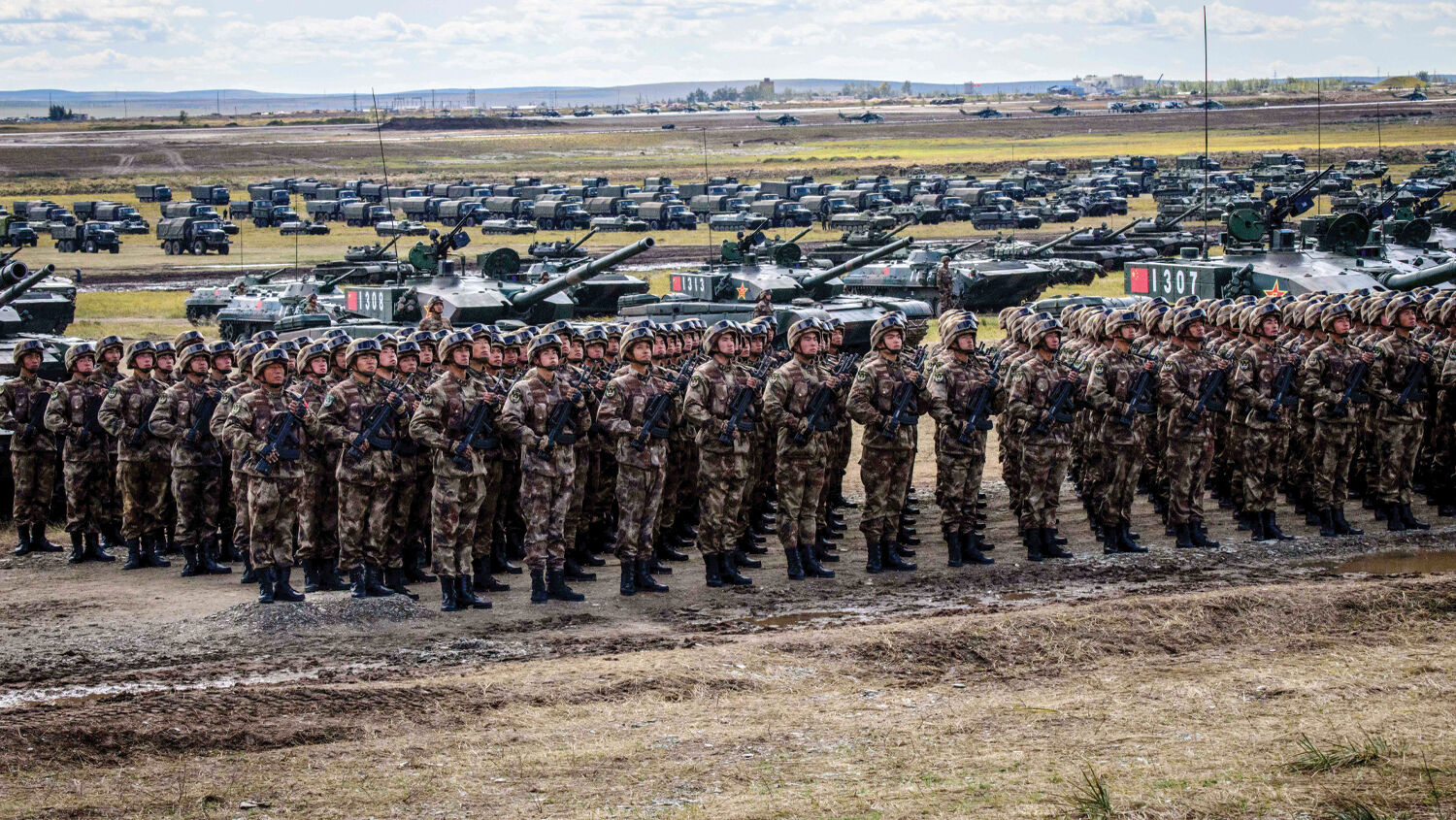
Russo-Chinese military cooperation has strengthened just as significantly. What began in 2003 as sporadic joint drills involving small numbers of forces has expanded into a dense calendar of increasingly sophisticated and large-scale war games. These drills include naval patrols, strategic bomber exercises, missile-defense exercises, coast guard operations and large-scale naval maneuvers. They take place across Eurasia, the Pacific and sometimes even in the Arctic and Mediterranean. In 2024, Russian and Chinese forces stunned the United States by conducting their first joint coast guard patrols in the Pacific Ocean—near Alaska.
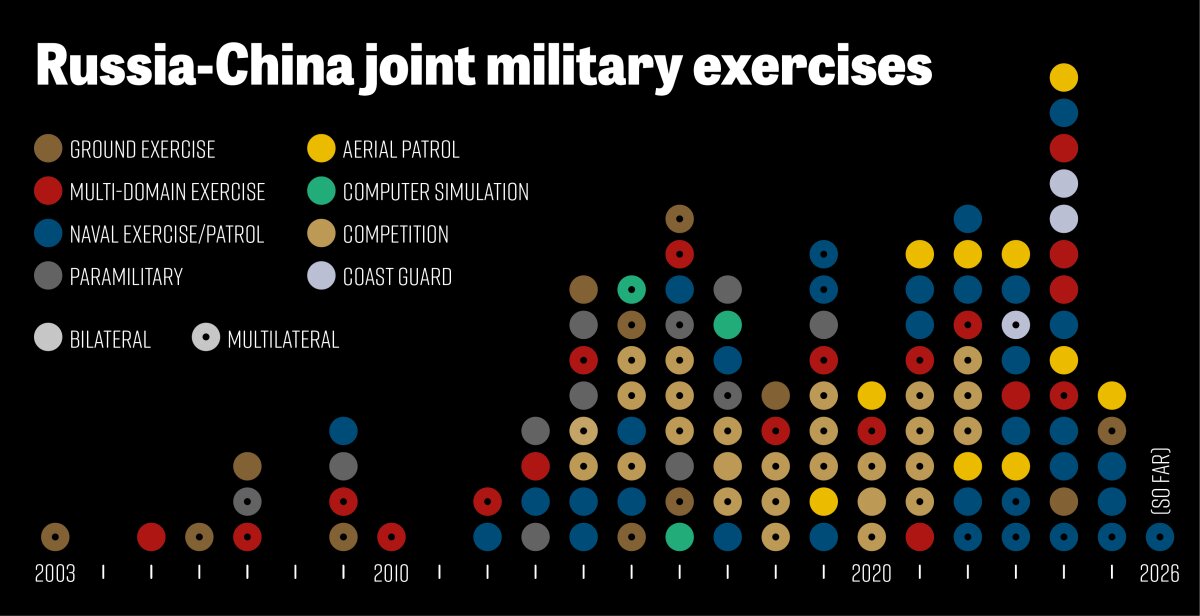
The Center for Strategic and International Studies calculates that Russia and China have conducted some 120 sets of joint military exercises, and their tempo and complexity continue to increase.
As military cooperation has expanded in both geographic scope and operational sophistication, the language describing the Russia-China relationship has also evolved. What was long labeled a “strategic cooperation” was elevated to a “comprehensive strategic partnership,” and finally to what both sides call a “no limits” partnership.
In the years since Russia’s war on Ukraine went full-scale, the partnership has lived up to that “no limits” label. Though China has not deployed troops to support the war, it has sold Russia $10.3 billion worth of advanced technology and industrial equipment since early 2022, according to the U.S.-China Economic and Security Review Commission’s 2026 report. This enables Russia’s continued defense production, including specialized manufacturing machines and tools for building missiles and other military equipment. China has also emerged as Russia’s primary source of dual-use items and critical electronics used in weapons manufacturing. Intelligence agencies say China-supplied components are present at more than 20 of Russia’s most important defense factories.
Since Russia can no longer easily obtain such products from the U.S., Europe, Japan or South Korea due to sanctions, China’s supply has been game-changing. It has been a major factor enabling Russia to keep prosecuting the war. And China has risked U.S. and other sanctions in order to keep supplies flowing. This clearly reflects a “no limits” bond that is growing stronger all the time.
Toward a Hardened Military Alliance
The Russia-China partnership still faces serious challenges. The Chinese economy and population are both 10 times larger than those of Russia, making Moscow increasingly dependent on Beijing for trade, technology access and financial connectivity. And many Russian strategists worry about their nation being the junior partner in the relationship. Long-standing tensions also persist beneath the surface, including border disputes, historical mistrust, competition in Central Asia and concerns over technology theft.
Even so, many of the old arguments against a durable Russia-China alignment now look far less convincing than they did before Russia’s invasion of Ukraine. What was long seen by analysts as a weak weld has been forged into an ironclad partnership—because leaders of both nations oppose the U.S.-led global order that has prevailed since World War ii and are determined to end it. Decision-makers in Moscow and Beijing repeatedly conclude that they can best challenge it if they bind themselves to one another. So the bond keeps getting stronger.
The Trumpet closely watches the strengthening Russia-China bond because biblical prophecy warns that a multinational Asian alliance will emerge in the end time—and harden into a force that will reshape the world order.
Kings of the East
Revelation 16:12 calls this bloc “the kings of the east.” Revelation 9:16 says it will field a force of 200 million soldiers, 15 times larger than the largest military power in history. These prophecies and related passages make clear that this Asian bloc will play a central role in the final world war. Ezekiel 38 shows that Russia is prophesied to lead this bloc, with China as a close partner. We are witnessing the two already fulfilling the early stages of these prophecies.
In the early days of Russia’s war on Ukraine, Trumpet editor in chief Gerald Flurry wrote: “The rise of Vladimir Putin, Russia’s invasions, a budding alliance between Russia, China and other Asian nations—these are all signs that Bible prophecies are true! Bible prophecy and an honest look at the world reveal that this is all building toward a nuclear World War iii! When nuclear bombs begin detonating, when a 200 million-man army mobilizes, when World War iii explodes, it will seem like this will literally be the end of the world, the end of life on Earth. And it would be, except for something else the Bible prophesies. The Bible forecasts not only the geopolitical situation we are facing right now and the resulting violent eruption but also what comes next: the precise events leading to the Second Coming of Jesus Christ!” (“Why We Must Warn About Vladimir Putin,” April 11, 2022).
To understand the details of the prophesied Asian alliance that is being dramatically forged today, the violent future it is building toward, and the peace that will follow directly after, order your free copy of Russia and China in Prophecy.