Should You Get Spiritual Advice From AI?

Should You Get Spiritual Advice From AI?
Good morning!
Nearly half of practicing Christians say they would trust artificial intelligence with their spiritual growth—slightly higher than non-practicing Christians, a recent Barna study found. One in three Americans says AI’s spiritual advice is as trustworthy as a pastor’s.

- Pastors, naturally, see it differently: Only 12 percent would trust AI to help someone’s spiritual growth.
This raises fascinating questions. It is unsurprising that, with people turning to AI for a growing range of questions, they would seek it for biblical and spiritual guidance.
- But is a chatbot reliable in spiritual matters?
AI may actually be more objective than a pastor on certain points of Scripture. And Scripture, not charisma or human reasoning, is the only trustworthy source of spiritual guidance.
- Many churches actually teach unbiblical doctrines. Ministers preach their own ideas or submit to institutional pressure and hedge on or avoid questions that have plain Bible answers. A chatbot may at least tell you what the verse says. That is not a defense of AI—it’s an indictment of apostate Christianity.
- Ask Chatgpt, for example, which day of the week the Bible says we should keep as a sacred day, and it plainly says, “The Bible consistently identifies the seventh day of the week as the Sabbath. According to the biblical text itself, that day—not the first day—is the day God blessed and made holy.” It gives several solid proofs from both Old and New Testaments, and says churches changed it to Sunday long after Jesus Christ died.
Jesus warned about exactly this: “[I]n vain they worship Me, Teaching as doctrines the commandments of men” (Matthew 15:9; New King James Version). Against that backdrop, a neutral-seeming chatbot has a certain appeal.
Trouble is, AI is not neutral. New research proves it. A multi-university consortium studying AI and religious bias found that AI models are biased toward giving a secular rather than a biblical perspective.
- On questions of grief and loss, people expected a religious perspective 59 percent of the time; AI provided one just 16 percent of the time. On ethics—honesty, forgiveness—people expected religion 45 percent of the time; AI brought it up only 5 percent of the time.
That’s not to say AI should give more religious answers. When AI does speak on religious matters, it isn’t objective. Every model tested showed consistent positive bias toward Catholicism rather than being strictly biblical.
- Faulty assumptions leaven the training data. It is based not only on the values and blind spots of the people making these models, but also on centuries of institutional Christianity’s influence.
The modern church world is a landscape of doctrinal compromise—on the Sabbath, on the nature of God, on the law and many other issues. In that vacuum, people are searching for something reliable.
- But AI cannot fill that void. The answer to corrupted human authority is not artificial authority, but revealed truth.
The Apostle Paul wrote in 1 Corinthians 2:14 that “the natural man receiveth not the things of the Spirit of God … neither can he know them, because they are spiritually discerned.”
- A chatbot has no spiritual discernment. And being shaped by the world’s accumulated theological compromise, it cannot give you revelation, which is essential to true Christianity.
But God doesn’t leave us without guidance. “[T]his commandment which I command thee this day, it is not hidden from thee, neither is it far off,” He says. “But the word is very nigh unto thee, in thy mouth, and in thy heart, that thou mayest do it” (Deuteronomy 30:11, 14). The question is whether we’ll apply it.
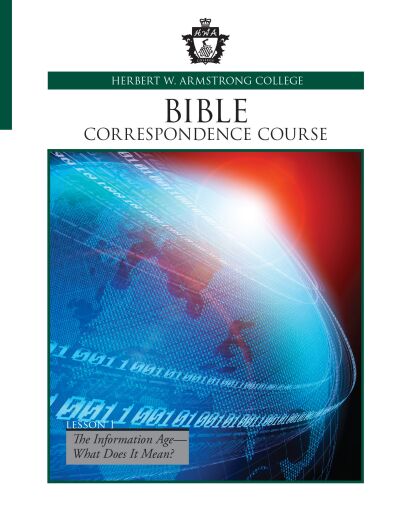
If you are looking for solid, spiritual, Bible-based guidance, I highly recommend you enroll in the Herbert W. Armstrong College Bible Correspondence Course.
Israelis Hate the Iran Deal
Israeli politicians on both sides of the aisle are recognizing the new U.S.-Iran peace deal as a catastrophe for Israel.
- The memorandum of understanding reportedly requires Israel to halt its war on Hezbollah in Lebanon, even though Israel is a sovereign nation and wasn’t a party to the agreement. Hezbollah is recognized as a foreign terrorist organization by the United States, and most of Lebanon’s elected government opposes it.
- Members of Israeli Prime Minister Benjamin Netanyahu’s government, such as National Security Minister Itamar Ben-Gvir, have lambasted the deal. Finance Minister Bezalel Smotrich said, “The agreement with Iran is bad for Israel and the entire free world, period.” Defense Minister Israel Katz said the Israel Defense Forces would defy such requirements and stay in Lebanon “indefinitely.”
It’s not just the politicians. Israel’s media are also largely against the deal.
- Prominent anti-Netanyahu journalist Ben Caspit claimed U.S. President Donald Trump’s nuclear negotiations will make Barack Obama’s 2015 deal “perfect in comparison.”
- Amit Segal, a journalist close to the prime minister, posted a quote to X attributed to Henry Kissinger: “It may be dangerous to be America’s enemy, but to be America’s friend is fatal.”
Leaders of the idf and Mossad, Israel’s foreign intelligence service, are united in their opposition. According to a Jerusalem Post report:
The vast majority of idf and Mossad top brass oppose the emerging Iran nuclear deal as insufficient in light of the power dynamics between the parties, the “blood and treasure” invested and the threats confronting Israel. … It is nearly unanimous, and senior officers and officials are making their views heard in private forums ….
The United States and the State of Israel share a heritage tracing back to the biblical kingdom of Israel. Isaiah 9:21, Zechariah 11:14 and other biblical passages prophesy that the brotherhood between the U.S. and Israel will be broken. The two countries entered the Iran war as allies, but its fallout could drive them further apart than ever.
NYT: ‘Germany and Japan Are Arming Again, 80 Years After World War II’
Germany and Japan’s “wariness of America has resurfaced,” the New York Times wrote on Sunday. It added that the two are “strengthening ties” and “rushing to rebuild their militaries” as China rises and Russia continues its aggression.
- The last time these two nations were wary of the U.S. and building their militaries, the worst war in history erupted. Their return to militarism and growing “wariness of America” is a sign of America’s soon-coming fall.
Though Germany and Japan seem peace-loving, democratic American allies, as the article noted, the peaceful sentiment that prevailed after World War ii has “waned in recent years.”
- Japan today has the world’s 10th-largest military budget, despite its constitutional obligation not to maintain a military and to renounce war forever.
- Germany has the fourth-largest military budget, despite having triggered the worst war in history, which killed 70 million people, and despite Allied leaders resolving in 1945 to “destroy German militarism” for all time.
The Plain Truth, the Trumpet’s predecessor magazine, consistently warned of this reversion to militarism and aggression. Its April 1968 issue said:
Despite popular belief, Japan is not permanently committed to a pro-Western position. America has foolishly followed the policy of assuming that … Germany and Japan can be converted to the virtues of democracy in less than a generation. … Both Japanese and Germans are willing, for the present, to put up with their so-called democratic form of government—until some serious internal crisis is precipitated.
The Times presented German and Japanese militarization and partnership as a “defensive posture” necessitated by the Trump administration’s “threats to abandon security commitments in Europe” and “eagerness to strike a trade deal with” China.
- It quoted German Defense Minister Boris Pistorius, visiting a Japanese naval base in March, saying that nations “who still stand by the rules-based international order, must move even closer together and make clear what we stand for.”
What do they stand for? Increasingly, it’s not peace or democracy—it’s resentment toward the United States.
Bible prophecy shows where this “wariness of America” is leading. Germany will work together with an Asian power bloc, likely including Japan, to economically besiege the U.S. That siege will not only bring the U.S. to its knees, but also lead to the worst suffering ever in human history and an even more devastating world war.
IN OTHER NEWS
Montenegro inches closer to joining the EU: Yesterday, Montenegro reached agreements on health, consumer protection and the right of EU citizens to work anywhere in the bloc, meaning that the Balkan nation has closed 16 out of 33 chapters of accession negotiations. If it joins the EU by 2028, as intended, this will further consolidate Germany’s control of the Balkans.
Hungarian legislature wants to ban Orbán from reelection: Yesterday, a two-thirds majority in Hungary’s new parliament passed a constitutional amendment that limits prime ministers to eight years in office. When officially signed into law, it will prevent Viktor Orbán, who has already served as prime minister for 20 years, from running again. But current Prime Minister Peter Magyar may be setting up his own autocratic rule.
London’s National Portrait Gallery says Churchill was a mass murderer: Winston Churchill deliberately starved millions of Indians, according to a video exhibit at the National Portrait Gallery in London. The script claims that Oliver Cromwell “starved people, en masse, a little like the willful starvation of the Indian population by Winston Churchill.” It also accuses Benjamin Netanyahu of deliberately starving Gazans. “The accusation that [the famine] was deliberately visited upon Bengalis by Churchill is foul and vile,” wrote historian Andrew Roberts. “It is also historically ludicrous.” Over 50 peers, including Churchill’s grandson Lord Soames, signed Lord Roberts’s letter, which was sent to the gallery’s board on Monday. For more on why Churchill’s reputation so often comes under attack, see our main story today.
UK plans social media ban for children under 16: Yesterday, British Prime Minister Keir Starmer announced that his government will ban children under 16 from social media platforms such as Facebook, Instagram, Snapchat, TikTok, X and YouTube. The ban, expected to be approved by Parliament and start early next year, will also limit live-streaming and talking to strangers on games and other sites. Starmer said the move protects children’s safety. Social media has exposed millions of young users to addiction, anxiety, cyberbullying, depression, disrupted sleep, explicit content, low self-esteem and predators. Many are noting that relying on bureaucratic policy to govern social media use, rather than parents, necessitates granting the government even greater surveillance powers over all citizens under—and over—age 16.
Most Americans think the country’s best years are behind us: Ahead of the nation’s 250th anniversary in July, a Pew Research Center survey published on May 15 shows that 59 percent of Americans believe the best years of the United States are in the past. Only 40 percent think the best years are ahead. When 3,560 U.S. adults were asked about life 50 years from now, 44 percent felt pessimistic, while 28 percent felt optimistic. Majorities of black, Hispanic and white adults, as well as lower- and middle-income people, say the best days are gone, and Democrats are more likely than Republicans to hold this view. Bible prophecy shows this is correct in the short term, but that America’s long-term prognosis is bright.
Australia’s honey crisis: Australia is expected to see a shortfall of close to 300,000 commercial beehives for the peak pollination season in August, as the parasite varroa mite wipes out bees, the Australian Broadcasting Corp. reported June 4. Industry experts are warning of crop failures and a potential food crisis as the bee-killing parasite wipes out at least 60 percent of hives and the costs to combat the mite force half of Australia’s beekeepers to quit. Honeybees contribute $10 billion in value to Australian agriculture, with pollination affecting two thirds of food production. This is just one of the many biblical curses for disobedience that Australia is currently experiencing.
Believe it or not, the Bible was written for our day—this generation! No book is as up-to-date as the Bible. It explains the causes of present world conditions—it reveals what’s ahead in the next few years. In its pages are the solutions to every problem we face in life—from personal and family relationships to national economics and foreign policy.
Yet, ironically, this incredible book is the least understood of all books. Most people, when they try to read it, find that they simply cannot understand it. Many assume it is irrelevant and out of date for our modern age.
But you can understand the Bible!
Herbert W. Armstrong College has been helping thousands learn the true meaning of current events and the true purpose for life through the Herbert W. Armstrong Bible Correspondence Course. This course has been designed to guide you through a systematic study of your Bible—the Bible is the only textbook.