

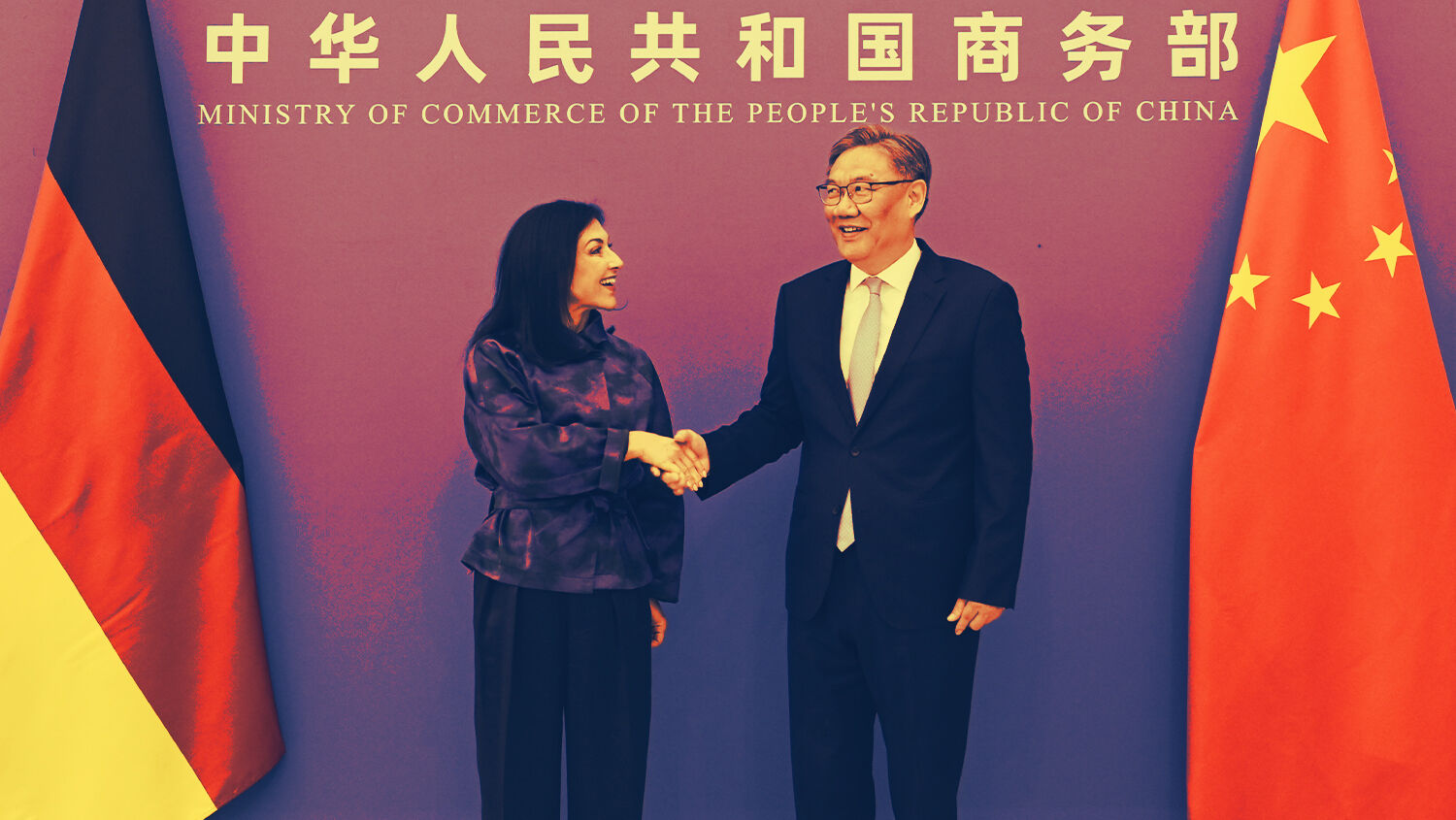
German Economics Minister Concludes China Visit
Today, German Economics Minister Katherina Reiche concluded her three-day visit to China aimed at boosting trade cooperation and ensuring German access to Chinese critical raw materials.
- This follows the February 25–26 visit by German Chancellor Friedrich Merz, who was accompanied by 30 leading German business executives.
- Reiche also brought several German business leaders, including the ceo of industrial manufacturing conglomerate Thyssenkrupp.
The Bible prophesies that Germany and China will develop a short-lived, anti-American economic alliance in the end time. Merz’s and Reiche’s visits shed light on that growing alliance.
- China and Germany have a complicated trade relationship: Germany relies on automotive exports to China’s huge market, but competition from Chinese manufacturers has helped stagnate Germany’s manufacturing sector and overall economy.
- Germany exported $93 billion to China last year while importing $198 billion, a problematic trade imbalance.
Reiche said yesterday that Chinese officials promised to address some of these issues, which she took as a “very, very positive signal from the Chinese government that it wants to work together in a trusting and constructive way.”
- “Our shared interest is to keep these relations stable,” Reiche said. She believes China is “so important and so large” that Germany must “maintain a stable, trusting and forward-looking relationship with the country, one that is also able to withstand critical issues.”
These high-level, in-person discussions show that Germany, the world’s third-largest economy, is focusing on developing a stronger trade relationship with China, the world’s second-largest economy—and both are gradually shutting out the world’s largest economy: the United States.
Gerald Flurry, the Trumpet‘s editor in chief, wrote about the prophetic implications of this relationship:
When the Holy Roman Empire attacks North America, there will be no help or sympathy from Asia. In fact, considering that China has come to possess most of the world’s strategic sea gates (which, ironically, at one time were held by Britain and America), we believe there may be a brief alliance between the German-led Holy Roman Empire and certain Asian powers (Russia, China, Japan—the kings of the east). Should Europe, the resurrected Holy Roman Empire, find a way to take advantage—even for a moment—of key resources and strategic holdings of China, Russia and Japan, it would have more than enough power to besiege the Anglo-Saxon nations and enslave them.


