
Social Media Destroys Young Minds
Social Media Destroys Young Minds

Platforms of Persuasion
Around the turn of the millennium, a handful of companies thrust social media upon the world, buoyed by nearly universal techno-optimism. The prevalent view was that these platforms would make the world better connected, more productive and more fun, especially for young people.
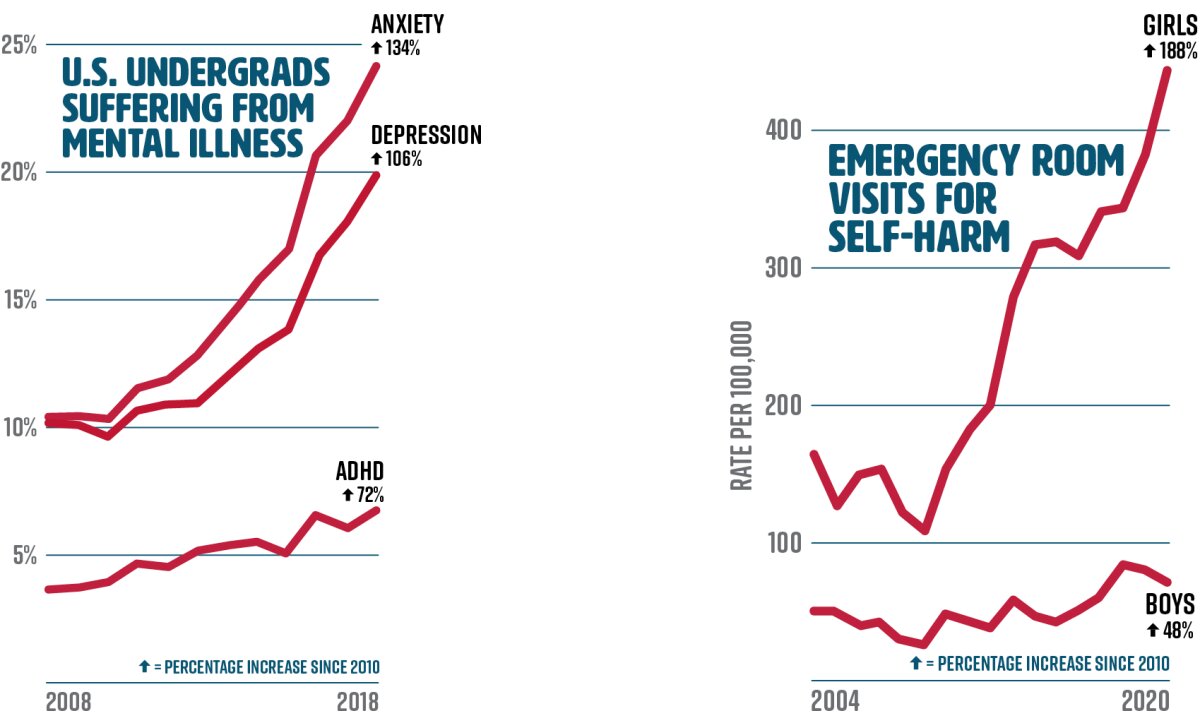
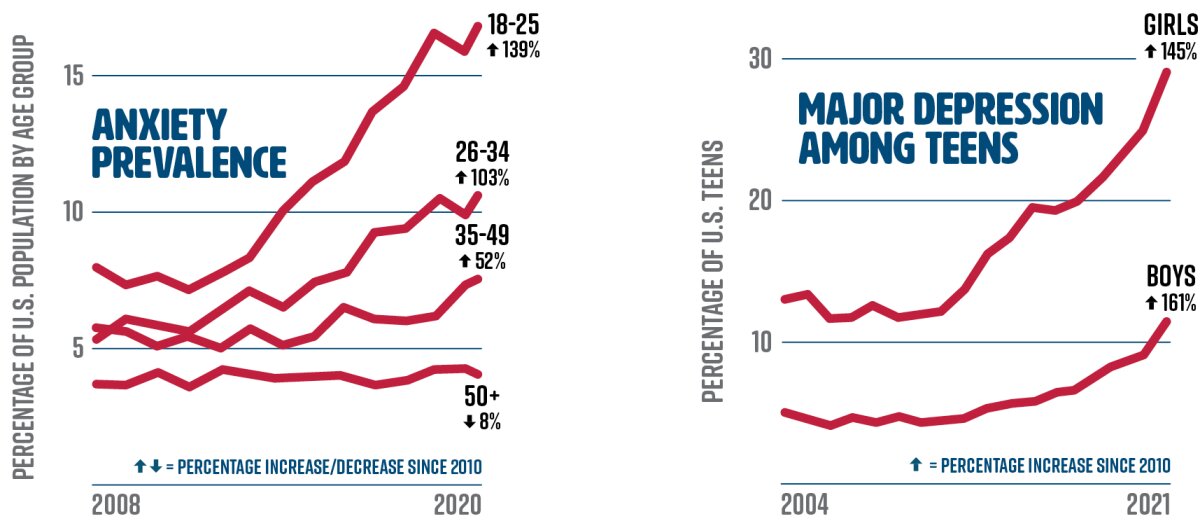
Two decades on, a starkly different picture has emerged. We have seen a dramatic upturn in youth depression, attention impairment, anxiety, eating disorders, drug abuse, suicide and other crises.
In The Anxious Generation, Jonathan Haidt lays out the problem plainly: “By designing a fire hose of addictive content that entered through kids’ eyes and ears, and by displacing physical play and in-person socializing, these companies have rewired childhood and changed human development on an almost unimaginable scale.”
Parents, educators and policymakers are finally waking up to the dangers that social media pose to young people. Yet many remain unaware of the harms posed by specific platforms, and the specific ways they are harming young, still-developing minds.

See complete infographic.
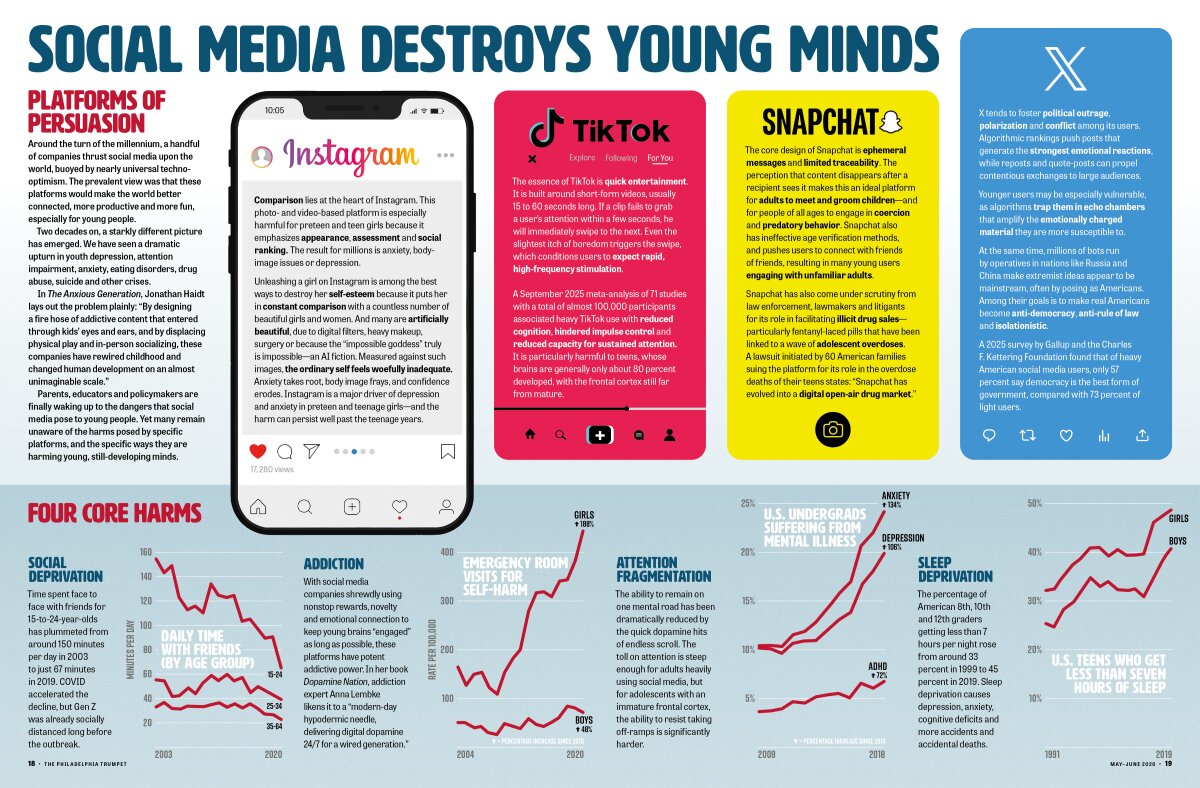

Comparison lies at the heart of Instagram. This photo- and video-based platform is especially harmful for preteen and teen girls because it emphasizes appearance, assessment and social ranking. The result for millions is anxiety, body-image issues or depression.
Unleashing a girl on Instagram is among the best ways to destroy her self-esteem because it puts her in constant comparison with a countless number of beautiful girls and women. And many are artificially beautiful, due to digital filters, heavy makeup, surgery or because the “impossible goddess” truly is impossible—an AI fiction. Measured against such images, the ordinary self feels woefully inadequate. Anxiety takes root, body image frays, and confidence erodes. Instagram is a major driver of depression and anxiety in preteen and teenage girls—and the harm can persist well past the teenage years.

The essence of TikTok is quick entertainment. It is built around short-form videos, usually 15 to 60 seconds long. If a clip fails to grab a user’s attention within a few seconds, he will immediately swipe to the next. Even the slightest itch of boredom triggers the swipe, which conditions users to expect rapid, high-frequency stimulation.
A September 2025 meta-analysis of 71 studies with a total of almost 100,000 participants associated heavy TikTok use with reduced cognition, hindered impulse control and reduced capacity for sustained attention. It is particularly harmful to teens, whose brains are generally only about 80 percent developed, with the frontal cortex still far from mature.

The core design of Snapchat is ephemeral messages and limited traceability. The perception that content disappears after a recipient sees it makes this an ideal platform for adults to meet and groom children—and for people of all ages to engage in coercion and predatory behavior. Snapchat also has ineffective age verification methods, and pushes users to connect with friends of friends, resulting in many young users engaging with unfamiliar adults.
Snapchat has also come under scrutiny from law enforcement, lawmakers and litigants for its role in facilitating illicit drug sales—particularly fentanyl-laced pills that have been linked to a wave of adolescent overdoses. A lawsuit initiated by 60 American families suing the platform for its role in the overdose deaths of their teens states: “Snapchat has evolved into a digital open-air drug market.”

X tends to foster political outrage, polarization and conflict among its users. Algorithmic rankings push posts that generate the strongest emotional reactions, while reposts and quote-posts can propel contentious exchanges to large audiences.
Younger users may be especially vulnerable, as algorithms trap them in echo chambers that amplify the emotionally charged material they are more susceptible to.
At the same time, millions of bots run by operatives in nations like Russia and China make extremist ideas appear to be mainstream, often by posing as Americans. Among their goals is to make real Americans become anti-democracy, anti-rule of law and isolationistic.
A 2025 survey by Gallup and the Charles F. Kettering Foundation found that of heavy American social media users, only 57 percent say democracy is the best form of government, compared with 73 percent of light users.
Four Core Harms
Social Deprivation
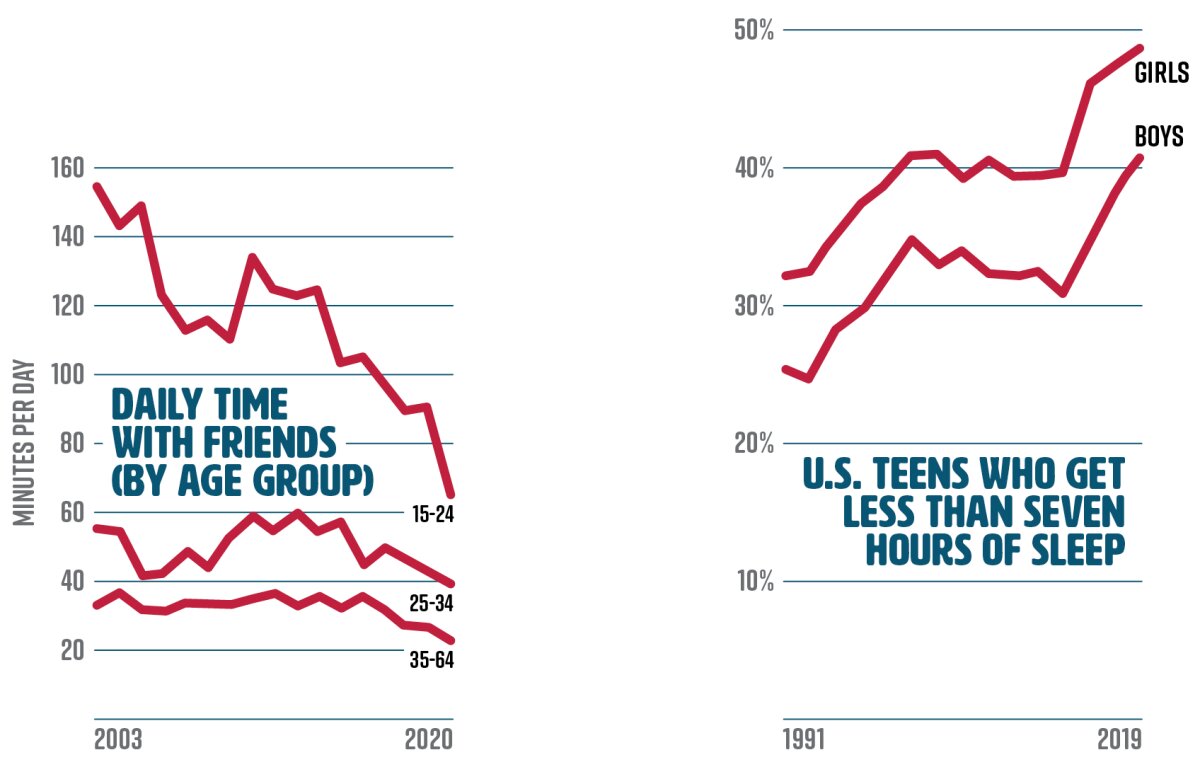
Time spent face to face with friends for 15-to-24-year-olds has plummeted from around 150 minutes per day in 2003 to just 67 minutes in 2019. Covid accelerated the decline, but Gen Z was already socially distanced long before the outbreak.
Sleep Deprivation
The percentage of American 8th, 10th and 12th graders getting less than 7 hours per night rose from around 33 percent in 1999 to 45 percent in 2019. Sleep deprivation causes depression, anxiety, cognitive deficits and more accidents and accidental deaths.
Attention Fragmentation
The ability to remain on one mental road has been dramatically reduced by the quick dopamine hits of endless scroll. The toll on attention is steep enough for adults heavily using social media, but for adolescents with an immature frontal cortex, the ability to resist taking off-ramps is significantly harder.
Addiction
With social media companies shrewdly using nonstop rewards, novelty and emotional connection to keep young brains “engaged” as long as possible, these platforms have potent addictive power. In her book Dopamine Nation, addiction expert Anna Lembke likens it to a “modern-day hypodermic needle, delivering digital dopamine 24/7 for a wired generation.”


