

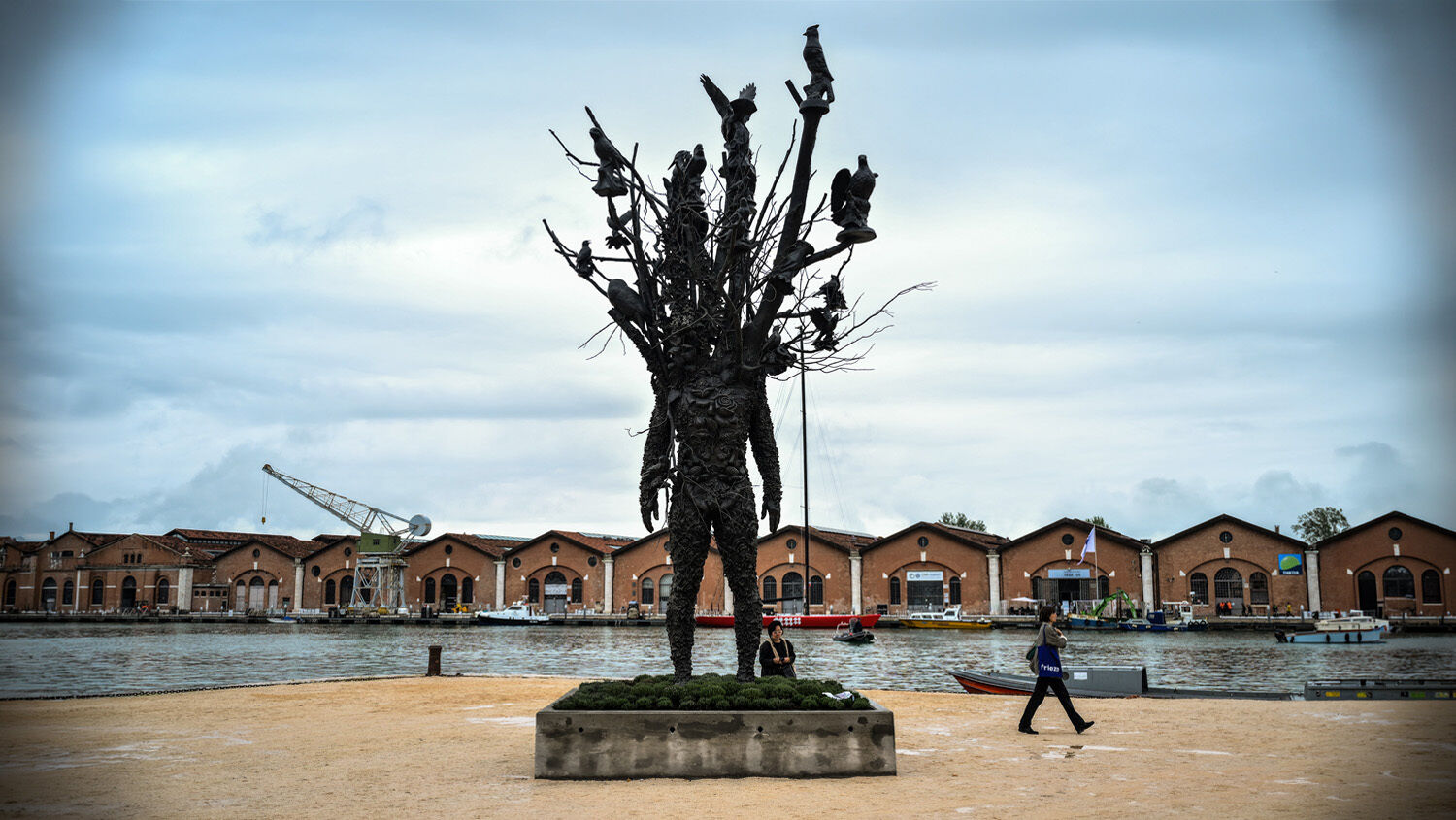
The Worst of the Human Spirit
Venice’s Biennale, an international arts exhibition hosted every two years, opened May 9. Sometimes called the “Art Olympics,” this year’s exhibition is attracting heavy controversy. The Biennale has allowed Russian and Israeli participation despite these nations’ military conflicts. Many critics take offense at this.
But this shouldn’t be the Biennale’s real controversy. What should bring international outcry is that the fair, which calls itself “for 130 years one of the most prestigious cultural institutions in the world,” is celebrating displays featuring pornography and feces.
Ninety-nine artists, each with a separate host country, have an entire pavilion to create a display, with a jury awarding a prize to the winner. “Artist” in this case is a loose term. Austria’s pavilion features live nudity. Naked models perform various stunts like jet skiing, climbing a weather vane, and even hanging upside down from a giant bell. Denmark’s showcase is a giant screen showing pornography generated by artificial intelligence. The Guardian’s first takeaway of this year’s event was “female nudity was everywhere.” Luxembourg commissioned “an immersive audiovisual installation” featuring “the figure of an anthropomorphic excrement.”
These descriptions sound like caricatures about how out-of-touch modern art has become. To be fair, not every display is this bizarre. But this kind of perverse content is drawing crowds. Vogue listed these three pavilions as among those “you should not miss this year.” The New York Times said displays like these “have the Venice Biennale buzzing.”
This is in the same city that gave us the music of Vivaldi and the paintings of Canaletto. This is the same city that crowds of tourists descend on to admire some of Western civilization’s most beautiful architecture.
Of course, many cultural works were scandalous in their day as well. Many a historic “masterpiece” was, and is, inappropriate. Ever since God exiled Adam and Eve from the Garden of Eden, man’s exploits have been a mixture of good and evil. Yet for centuries, most cultural standards focused on the aesthetically pleasing. Designs and colors were to uplift. Often, they exemplified God’s creation. The “art” celebrated at the Venice Biennale today is about shocking and desensitizing people.
One may wonder why this is important. Contemporary art has always been decadent, but cultural output is generally a good barometer of a society’s well-being. Trumpet contributor Abraham Blondeau wrote in 2022:
The art of a nation declares the morality, ideals, dreams, imaginations, talents, lifestyles, hobbies and motivations of its citizens. Therefore, art is a visual barometer of cultural health.
When art is creative and original, it displays a nation that is visionary, outward-looking, inventive and thriving. Conversely, when art becomes freakish and sensationalistic, it displays a nation that is stagnant, self-important, inward-looking, immoral and lawless. A shift in art mirrors the shift from a nation thriving to a nation collapsing.
Mr. Blondeau used the art of the Roman Empire as an example. Imitating earlier Greek designs, early Roman imperial art emphasized the purported ideal human form, realistic renderings and mathematical proportions. As the empire declined, art became cruder and less aesthetically pleasing.
The Venice Biennale once displayed works from renowned artists like Renoir, Matisse and Klimt. Even if not every historic work was appropriate, the institution still focused more on the pleasing than the bizarre.
Today, the Biennale showcases not only the regression of one nation, but also the cultural output of human civilization. It’s a sober revelation of the state of global society.
The parent organization of the Trumpet also sponsors the Armstrong International Cultural Foundation, which sponsors classical music, dance performances and archaeological exhibits. One of its creeds is to showcase “the best of the human spirit.” The Venice Biennale, arguably the most prestigious arts award anywhere, has fallen to promoting the worst of the human spirit.
In Isaiah 3, God records the punishment He sends on a nation that rejects His ways: “For, behold, the Lord, the Lord of hosts, Takes away from Jerusalem and from Judah … The mighty man and the man of war, The judge and the prophet, And the diviner and the elder; The captain of fifty and the honorable man, The counselor and the skillful artisan …” (verses 1-3; New King James Version).
The Hebrew word rendered skillful is used in Exodus 31 about God blessing artistic talent in His people. The implication is that God would bless obedient nations with incredible cultural achievements and curse wayward nations with degeneration. This doesn’t mean that everything of value in human civilization came because of God’s blessing. But looking at the Biennale today, it’s easy to discern that the world’s skillful artisans are long gone.
The implication is also that God values high culture and wants His people to partake in it. But why?
Ryan Malone writes in How God Values Music:
Your ability to be inspired by a symphony, to be enriched by a sculpture, or to be uplifted by a sunset is a miracle. That ability is possible because of the God-like mind that God created in you.
God “endowed man with the power of mind,” Herbert W. Armstrong wrote in The Incredible Human Potential. “It seems obvious that human minds were made to function in the same manner as the Creator’s, although in an inferior way. But how do we humans use our minds? We are endowed with something akin to creative powers.”
This ability makes the human being a unique creation. No animal has this ability. God gave it only to man because of our unique and special purpose. A feature of the unique, God-like mind that humans possess is the ability to appreciate creative, artistic endeavors. …
God gave us mind power so He could create His character in us. And His character is that of a perfectionist, of creating the highest quality and appreciating the finest things.
God wants us to appreciate the finer things in life. In today’s age of mass media, it is far easier for the common man to partake of what was once reserved for the aristocracy. But with the world’s standards in the gutter, how is one supposed to discern what is wholesome versus what is spiritually corroding?
The Trumpet has many resources to help with increasing one’s cultural education. A good place to start is our 2012 article “Art—The Good, the Bad and the Mediocre,” by Jeremiah Jacques. It helps explain why man is a cultured creature and what God expects. Becoming culturally educated God’s way can make life more enriching, happy and rewarding.


