

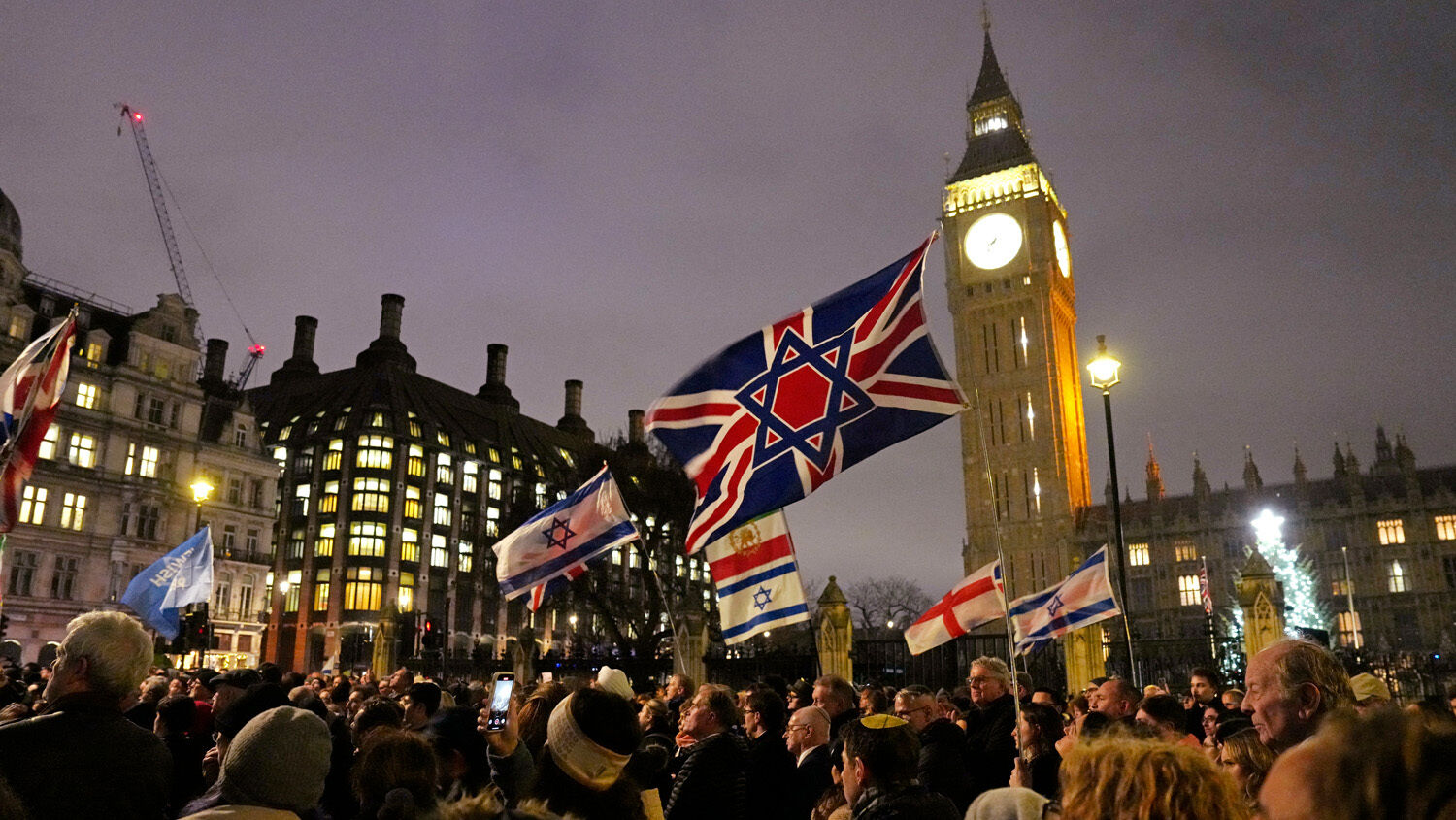
For Jews in Britain, the 1930s Are Back
Modern Britain is strongly reminiscent of 1930s Germany.
That was the conclusion of a March 23 Telegraph article by Danny Cohen. In it, he shared experiences reported to him by British Jews. One took her mezuzah down from her doorframe so her house isn’t recognizably Jewish. Another changed her name on her Uber account to hide her ethnicity. Many of Cohen’s friends are discussing their “escape plan” from the United Kingdom. These are just some of the examples he listed. He wrote:
[T]he Jews of Britain are facing conditions not seen in my lifetime. More and more, there is a whiff of the 1930s in the air.
In a March 28 Telegraph article, former British Ambassador to Israel Matthew Gould said he could no longer deny claims of rank anti-Semitism in his country. He mentioned the lack of outcry after Iran murdered over 30,000 of its own people—even though many Britons protest Israel’s self-defense against terrorism. “The people who marched about the deaths in Gaza clearly did not feel as strongly about the deaths in Iran,” he wrote. He then exposed the hypocrisy: “Imagine the national soul-searching we would have if ‘Jewish’ were replaced with any other minority group.”
Anti-Semitism is growing around the world, but this trend is especially shocking in the UK. Less than 90 years ago, it was the only major power defending the Jews’ right to survive. It arguably played a more integral role in the founding of the Jewish state than any other nation. Now some of the worst stories of anti-Semitism come from within its borders.
Many may argue this is merely the result of mass Muslim migration. Though this is a factor, the UK’s anti-Semitic problem goes beyond that.
Civilian Persecution
On March 23, suspects ignited four Jewish charity ambulances in London. The attack destroyed the vehicles and shattered nearby windows. British police arrested two suspects—both British nationals—who were later released on bail.
This is just one example: The Community Security Trust estimated a total of 3,700 anti-Semitic acts in the UK last year—4 percent more than in 2024. For the first time on record, there were over 200 incidents in every month of the year. There was an average of 308 per month—double the rate before October 2023. According to a poll from the Institute for Jewish Policy Research, while only 9 percent of Jews said they felt unsafe in Britain in 2023, 35 percent felt unsafe last year.
Jewish fears are not unfounded. In addition to the rise of anti-Semitic attacks, average Britons are growing increasingly anti-Jew.
Britain’s growing anti-Semitism does not stop short of persecuting children. On March 5, London’s Jewish Free School played in an under-15 national tournament at Thorpe St. Andrew School. During the game, spectators reportedly chanted “Jews” and yelled phrases including “dirty Jews,” “dirty Zionists” and “Go back to the gas chambers.” Police are investigating the incident as a hate crime. These spectators’ views are so twisted that they taunted and told children to die.
A March 16 poll by the Union of Jewish Students questioned 1,000 British students from all different belief systems; it found that 1 in 5 would be reluctant or would never want to live with a Jew. The report highlighted an apartment of non-Jewish students who had “only one rule—no Zios in the flat.” One in 4 said they didn’t care if Jewish students can be open about their ethnicity on campus.
This poll also showed how Jewish hate is being normalized:
- Half have seen terrorist atrocities by Hamas and Hezbollah justified.
- 1 in 4 said they know of or have experienced a friendship with a Jewish student becoming more distanced or strained.
- 65 percent have had anti-Israel protests disrupt their schooling.
The report also highlighted an October incident when multiple student groups circulated an image featuring a skull and gun that said, “Put the Zios in the ground.”
In this context, consider again what Gould wrote for the Telegraph: “Imagine the national soul-searching we would have if ‘Jewish’ were replaced with any other minority group.” Consider the personal testimonies written here and here, and imagine the outcry if someone experienced the same persecution who was a woman, gay, nonwhite or Muslim.
Adding insult to injury, when planning an anti-far-right march against hate, division and racism last month in London, organizers failed to reach out to Britain’s main Jewish groups—even though they invited multiple groups who praise Hamas terrorists. One would think that when considering groups that have suffered the most from far-right extremism, the Jews would be at the top of the list. But Jewish groups that came to this march could have become victims of the “persecuted.”
Governmental Prejudice
Anti-Semitism in the UK is not limited to the general populace. Even several government and law enforcement figures have gotten involved in this ominous trend. Not only has Britain largely failed to support Israel in its self-defense against terrorism, it has actually sanctioned members of the Jewish state for it. In September, the Scottish government banned funding for arms companies linked to Israel, and Britain went so far as to recognize a “Palestinian state.” More recently, Prime Minister Keir Starmer refused to join United States President Donald Trump’s blockade of the Strait of Hormuz.
Being anti-Israel doesn’t necessarily mean being anti-Semitic, but something is clearly wrong when a Western nation supports a terrorist nation over a historic ally.
In November, Birmingham police banned Israeli soccer fans from watching their team play Aston Villa. Local politicians praised the action. The UK government, including Starmer, condemned it, but it still shows a terrifying sickness in local government. On the day of the game, Israeli fans who came to protest found themselves confined in a caged basketball court. As Jews sat behind metal fencing, Muslim mobs roamed the streets yelling, “Death, death to the idf [Israel Defense Forces].” Jake Wallis Simons wrote: “If there has been a more shameful day in recent British history, I’m struggling to recall it tonight.”
More recently, on February 12, UK Foreign Office staff met at Iran’s embassy to celebrate the Iranian Revolution. That same day, U.S.-based Human Rights Activists News Agency reported that Iran had murdered over 7,000 of its own people to crack down on protests. Part of the event’s decorations were posters of Ruhollah Khomeini and Ayatollah Ali Khamenei—the mass murderer himself.
On March 22, the Telegraph reported that the Labour Party-led Thanet district council supported an “openly anti-Semitic exhibition.” Among other disgusting anti-Semitic tropes, the exhibition featured displays of sharp-teethed, bloody-mouthed Jews eating babies. Debbie Fox of the Jewish Leadership Council said, “This sort of imagery has been used to dehumanize Jews for centuries, with deadly consequences. In the context of rising global anti-Semitism and attacks against Jewish communities, the exhibition is not just sickening but dangerous.”
Matthew Collings, previously one of the nation’s leading art critics, said the art was “about raising consciousness about hell” and that “Israel is the pure encapsulation of it.” Collings said the exhibition was merely against the Zionist movement, not Jews themselves. However, he has a history tied to anti-Semitic claims. The council’s page that seemed to promote this exhibition has since been taken down.
Police are seemingly glossing over crimes against Jews. Official figures reported by the Times found that crimes against Muslims are 76 percent more likely to be prosecuted than crimes against Jews. According to the same numbers, Jews are almost 10 times more likely to face hate crimes than Muslims.
As British journalist Melanie Phillips brought out in an interview: “In terms of cultural leadership of the West, Britain is still the leader. … Where Britain goes, the rest of the West follows.” She pointed out that the terrorist group al Qaeda was formed in London; not only do Islamists see the UK as the most vulnerable target to Islam, but they know it will have a domino effect on the rest of the Western world.
It seems anti-Semitism in Britain will only get worse. This will lead the rest of the West down the same path.
An Old Rivalry
British animosity toward the Jewish people is not new, nor is it confined to Britain. It is rising across Europe and the world.
Our free book The Key of David shows the real source of anti-Semitism: Satan the devil. Growing anti-Semitism is a sign of Satan’s tightening grip on humanity. Revelation 12:9 says Satan deceives the entire world, increasing in power as time goes on.
Bible prophecy says this will soon lead to a nuclear World War iii. Historically, rising anti-Semitism has been a precursor to war. This was clearly seen in World War ii, and today is no exception. The only difference today is that humans have far deadlier weapons that could exterminate all life. Bible prophecy says that is our fate if this trend is not reversed (Matthew 24:22).
In 1753, when the British government tried to make it easier for Jews to obtain citizenship, backlash caused the bill to be repealed. In 1290, King Edward i banned Jews from England—a verdict that stood for over three centuries. The first-ever known blood libel—accusing the Jews of killing Christian children and using their blood for religious rituals—came out of England in 1144. Multiple massacres of Jews followed these accusations.
The British enmity toward Jews goes back even further.
In his free book The United States and Britain in Prophecy, Herbert W. Armstrong proved that the UK and Israel are the modern descendants of the Israelite tribes of Ephraim and Judah. Anciently, these tribes assumed Israel’s main leadership roles (1 Chronicles 5:1-2). Even under King David, Judah was politically separate for a time from the rest of the nation (2 Samuel 2:4, 8-10; 24:1, 9). Ephraim was often looked to as the leader of the other tribes. Shiloh, Israel’s capital before Jerusalem, was in Ephraim’s territory (Joshua 18:1). Jeroboam, who led the split away from Judah, was of Ephraim. The Ephraimites knew they were a special tribe (Joshua 17:14, Judges 8:1, 12:1-3).
This division of blessings between the two tribes often caused tension between Israel and Judah (see 2 Samuel 2:8-10 and 19:41-20:2).
In fact, Bible prophecy said this tension would still exist today. A prophecy in Isaiah 9:21 mentions this tension still existing. But the “normalcy” of Ephraim’s animosity toward the Jews does not make this trend any less threatening.
Thankfully, this story will not end here.
Healing
Bible prophecy says Jesus Christ will soon return and stop mankind from killing itself (Revelation 19:11-16). After His return, He will heal the animosity between Ephraim and Judah.
“The envy also of Ephraim shall depart … Ephraim shall not envy Judah, and Judah shall not vex Ephraim” (Isaiah 11:13). In Ezekiel 37:15-19, God again says Ephraim and Judah will be united. British anti-Semitism will be a thing of the past.
Finally, after millenniums of strife, the prophecy in Hosea 1:10-11 will be fulfilled:
Yet the number of the children of Israel shall be as the sand of the sea … and it shall come to pass, that in the place where it was said unto them, Ye are not my people, there it shall be said unto them, Ye are the sons of the living God. Then shall the children of Judah and the children of Israel be gathered together … for great shall be the day of Jezreel.


