

Cuba’s ‘Berlin Wall Moment’
The Communist regime in Cuba is collapsing in real time. Now that United States President Donald Trump has blocked the fuel shipments that supply roughly 60 percent of Cuba’s energy needs, the island’s blackout problem has worsened. On February 13, Bloomberg published an analysis of satellite imagery that shows that nighttime light levels in major cities like Santiago de Cuba have dropped by as much as 50 percent.
Some analysts estimate that Cuba has only enough oil left in storage to last 15 to 20 days.
The Mexican Navy has sent two ships to Cuba carrying more than 800 tons of aid, including beans, milk, sardines, rice, vegetable oil and personal hygiene items. Yet Mexico is not sending oil after President Trump signed an executive order on January 29 enacting tariffs on any nation that provides oil to Cuba.
Last month, President Trump said his oil embargo was designed to force the Cuban leadership to “come to us and want to make a deal,” claiming the island “would be free again.” The Communist regime in Cuba would have collapsed decades ago if not for economic aid from the Soviet Union. It did not collapse after the Soviet Union fell, mainly because the Bolivarian Republic of Venezuela stepped in to fill its oil needs.
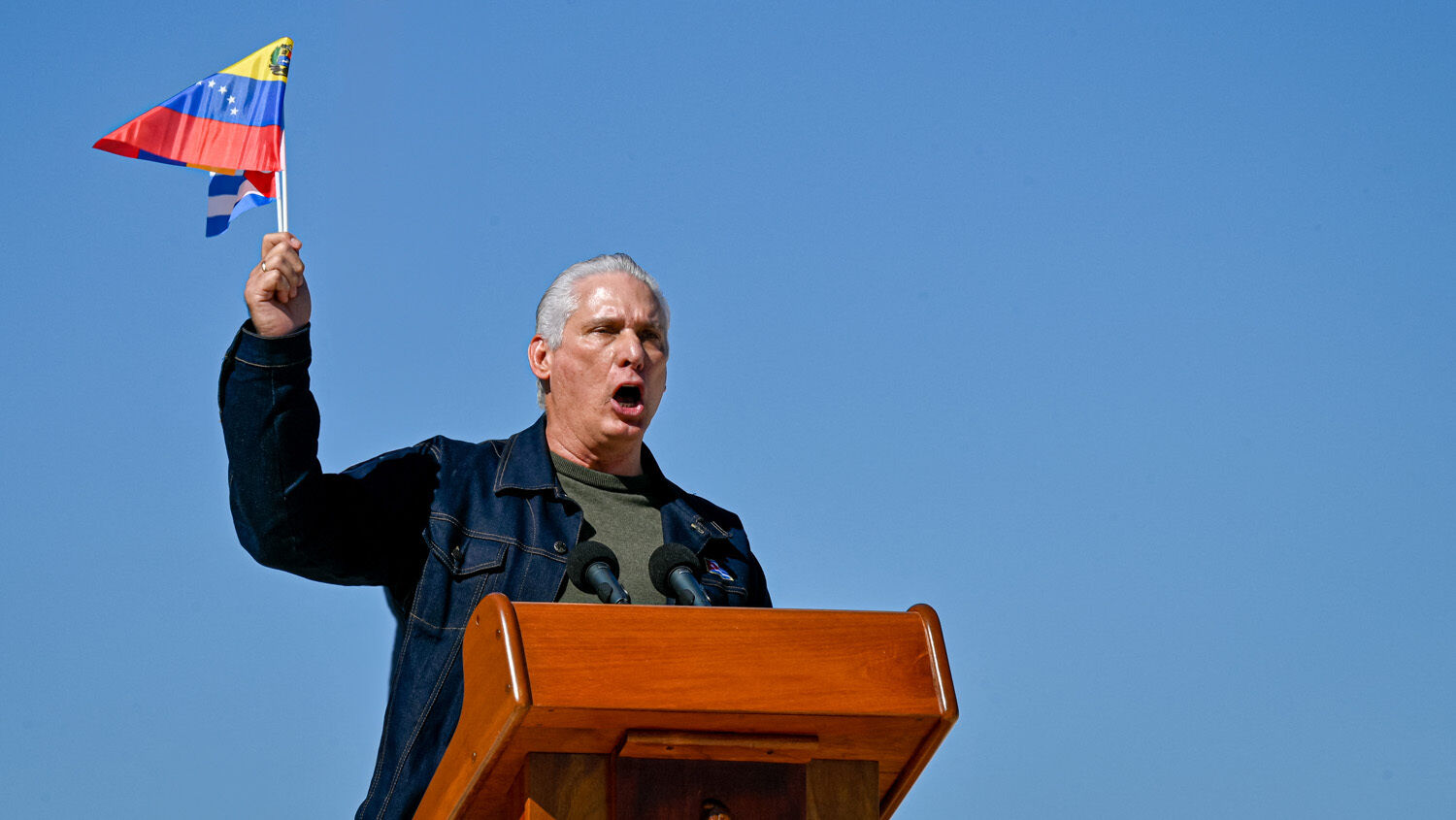
This means that the arrest of Venezuelan dictator Nicolás Maduro on January 3 presents a unique opportunity for the U.S. government to pressure Communist Cuba into regime change. The mood about regime change in Cuba is currently optimistic, with betting agencies like Polymarket giving 55 percent odds that Cuban dictator Miguel Díaz-Canel will be out before the end of the year.
Rep. Carlos Giménez, the only Cuban-born member of the United States Congress, says Cuba is approaching its Berlin Wall moment. “We are closer than ever to ending the tyranny in Havana, but only if we act decisively and refuse to repeat the failed policies of the past,” he wrote. “The situation on the island is dire by every measure. Cuba faces severe shortages of food, medicine, electricity and fuel. Hospitals lack basic supplies. Power outages last for days. Families ration meals and struggle simply to survive.”
The comparison to the collapse of the Berlin Wall is apt. The late Herbert W. Armstrong long forecast that the Berlin Wall would collapse and Germany would reunite based on Bible prophecies about a revived Holy Roman Empire comprised of five nations in Western Europe and five nations in Eastern Europe. More recently, Trumpet editor in chief Gerald Flurry has made a similar prophetic forecast about Cuba.
In a 2015 article written shortly after the Vatican brokered a deal between Cuba and the Obama administration to restore diplomatic ties between America and Cuba, Mr. Flurry highlighted Bible prophecies about the U.S. being economically besieged by a revived Holy Roman Empire, noting that the Catholic Church would actually be a bigger enemy to America than the Communist Party of Cuba. “Modern Cuba is a Communist nation, but it has only been Communist for about 50 years—less than a lifetime,” he wrote. “It has been a Catholic country for almost 500 years! Today, between 60 and 65 percent of Cubans say they are Catholic, so it’s clear that the church’s influence remains deeply entrenched. Fidel Castro is close to death. And Raúl Castro is quite old. So the political equation could change radically in the next few years—or even months.”
Fidel Castro died a year later, and his brother Raúl stepped down as the head of the Communist Party of Cuba five years after that. The main reason the Communist Party of Cuba is still in power is Venezuelan oil, and now President Trump is cutting that off. This makes regime change likely if the U.S. keeps up the pressure.
In Revelation 17 and 18, God labels the German-led, Vatican-influenced empire currently emerging in Europe as “Babylon the great.” In the corresponding Old Testament prophecies of Isaiah 23 and Ezekiel 27, this empire appears under the name of Tyre, the most powerful trading center of the ancient Mediterranean.
Based on these scriptures, the late Herbert W. Armstrong long predicted that the alliance between Europe and South America would grow extremely strong. The most significant factors that will cement this alliance are the Roman Catholic religion and the Spanish language. This union, however, will not be a union of equals: The Latin American countries will again become vassal states to a Catholic-dominated Holy Roman Empire.
Germany and the Vatican are building an empire that will include 10 European kings. It will extend its influence to a loyal network of Latin American vassal states and an anti-Iran alliance of Arabic regimes. With its left arm, this Vatican-dominated conglomerate will reach southward and eastward into the Middle East to conquer the Holy City of Jerusalem. Then, with its right arm, this “Holy” Roman Empire will reach southward and westward across the Atlantic to take control of Latin America and besiege the United States of America.
This makes the fact that America is pushing for regime change in Cuba tragically ironic. The Trump administration is pushing one U.S. enemy out of Cuba, but it is blind to the rise of another enemy that God will allow to punish the U.S. if its people do not repent of their many moral sins and failings.
Read Chapter 7 of Mr. Flurry’s booklet Isaiah’s End-Time Vision for more information on the Holy Roman Empire’s attempts to use Latin America to besiege and conquer America.


