

Communist Cuba Is Ready to Fall
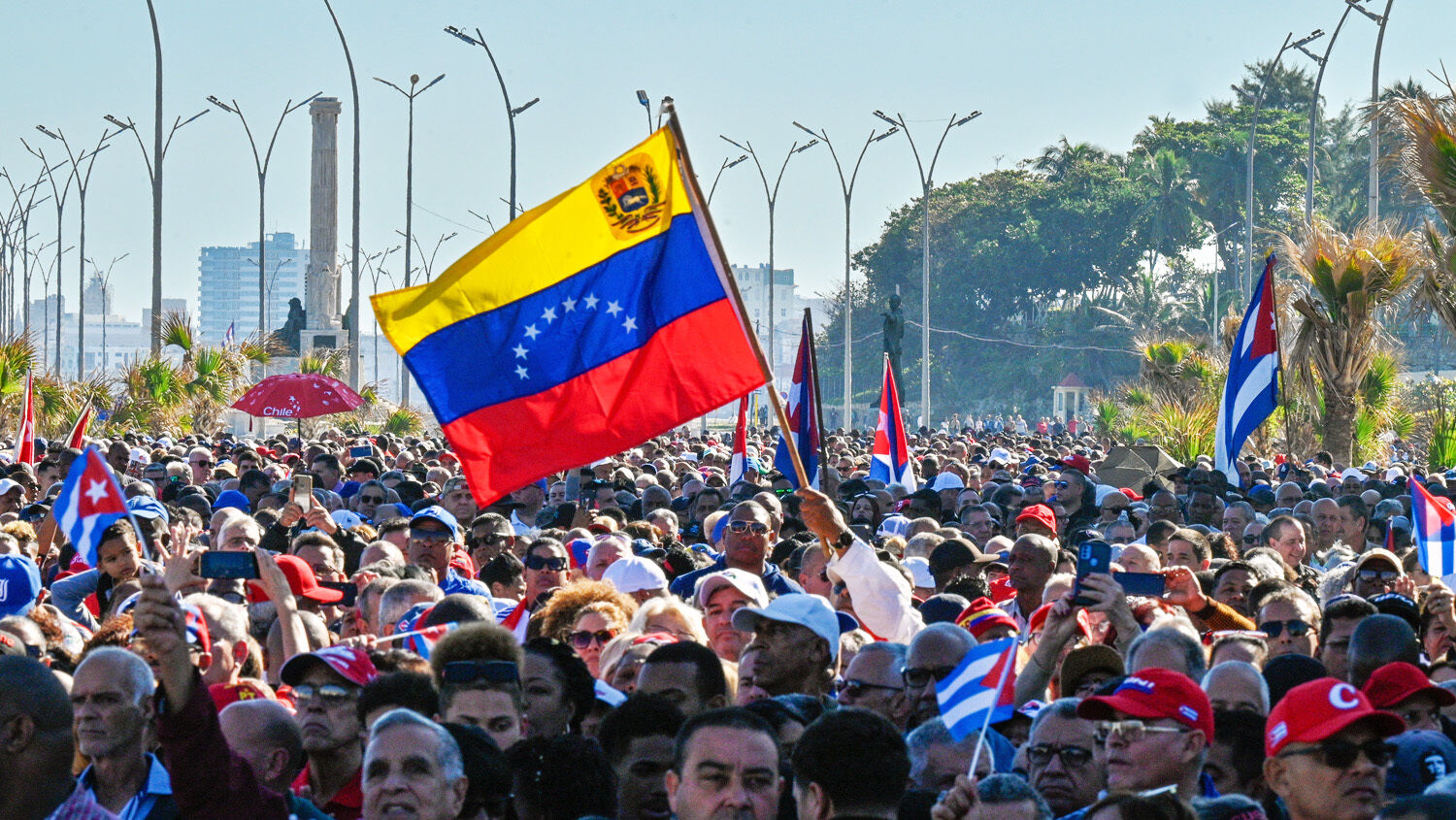
For over two decades, Communist Cuba and the Bolivarian Republic of Venezuela have worked together against the United States. The Venezuelan government ships hundreds of tons of cocaine into the U.S. and Europe, while Cuba remains a U.S.-designated state sponsor of terrorism. Both nations have offered U.S. enemies in China, Iran and Russia a foothold in the Western Hemisphere. The U.S. government has tried to isolate these pariahs with sanctions, which have largely proved ineffectual since Venezuela ships oil to Cuba for resale on the black market. The economic, military and political alliance between Cuba and Venezuela is so close that many analysts call the two nations Cubazuela.
U.S. President Donald Trump understands the threat Cubazuela poses to America and is taking bold action to deal with it. On Saturday, more than 150 U.S. military planes bombed infrastructure across northern Venezuela while the U.S. Army’s elite Delta Force raided the home of Venezuelan dictator Nicolás Maduro, arresting both Maduro and his wife, Cilia Flores. Maduro was sent to New York City to face long-standing drug trafficking charges in the U.S. District Court for the Southern District of New York.
As refreshing as it is to see a dictator like Maduro face justice, President Trump did not order his capture purely for humanitarian reasons. On Sunday, President Trump predicted Cuba was “ready to fall” now that it can no longer rely on Venezuela for security and oil. It has long been known that Cuban spies effectively run Venezuela’s internal intelligence and security operations, so severing the economic ties between the two halves of Cubazuela will be key in bringing about regime change in both nations.
The White House released a 33-page document on December 5 outlining the Trump administration’s plans to reduce U.S. involvement in the Eastern Hemisphere while increasing U.S. involvement in the Western Hemisphere. This document prompted George Friedman, founder of Geopolitical Futures, to predict on December 22 that Trump’s military buildup in the Caribbean was ultimately intended to address the Cuba problem.
“The deployments to the Caribbean were the first step,” Friedman clarified on January 5. He continued:
The second step occurred early Saturday morning with the U.S. attack on Venezuela and the capture of President Nicolás Maduro and his wife. In a subsequent press conference, President Donald Trump announced that the United States would run Venezuela for an unspecified period, reorganize the Venezuelan economy, particularly the oil industry, and make Venezuela a wealthy country …. Trump and [Secretary of State Marco Rubio] both referenced American interest and concern in Cuba. The U.S. president also explicitly mentioned the Monroe Doctrine, which declared U.S. preeminence in the Western Hemisphere. Given this emphasis, the move to depose a hostile leader in Venezuela makes sense and could be a useful preface to dealing with Cuba.
This is some pretty astute analysis. Friedman also noted:
Cuba and Ukraine are to some degree geographical equivalents due to their proximity to the U.S. and Russia, respectively. Just as a Western-armed Ukraine is a threat to Russia, a Russian-armed Cuba is a threat to the U.S.—not in terms of nuclear war, but because it could block essential trade routes from the U.S. Gulf Coast to the Atlantic, and to some extent the Pacific, with conventional weapons.
Securing Cuba is a much higher geopolitical priority for the U.S. than securing Venezuela. Yet since Venezuelan oil props up the Cuban economy, it makes sense to deal with Venezuela first.
Trumpet editor in chief Gerald Flurry highlighted the Cuba threat 10 years ago in an article he wrote after the Vatican brokered a deal between Cuba and the Obama administration to restore diplomatic ties between America and Cuba. Mr. Flurry highlighted Bible prophecies about America being economically besieged by its enemies, noting that the Catholic Church would be a bigger enemy than the Communist Party of Cuba. “Modern Cuba is a Communist nation, but it has only been Communist for about 50 years—less than a lifetime,” he wrote. “It has been a Catholic country for almost 500 years! Today, between 60 and 65 percent of Cubans say they are Catholic, so it’s clear that the church’s influence remains deeply entrenched. Fidel Castro is close to death. And Raúl Castro is quite old. So the political equation could change radically in the next few years—or even months. If enormous changes occur, the Vatican could gain real power in Cuba.”
Fidel Castro died in 2016, and his brother Raúl stepped down as the head of the Communist Party of Cuba in 2021. Cuba is now run by Miguel Díaz-Canel, but even his days may be numbered if the U.S. seizes control of Venezuela’s oil fields. President Trump is taking a much harder stance against socialist dictators in Latin America than President Obama ever took, yet he is likely to underestimate the threat from the Vatican.
Pope Leo xiv underscored the importance of safeguarding Venezuelan sovereignty after U.S. forces captured Maduro; the Vatican and the Venezuelan Bishops’ Conference will likely play a huge role in determining what type of government replaces the Bolivarian Republic. In the short term, ousting Maduro from office will likely benefit both the U.S. and the Catholic Church. Yet a pro-Catholic Venezuela could still turn on America.
In fact, Bible prophecy indicates this will happen.
In Revelation 17 and 18, God labels the German-led, Vatican-influenced empire currently emerging in Europe as “Babylon the great.” In the corresponding Old Testament prophecies of Isaiah 23 and Ezekiel 27, this empire appears under the name of Tyre, the most powerful trading center of the ancient Mediterranean.
Based on these scriptures, the late Herbert W. Armstrong long predicted that the alliance between Europe and South America would grow extremely strong. The most significant factors that will cement this alliance are the Roman Catholic religion and the Spanish language. This union, however, will not be a union of equals: The Latin American countries will again become vassal states to a Catholic-dominated Holy Roman Empire.
As the July 1965 Plain Truth foretold, “Flowing across the Atlantic to feed the hungry furnaces of the Ruhr and the other industrial complexes of Europe will come the rich mineral wealth of Latin America.”
Germany and the Vatican are building a transcontinental alliance that will include 10 European kings, a loyal network of Latin American vassal states and an anti-Iranian alliance of Arabic regimes.
With its left arm, this Vatican-dominated conglomerate will reach southward and eastward into the Middle East to conquer the Holy City of Jerusalem. Then, with its right arm, this “Holy” Roman Empire will reach southward and westward across the Atlantic to take control of Latin America and besiege the United States.
Read Chapter 7 of Mr. Flurry’s book, Isaiah’s End-Time Vision, for more information on the Holy Roman Empire’s attempts to use Latin America to besiege and conquer America.


