
The War Machine That Won’t Break Down
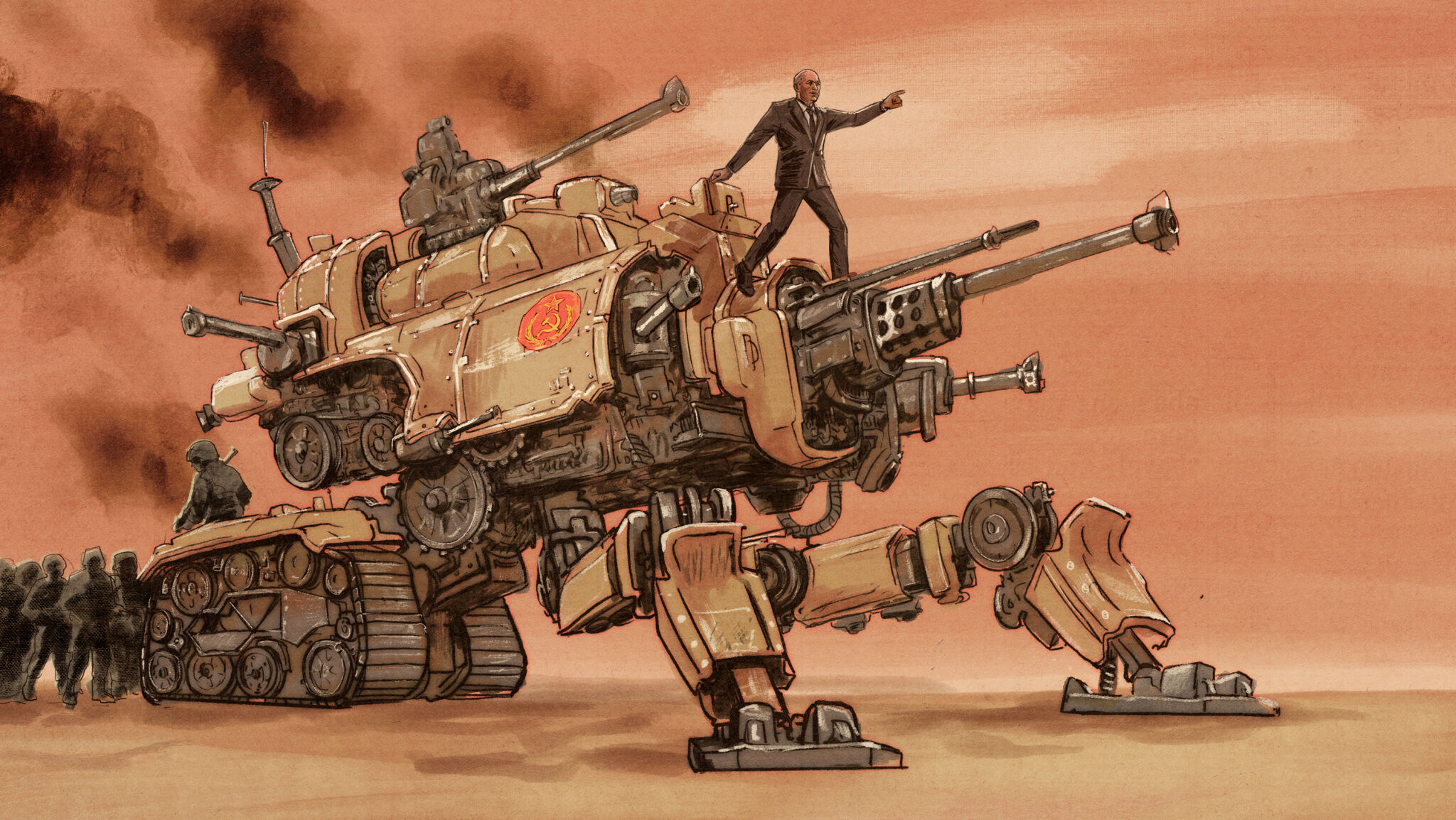
The War Machine That Won’t Break Down
The Russian Federation is on the cusp of economic collapse in the eyes of more and more leaders and analysts.
- “[T]hey have long lines waiting for gasoline in Russia right now,” United States President Donald Trump told reporters in the Oval Office on Oct. 15, 2025. “All of a sudden, this economy is going to collapse.”
- “Vladimir Putin’s War Machine May Finally Be Running Out of Fuel,” the Atlantic Council headlined on October 21.
- “To keep [Russia’s] military machine running like this, a lot more money is needed—and there simply is not any,” Russian opposition politician Vladimir Milov said on November 10.
It is easy to see why observers believe the gears of Russia’s economy are about to strip. Nearly four years into the nation’s “Three-Day War,” its forces control only 19 percent of Ukraine’s territory. And that came at a staggering cost in blood and treasure—over 1.1 million personnel losses and as much as $300 billion.
As a result of the war, Russia has been cut off from the swift international banking system and much of its access to its own foreign currency reserves. It is suffering sky-high interest rates and stratospheric levels of inflation. Purchasing power for Russians has dropped, and they are spending less. At the same time, a demographic crisis caused by emigration and abysmal birth rates is further degrading the economy, as is the nation’s systemic corruption, which chokes efficiency and private-sector growth.
Meanwhile, the U.S. has lifted Biden-era restrictions on American weapons systems in Ukraine. This has enabled Ukraine to destroy energy infrastructure deep in Russia, lowering its oil refining capacity by perhaps as much as 25 percent. This has caused serious fuel shortages across the nation, prompting strict export restrictions so Russia’s own people have enough to drive their cars, heat their homes, and power their factories. And there’s still not enough for everyone.
On top of that, the U.S. sanctioned Russia’s two largest oil firms in October, including “secondary sanctions” that threaten to block any organization that trades with these companies from American capital markets. Although China and India are finding loopholes and workarounds, their purchases of Russian energy are declining. With Russia’s economic engine starved of lubricant, every component is scraping harder just to move.
At the same time, global oil prices are falling, further shrinking the profits from whatever Russia manages to sell.
It is easy, then, to see why many say the wheels are about to fall off.
But what those who predict collapse fail to grasp is that the rules applying to Russia’s economy are different. War economies—as Russia’s has become—are fundamentally unlike the peacetime systems they are accustomed to assessing.
How a War Economy Works
Put simply, a war economy is organized around sustaining a military effort. Shifting from a civilian system to a war economy means redirecting the nation’s resources and priorities from serving the needs of its people to serving the demands of the war.
Of course, war causes destruction and death, and that weakens an economy over the long term. But war also brings massive government spending, wide-scale industrial retooling and innovation, surges in production and full employment. So a war economy can actually generate significant growth in gross domestic product for several years.
This was true for several nations in the World War i era, including France, Italy and the United States. It was true in the World War ii era for Britain, the U.S., Germany, the Soviet Union and other belligerents. And it is true for Russia today.
Before Russia took its war on Ukraine full scale in February 2022, a considerable portion of its workers were unemployed and many of its factories were idle. In the time since, the nation has activated much of that untapped economic potential. Unemployment has hit record lows, and factories are in overdrive to keep soldiers equipped with weaponry, ammunition, vehicles and drones. As a result, Russia’s economic growth has outperformed major economies such as Germany and the United Kingdom.
Evidence suggests that Russia’s leadership could keep the war machine throttled at its current rpm and avoid collapse for far longer than many onlookers would expect—or hope.
Four Pistons of Financial Failure
Economists generally point to four main causes of national economic collapse: a currency crash, blockage from vital resources, excessive debt levels, and widespread public discontent. The Russian economy appears largely insulated from all four.
Moscow has safeguarded against a currency crash by implementing capital controls. This means the government decides how much money can flow out of the nation. This reduces the freedom of Russian citizens to invest abroad, convert rubles to dollars or euros, or even send money to relatives in other nations—but it enables the government to tap into much of that previously unrealized economic potential without tanking the ruble.
“This move surprised many economic analysts,” economist Joeri Schasfoort said in a Money and Macro episode, “because they were no longer used to thinking about capital controls as a viable option. It is, however, the first crucial step to see why Russia’s economy will not collapse” (Oct. 17, 2025).
The prospect of an economic blockade by outside powers would terrify many nations. But Russia is the world’s largest country, with more surface area that the dwarf planet Pluto. It has vast reserves of oil in all that land, as well as natural gas, coal, metals, timber, uranium, phosphates, potash, gold, diamonds and rare earths. Russia is also home to nearly a quarter of the world’s fresh water and enough arable land to produce more than enough food for its people. Virtually the only things Russia is critically dependent on importing are machinery, high-tech components, chemical products and some medical equipment—and China has demonstrated its ability and will to reliably supply most all of these goods, regardless of sanctions. So Russia is not particularly vulnerable to a collapse due to a disruption of inputs.
Debt is rising in Russia today. A housing bubble is forming, excessive government spending is depleting reserves, and debt-servicing costs are climbing. But with the government debt-to-gross domestic product ratio at only 16.4 percent, Russia still has considerable budget flexibility. Household debt, meanwhile, is around 20.7 percent of gdp, quite modest compared to many Western economies. At least in the short run, the numbers show that a debt-driven collapse remains extremely unlikely.
Meanwhile, the Russian people continue to rally behind Vladimir Putin. This is partly because the Orthodox Church backs the war and has convinced the population that Russia’s cause is righteous. Meanwhile, Putin’s United Russia party dominates the legislature; opposition voices are killed, jailed, exiled or otherwise sidelined. Add to this a strong current of nationalism and xenophobia, and the Putin regime maintains broad legitimacy across society.
Russia’s position in all four of these factors that would normally bring economic collapse suggests that it can keep its war machine thrumming at current levels for years longer than many Western analysts expect. “If you compare Russia’s war economy to historical ones like Nazi Germany, the Soviet Union and even Vietnam-era U.S.A.,” Schasfoort said, “it actually looks like Russia’s war economy is just getting started.”
Eurasia Group’s Ian Bremmer stated in a Nov. 10, 2025, briefing that he agrees with this assessment: “Russia can economically keep going with really zero impact on their war-fighting ability, despite all of these additional measures, both in terms of what the Ukrainians are hitting and the hits to the Russian economy, certainly for the next year and a half to two years.”
None of this means Russia doesn’t face serious problems. The early phase of a war economy is generally the easy one, and that phase is nearing an end. In the months ahead, sanctions could tighten, manpower and fuel shortages could intensify, and Putin’s government may feel compelled to intervene with a heavier hand to keep the engine of war turning. He might crank sky-high interest rates still higher, introduce wage and price controls, and sideline more civilian industries to free up resources for the growing war economy. This will bring greater economic pain to the Russian people, but Putin already has most of them convinced that the war is a righteous cause that requires noble sacrifice. So even as the Russian war economy reaches steeper inclines and shifts into lower gears, we should not expect it to break down—nor for its driver to be significantly weakened or removed.
Once biblical prophecy is factored in, we can be certain of this.
A Prophesied ‘Prince’
Around the year a.d. 90, the Apostle John recorded a prophecy in Revelation 9:16 describing an army of 200 million soldiers, a force many times larger than any ever amassed in human history up to the present day. Other passages provide vital details about this gargantuan force. Revelation 16:12 indicates that the army is amassed by “the kings of the east,” a coalition of Asian countries. Daniel 11:44 to 12:1 make clear that this bloc will be one of the primary belligerents in a nuclear World War iii. Ezekiel 38 shows that at the helm of this coalition will be one lead nation and one leading man.
“And the word of the Lord came unto me, saying, ‘Son of man, set thy face unto Gog, of the land of Magog, prince of Rosh, Meshech and Tubal, and prophesy concerning him’” (verses 1-2; King James Version and Young’s Literal Translation).
Who is this prince? Rosh here signifies Russia, once called Rus, a point that is recognized by commentaries such as the Jamieson, Fausset and Brown Commentary. The names Meshech and Tubal designate the modern Russian cities of Moscow and Tobolsk.
Ezekiel 38 goes on to detail the conquests of the mighty force led by this “prince of Rosh, Meshech and Tubal” and his army’s eventual defeat. In the September 2014 Trumpet, editor in chief Gerald Flurry explained who this man is. “I strongly believe Vladimir Putin is going to lead the 200 million-man army. Just look at the power he already has,” he wrote.
“Can you think of any other Russian politician who could become so powerful and have the will to lead Russia into the crisis of crises? I see nobody else on the horizon who could do that. And only a tiny few years remain for the prince of Rosh to appear! … This much is absolutely certain: The restoring of Russia’s power by Vladimir Putin—the prince of Russia—was prophesied! He has already solidly allied Russia with China. The prophecy about the prince of Russia includes that main alliance. … The only question is whether or not Putin personally finishes the entire prophecy.”
When Mr. Flurry wrote his booklet The Prophesied ‘Prince of Russia’ in 2017, he removed all doubt from his stance, asserting with conviction that Putin would personally fulfill this role: “His track record, his nationality and his ideology show that he is fulfilling a linchpin Bible prophecy. The time frame of his rule also shows that nobody else could be fulfilling the Ezekiel 38 and 39 prophecy. …
“We need to watch Vladimir Putin closely. He is the ‘prince of Rosh’ whom God inspired Ezekiel to write about 2,500 years ago!”
Since the Trumpet identifies Putin as specifically fulfilling end-time prophecies, we believe Russia’s economy will avoid seizing up and that Putin will grow more powerful in the time ahead, fighting wars far more momentous and destructive than his current war on Ukraine.
It is clear that the future for Russia, Ukraine and the world is growing bleaker. Yet Mr. Flurry says, the fact that this “prince of Russia” is now ruling shows that the most hope-filled event in mankind’s history is near. “Vladimir Putin is a sign, literally a sign, that Jesus Christ is about to return!” he writes in his booklet. “This is one of the most inspiring messages in the Bible. What we are seeing in Russia ultimately leads to the transition from man ruling man to God ruling man!”
A beautiful solution that will finally bring real peace to a fractured world is coming soon. It is a force of hope and renewal that will end war and restore hearts, minds and nations alike. Swords will be beaten into plowshares, spears into pruninghooks, and war economies will be dismantled and rebuilt into systems of peace, serving people and building healthy, prosperous lives. When it arrives, the violence and turmoil that has plagued mankind will at last give way to harmony beyond anything we have dared to imagine.


