
The Real Legacy of Nicaea
The Real Legacy of Nicaea
Religious freedom is rare in human history. For thousands of years, governments have used their power over speech, taxation, freedom and use of force to compel their subjects to observe the regime’s preferred religion. Even today, about 3 out of 4 people worldwide live in a nation where leaders significantly restrict the free exercise of religion. In many Middle Eastern nations, authorities can fine, jail or kill you for the “crimes” of apostasy, blasphemy or heresy.
Only a privileged few live in a time and a nation that guarantees religious freedom. For these people, it is easy to forget how historically unique it is to live according to the dictates of their conscience without fear of persecution.
The first Christians were mercilessly persecuted for their sincerely held beliefs. History records 10 great persecutions between a.d. 64 and 305, when the Roman Empire tried to blot out Christianity by burning scriptures, destroying homes, and feeding Christians to lions. This nightmare stopped under Rome’s first Christian ruler, Emperor Constantine the Great.
This is why much of the Christian world paused this year to commemorate the 1,700th anniversary of the First Council of Nicaea—a pivotal event that has defined the foundations of mainstream Christianity.
But they are hardly telling the real story. In fact, that council represents a dark historical turn from which the world today should take warning.
Unity
On Nov. 30, 2025, Pope Leo xiv of Rome met in Turkey with Ecumenical Patriarch Bartholomew i of Constantinople to promote Christian unity. At a prayer service at the Patriarchal Church of Saint George in Istanbul, Leo reiterated that despite history’s “many misunderstandings and even conflicts” and the challenges of the present in “achieving full communion,” Christians must strive for unity and “continue to consider each other as brothers and sisters in Christ and to love one another accordingly.”
Days earlier, Leo published a letter titled “On the Unity of Faith,” pointing to the Nicene trinity as the solution to divisions between Roman Catholics, Eastern Orthodox adherents and Protestants. In summarizing the history of the Council of Nicaea, Leo noted that as the controversy over the trinity raged between Dr. Arius and Bishop Alexander, “Emperor Constantine realized that the unity of the church, and indeed the empire itself, was in danger. He therefore summoned all the bishops to an ecumenical, or universal, council in Nicaea to restore unity. The synod, known as the ‘Synod of the 318 Fathers,’ was presided over by the emperor, and the number of bishops gathered together was unprecedented.”
The number was indeed unprecedented, but Leo buried the lede. Far more important, and equally unprecedented in the history of Christianity, was the fact that the civil leader of the empire was intervening to force people to agree to doctrines they did not believe. This was a blow to both freedom and truth.
Pope Leo and Patriarch Bartholomew hope the 1,700th anniversary of the First Council of Nicaea will spur Catholic, Orthodox and Protestant Christians to set aside their differences. Yet this anniversary was not a celebration of religious tolerance. It commemorated a church-state alliance that did not tolerate dissent.
It is important to understand the legacy of Nicaea because the Bible says a revived “Christian” empire will once again martyr the true followers of Jesus Christ.
History of Christianity
Most Christians have a basic understanding of how their faith started. The Gospels tell us that in the 15th year of the reign of Tiberius Caesar, John the Baptist came “into all the country about Jordan, preaching the baptism of repentance for the remission of sins” (Luke 3:1-3). About six months later, Jesus Christ “came into Galilee, preaching the gospel of the kingdom of God” (Mark 1:14). After 3½ years of preaching, Pontius Pilate had Jesus crucified and buried in a tomb near Golgotha for three days and three nights.
Jesus was resurrected from the dead, and 40 days later appeared before “five hundred brethren at once” to prove the miracle (1 Corinthians 15:6). Jesus then ascended into heaven, and 10 days later the Christian Church was founded when 120 of His followers gathered in Jerusalem on Pentecost and received the Holy Spirit (Acts 1:15).
This small group of Christians was initially united in its mission to preach the gospel of the kingdom of God to “every creature” (Mark 16:15). Yet false Christians soon arose. Acts 8 records that the great Samaritan sorcerer Simon tried to buy the Holy Spirit with money. The Apostle Peter rebuked him, and history shows us that Simon responded by appropriating the name of Jesus while suppressing the message Christ taught.
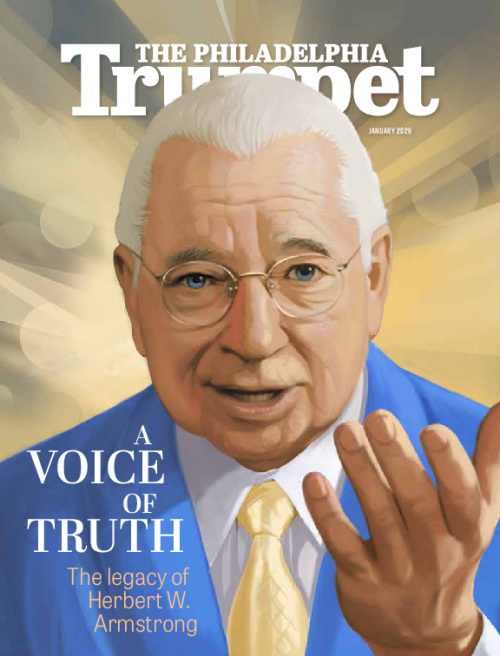
The late Herbert W. Armstrong explained in his book Mystery of the Ages (request a free copy) that Simon the Sorcerer “caused a violent controversy to flare up in the early months and years of the Church disputing whether the gospel to be proclaimed was the gospel of Christ, or man’s gospel about Christ. Satan caused the latter to win out, and in less than 20 years a false and counterfeit gospel about Christ was being proclaimed by all but the persecuted few who loyally remained as the small and persecuted true original Church of God.”
That is an astonishing statement, but absolutely true! By the time the original 12 apostles died, Christ’s gospel about the coming Kingdom of God had been replaced with a very different message, one that focused on Jesus Himself. This new gospel soon splintered into dozens of competing gospels as Christians argued over what type of being Jesus was.
In a 1979 World Tomorrow program, Mr. Armstrong estimated that over 50 different “Christian” sects and denominations sprang up within the first two centuries of Jesus’s death and resurrection. Some Ebionites believed Jesus was a mere human, the natural son of Joseph and Mary, who perfectly obeyed the Jewish law and was “adopted” as the Son of God. Docetists believed Jesus was a Spirit Being who only manifested Himself as a mortal man, and therefore it was impossible for Him to sin or experience pain. Valentinians allegedly believed Jesus had a spiritual twin sister named Sophia, who became the third person in a holy trinity. Sabellians argued that the Father, Son and Holy Spirit were not three distinct persons but different manifestations of the same divine being. Other groups like the Marcionites said Jesus came to free the world from the tyrannical God of the Old Testament.
It is hard to overstate the amount of religious confusion that cropped up during the three centuries after Jesus Christ’s ministry. The differences in beliefs among those calling themselves Christian were so vast and so contentious that doctrinal differences among Catholics, Orthodox, Lutherans and Baptists pale by comparison! To help solve doctrinal disagreement, some Christians, who were highly educated in the teachings of the Greek philosopher Plato, founded the Catechetical School in Alexandria, Egypt. Here, philosophers like Clement and Origen taught that God is actually one God in three co-eternal persons: the Father, the Son and the Holy Spirit. Yet they relied far more on Plato than on the Bible.
Enforced Unity
The conflicts between these “Christian” beliefs, however, did not keep the number of people professing the name of Jesus Christ from multiplying. By a.d. 300, about 6 million “Christians” lived in the Roman Empire.
Emperor Diocletian, who ruled from a.d. 284 to 305, failed to extinguish Christianity, so his successors began to tolerate Christian beliefs. In a.d. 313, Emperor Constantine i issued the Edict of Milan, a promise to treat Christians with tolerance—“so that we might grant to the Christians and to all others full authority to observe that religion which each preferred; whence any divinity whatsoever in the seat of the heavens may be propitious and kindly disposed to us and all who are placed under our rule.”
Before this point, Constantine had worshiped the Syrian sun god Sol Invictus. Yet he recognized Diocletian’s persecution strategy was not working and sought peace with the growing religion. Though he would not be baptized for more than 25 years, he professed his faith in Christianity before Bishop Miltiades of Rome.
Around this time, a religious dispute broke out in Alexandria, Egypt, the second-largest city in the Roman Empire. Patriarch Alexander i of Alexandria delivered a sermon about the similarity of the Son to the Father, and a local priest named Arius publicly accused him of being one of the Sabellians, who believed that the Father, Son and Spirit were different manifestations of the same divine being. Arius cited the Gospel of John, which clearly establishes that God and the Word are different beings (John 1:1), and reasoned that God the Father must have created the Word sometime before time began. Many people supported Arius. The religious dispute in Alexandria soon grew so intense that riots broke out over the controversy. Emperor Constantine became concerned.
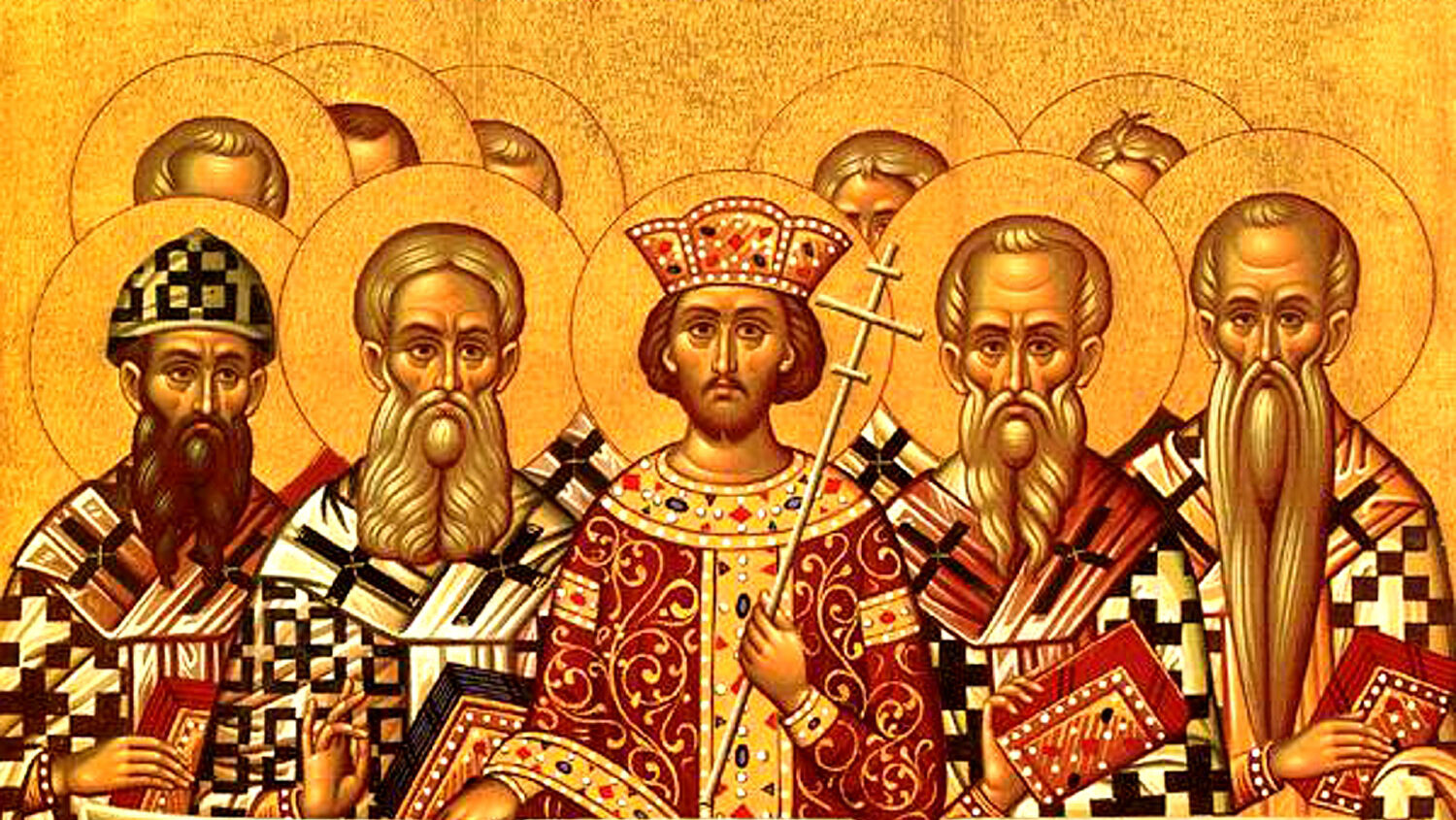
The emperor sent a letter to Alexander and Arius demanding that they settle their dispute. The church in Alexandria responded that it was “settled”—it had excommunicated Arius and his supporters. This prompted Constantine to summon a council on May 20, a.d. 325, the first-ever such governmental meeting to pressure Christian factions toward unity.
Tradition says that 318 bishops gathered in the Bithynian city of Nicaea to hear Arius’s case, less than 20 percent of the approximately 1,800 bishops in the Roman Empire. About 22 of these bishops, led by Eusebius of Nicomedia, came to support Arius. The debate was heated. Tradition states that during an argument, Nicolas of Myrna punched Arius in the face. After a month, under an imperial mandate to come to an agreement one way or another, all but two bishops condemned Arius as a heretic. These two—Theonas of Marmarica and Secundus of Ptolemais—were exiled.
The Council of Nicaea produced a creed stating that God is one divine being who exists as three co-equal and co-eternal persons. This satisfied Constantine and the civil government’s requirement that one “official” belief be adopted. The council also decreed that Easter would be observed on the first Sunday after the first full moon following the vernal equinox. The Church of Rome had observed Easter Sunday since the days of Pope Sixtus i (a.d. 115–125), but disputes over which Sunday should be kept had arisen.
Perhaps the biggest decision settled at Nicaea, however, was that the Roman emperor now had authority to enforce doctrine. This was the original unification of church and state. The intermingling of governmental power and worship involving Jesus Christ would change world history for 17 centuries to come!
“Imagine a political ruler establishing law and doctrine in the Church,” Trumpet editor in chief Gerald Flurry writes in The True History of God’s True Church. “There is no way such a satanic work could be done in God’s true Church! It was from this discussion that the doctrine of the trinity as many churches understand it today was finally formalized—three centuries after Jesus Christ’s ministry! … That is the way Satan works: Once he takes away someone’s understanding of the gospel and the Family of God, he can deceive them all the more. …
“This was a turning point in the history of the world! And it all began with Constantine and the Council of Nicaea. … Constantine personally and actively championed the military operation to eradicate Passover-keepers, whether they were in God’s true Church or worldly churches.” (Request a free copy of this book.)
This is bloody history that many Catholics and most Christians are unfamiliar with. In Revelation 2:10, God tells the Smyrna era of His Church, “[Y]e shall have tribulation ten days.” Applying the day-for-a-year principle often found in prophecy (Numbers 14:34; Ezekiel 4:4-6), this refers to 10 years of persecution after Nicaea.
Great False Church
Emperor Constantine started the process of using state power to force Christians to accept state-sanctioned doctrine, starting with the trinity. The Catholic Church, which began in the early second century, looked to the emperor to enforce more doctrines. In a.d. 364, the Council of Laodicea forbade Christians from observing the seventh-day Sabbath and commanded them to work on that day and honor Sunday instead.
The laws became so strict that no man could hold a job or engage in business unless he worked on Saturday and rested on Sunday. Most Christians gave up trying to keep the Sabbath. Those who clung to it fled the emperor as Christians in league with the government became as tyrannical as the pagan emperors of old.
After the ancient Roman Empire morphed into the medieval Holy Roman Empire, the Catholic Church-influenced government stopped banishing those they deemed Christian heretics and started killing them.
In 1487, Pope Innocent viii issued a Bull of Extermination against Christians known as the Waldensians, many of whom were Sabbath-keepers. The fruits prove that Emperor Constantine’s decision to start enforcing religious doctrine established the great false church—just as the Apostle John had prophesied in Revelation 17:1-6. Bible prophecy uses a woman to symbolize a church and a beast to represent a human government. This passage prophesied that a false Church would guide a human government to kill true Christians and dictate false doctrines.
The first Christian Church in history to persecute other Christians was the church empowered as the official imperial religion by Emperor Constantine the Great. This Great Nicaean Church has since splintered into thousands of Catholic, Orthodox and Protestant denominations. Christian leaders are using the 1,700th anniversary of the Council of Nicaea to call for religious unity among all the trinitarians who consider Constantine a true Christian. Yet those who look nostalgically at Nicaea have some hard questions to answer.
The Apostle Paul said his goal was to present the true Church as a “chaste virgin to Christ” (2 Corinthians 11:2). The church of Revelation 17 is described as a “great whore” and a “mother of harlots.” Why is this false church described this way? Because her mixing of religion, policy, banishment and execution equates to spiritual fornication with the “kings of the earth.” This false Church looks to human leaders like a whore to her clients. True Christians look to their real husband, Jesus Christ.
Only the Great Nicaean Church, with its church-state alliance, its protesting daughter churches, and its pagan doctrines, fits the description of the “great whore” of Revelation 17. All the Orthodox and Protestant denominations that have split from Rome and involved themselves with various governments to various degrees fit the description of Rome’s harlot daughters.
The one true Church is a Sabbath-keeping Church that never took part in the First Council of Nicaea. It heeded the Apostle John’s admonition to come out of Babylon—“that ye be not partakers of her sins, and that ye receive not of her plagues” (Revelation 18:4). This Church has taken advantage of the fact that the United States offers freedom of religion. It has never committed spiritual fornication by forging an alliance with any of “the kings of the earth.”
Resurrected Kingdom
The Catholic Church is misrepresenting the real legacy of Nicaea in its attempt to entice more churches to seek full communion with Rome. “The Council of Nicaea took place at a time when Christianity had not yet been divided by so many subsequent schisms,” Cardinal Kurt Koch, prefect of the Dicastery for Promoting Christian Unity, said in 2025. “[I]ts creed is therefore shared by all Christian churches and ecclesial communities, uniting them in a common confession to this day. Its ecumenical importance cannot be underestimated.”
This is not true. The Council of Nicaea did not take place at a time when Christianity was more united. Rather, it was the Council of Nicaea that united Christendom around a state-sponsored brand of Christianity and revolutionized Christian and political history.
This is troubling history that the Bible warns is about to be repeated. A companion prophecy to Revelation 17 is found in Isaiah 47, in which the “daughter of Babylon” says, “I am, and none else beside me; I shall not sit as a widow, neither shall I know the loss of children” (verse 8).
As Herbert W. Armstrong repeatedly identified in the Plain Truth magazine, this passage describes a church that has protesting daughter churches. This church wants to bring these daughter churches back under its authority. To do this, the church ceases being a widow and revives her illicit relationship with the Roman Empire.
Pope Leo and Patriarch Bartholomew are using the anniversary of Nicaea to stir up a false nostalgia and a desire for unity through compromise. Mr. Flurry wrote in 2007, “Indeed, biblical prophecy indicates that full unity will not be achieved purely voluntarily. At a certain point, the mother church will abandon its efforts to woo her daughters back by flatteries and instead revert to the age-old method of preserving ‘Christian’ unity by exerting physical force” (Trumpet, May 2007).
Revelation 13:17 says a time is coming when “no man might buy or sell, save he that had the mark, or the name of the beast, or the number of his name.” Just as Constantine exiled Christians from the Roman Empire if they refused to adhere to the doctrines of the state-endorsed church, a coming revived Holy Roman Empire will ban Christians from participating in the world economy if they refuse to obey the state-endorsed church.
It is becoming more and more crucial to know what the Bible says, who God really is, who Jesus Christ really is, what the true doctrines are, and where the true Church is.
When Jesus Christ’s disciples asked Him for a sign of His Second Coming to establish the Kingdom of God, He answered: “Take heed that no man deceive you. For many shall come in my name, saying, I am Christ; and shall deceive many. … Then shall they deliver you up to be afflicted, and shall kill you: and ye shall be hated of all nations for my name’s sake” (Matthew 24:4-5, 9).
Jesus Himself specifically prophesied not only of false religions but false Christians, false Christs and false churches. Read the Gospels, and you will realize that whatever churches ally with the state to enforce their religious doctrines and increase their power are not God’s one true Church. Jesus prophesied that His true Church will not be a powerful influence on a government—but will be persecuted just before His return.
Based on these prophecies, we can know that an assault on religious freedom will continue and intensify—not only in the Middle East but in every nation. The Holy Roman Empire is about to be revived one last time!


