Is Empathy Sin?

Is Empathy Sin?
Good morning!
Is empathy sin? “Empathy is the new Christian battleground,” Axios reported yesterday. High-profile pastors and conservative influencers are pushing back against empathy for illegal immigrants, transsexuals and other victims of “social injustice,” equating wokeness with weakness.

“Empathy is dangerous. Empathy is toxic. Empathy will align you with hell,” Axios quoted one conservative men’s-ministry pastor, Josh McPherson, as saying.
The validity of this point is easy to see when people equate empathy with tolerance of criminality and other sins.
It’s true that God calls Himself “The Lord God, merciful and gracious, longsuffering, and abundant in goodness and truth, keeping mercy for thousands, forgiving iniquity and transgression and sin.” He is pained by injustice, grieved by suffering, and deeply empathetic toward His creation. His mercy is extravagant and virtually inexhaustible. So labeling empathy as dangerous and toxic without qualification is clearly hyperbole.
But read the rest of that statement in Exodus 34:6-7, and you get closer to the full picture of godly empathy: God “will by no means clear the guilty; visiting the iniquity of the fathers upon the children, and upon the children’s children, unto the third and to the fourth generation.” Here is where people, including Christians, who have made peace with sin jump the track.
On one occasion, Jesus pardoned an adulteress. But He then commanded her, “Go, and sin no more.” God is gracious, but it is only “If we confess our sins,” that “he is faithful and just to forgive us our sins” (1 John 1:9). God loves sinners, which we all are; but He passionately hates sin (Psalm 5:4-5). Sin destroys others, destroys us, destroys our relationships and potential with God. God knows what is sin and what isn’t: It is defined by His eternal spiritual law, not by us. Because He loves us, He commands us to purge it from our lives (Revelation 18:4-5).
Those railing against “empathy” may be using melodramatic language, but in doing so they are exposing those who say it is godly to embrace sin. Jesus asked in Luke 6:46, “And why call ye me, Lord, Lord, and do not the things which I say?”
Pope Leo’s olive branch to estranged churches: Pope Leo xiv made a historic concession when he joined Orthodox, Oriental Orthodox and Protestant leaders in Iznik, Turkey, on November 28.
-
The meeting commemorated the 1,700th anniversary of the First Ecumenical Council, the momentous meeting in a.d. 325 that established governmental involvement in Christian doctrine and changed the Western world forever.
In a landmark development, the heads of 27 churches recited the Niceno-Constantinopolitan Creed in English. They did not include the “Filioque clause” added by the Roman Catholic Church in 1014. This seemingly small linguistic change could herald the beginning of a major religious revolution.
- It took two councils—the First Council of Nicaea (a.d. 325) and the First Council of Constantinople (a.d. 381)—for the Roman Catholic and Eastern Orthodox churches to agree that they believed “in the Holy Spirit, the Lord, the Giver of Life, who proceeds from the Father; who with the Father and the Son together is worshiped and glorified; who spoke by the prophets. In one holy, Catholic and apostolic church.”
- Yet centuries later, Pope Benedict viii added the Filioque clause to the creed, a Latin phrase meaning “and the Son.” This addition was meant to emphasize the Roman Catholic belief that the Holy Spirit proceeds jointly from the Father and the Son, rather than from the Father alone.
- The Eastern Orthodox rejected this addition, and it was a major contributing factor to the Great Schism of 1054.
The fact that the current leader of the Catholic Church is willing to recite the creed without this clause is a major olive branch to the Eastern Orthodox churches.
The pope knows that the Catholic Church cannot be a major political player as long as it remains divided, so he is glossing over doctrinal differences, such as the “Filioque clause,” to bring Catholics, Orthodox and Protestants together under Rome’s overall authority.
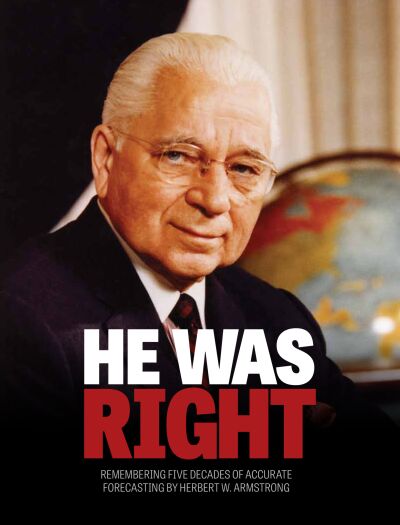
A prophecy in Isaiah 47 speaks of a “daughter of Babylon” who says, “I am, and none else beside me; I shall not sit as a widow, neither shall I know the loss of children” (verse 8). As the late Herbert W. Armstrong wrote, this passage describes a church that has protesting daughter churches. This church wants to bring these daughter churches back under its authority. To do this, the church revives its illicit relationship with the emperor of a revived Roman Empire.
Ultimately, the pope won’t be able to unify Catholics, Orthodox and Protestants until he finds a new Emperor Constantine to enforce his decisions. But in the meantime, he is pushing to bring together all trinitarians into a politically powerful church that can stamp out the “old heresies.”
‘Deathware’ business is booming: The world is arming itself to the teeth. The arms revenue of the world’s 100 largest arms-producing and military services companies reached a record high of $679 billion last year. This marks a 5.9 percent increase over the previous year and a 26 percent jump from 2015, the Stockholm International Peace Research Institute reported today.
- Thirty-nine of the top 100 companies are based in the U.S. and experienced 3.8 percent growth, reaching $334 billion.
- Europe is growing at well over triple that rate: The 26 European companies increased by 13 percent to $151 billion.
- The eight Middle Eastern companies grew even faster, by 14 percent, to $31 billion.
- By contrast, the 23 companies based in Asia and Oceania decreased by 1.2 percent to $130 billion. Revenue for the eight Chinese companies dropped by 10 percent to $88.3 billion.
The fastest-growing companies come from Germany and Japan:
- Five Japanese companies topped the list with a 40 percent increase that reached $13.3 billion.
- Revenue for Germany’s top four companies increased by 36 percent to $14.9 billion.
The spike in European companies “is almost all linked to Russia’s invasion of Ukraine,” Nan Tian, one of the report’s authors, told Deutsche Welle, adding:
There has been an increase in demand from the German armed forces. Whether it’s Rheinmetall or Diehl, building tanks, armored personnel carriers, ammunition, of course, for the German armed forces to replenish what they’ve sent to Ukraine as military aid, but also to expand their number of tanks, infantry fighting vehicles, etc.
These large quantities of what some call “deathware” are frightening to consider. Already, our world has much more explosive power than needed to eradicate all life on Earth many times over, just as Jesus Christ warned about in Matthew 24:21. Christ and other prophets prophesy that these weapons will be used.
But the power of these manufacturers and the world’s militaries is just a drop in the bucket compared to God’s power (Isaiah 40:15). He oversees their rise and ensures that His purpose stands.
IN OTHER NEWS
Netanyahu asks for preemptive pardon: Israeli Prime Minister Benjamin Netanyahu yesterday asked President Isaac Herzog to pardon him from corruption allegations. The request is highly unusual, since Netanyahu has not yet been convicted. President Herzog’s office stated today that the pardon request “is clearly provoking debate and is deeply unsettling for many people in the country, across different communities. I have already clarified that it will be handled in the most correct and precise manner. I will consider solely the best interests of the State of Israel and Israeli society.”
Lithuania teaches children to use drones against Russia: The Lithuanian Defense Ministry has been offering drone assembly, programming and piloting courses to citizens over the past two months, with the goal of training 22,500 Lithuanians, including 7,000 children as young as 10 years old, by 2028. The ultimate objective is to bolster the nation’s defense against Russian aggression, something Europeans increasingly fear and are now acting upon.
Russian warplanes put Poland on high alert: On Friday, Russian MiG-31 fighter jets flew westward over the Baltic Sea, prompting the Polish military and nato forces to put their Patriot air defense systems on high alert. The jets then changed course. MiG fighter jets can carry Kinzhal hypersonic missiles, which have a range of 300 miles. Two Patriot systems from the German Air Force, which are currently stationed in Poland, were also involved. An officer told Bild, “Russia is constantly testing us. They want to know how we will respond to such actions.” Russia’s provocations are causing Europe to militarize and unite.
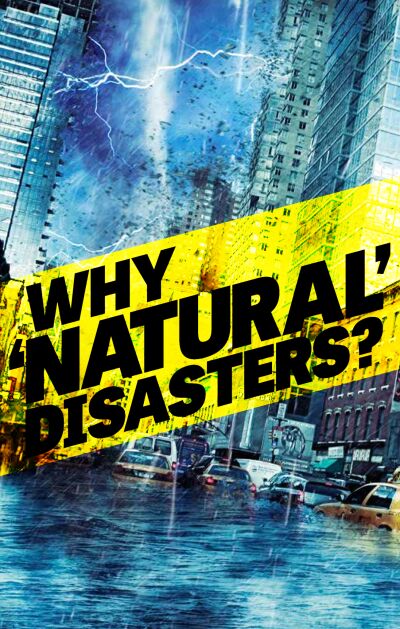
Cyclone Ditwah kills at least 69 people in Sri Lanka after arriving on the island Friday. Twelve inches of rain caused landslides and floods; more deaths are expected as flooding continues. The flooding has disrupted transit routes, and neighboring India is flying in food aid. Sri Lanka effectively went bankrupt in 2022, its economy is still struggling, and now this cyclone adds another major burden. This comes after two deadly typhoons struck the Philippines. Why does a loving God allow such disasters? Read the Bible’s answer in your free copy of Why ‘Natural’ Disasters?
Is the U.S. about to strike Venezuela? “To all airlines, pilots, drug dealers and human traffickers, please consider THE AIRSPACE ABOVE AND SURROUNDING VENEZUELA TO BE CLOSED IN ITS ENTIRETY,” President Trump posted on Truth Social on Saturday. The next day, he confirmed that he had called Venezuela’s dictator, Nicolás Maduro. Anonymous sources told the Miami Herald he gave Maduro an ultimatum: “You can save yourself and those closest to you, but you must leave the country now.” Venezuela under Maduro and his predecessor, Hugo Chavez, has been transformed into a nest of vipers on America’s doorstep. Few realize that Maduro’s fall, if it happens, could provide an opportunity for Europe, much more so than for America, to the detriment of the latter. Read what the Bible says about Latin America and the rising Holy Roman Empire in Europe in “Vatican Eyes Regime Change in Venezuela.”