

Germany’s War for Bosnia—30 Years On
Thirty years ago today, Germany conquered Bosnia and Herzegovina, made possible by the internationally acclaimed Dayton Agreement.
By the early 1990s, the Soviet Union had fallen. Russia’s hold over Eastern Europe was broken, but Yugoslavia remained a powerful potential rival to Germany. Serbia, which had fought against Germany in both world wars, was gaining influence. As the New York Times later wrote, “If there has been a single obsession in Serbian policy this century, it has been to prevent what Belgrade sees as German expansionism in the Balkans.”
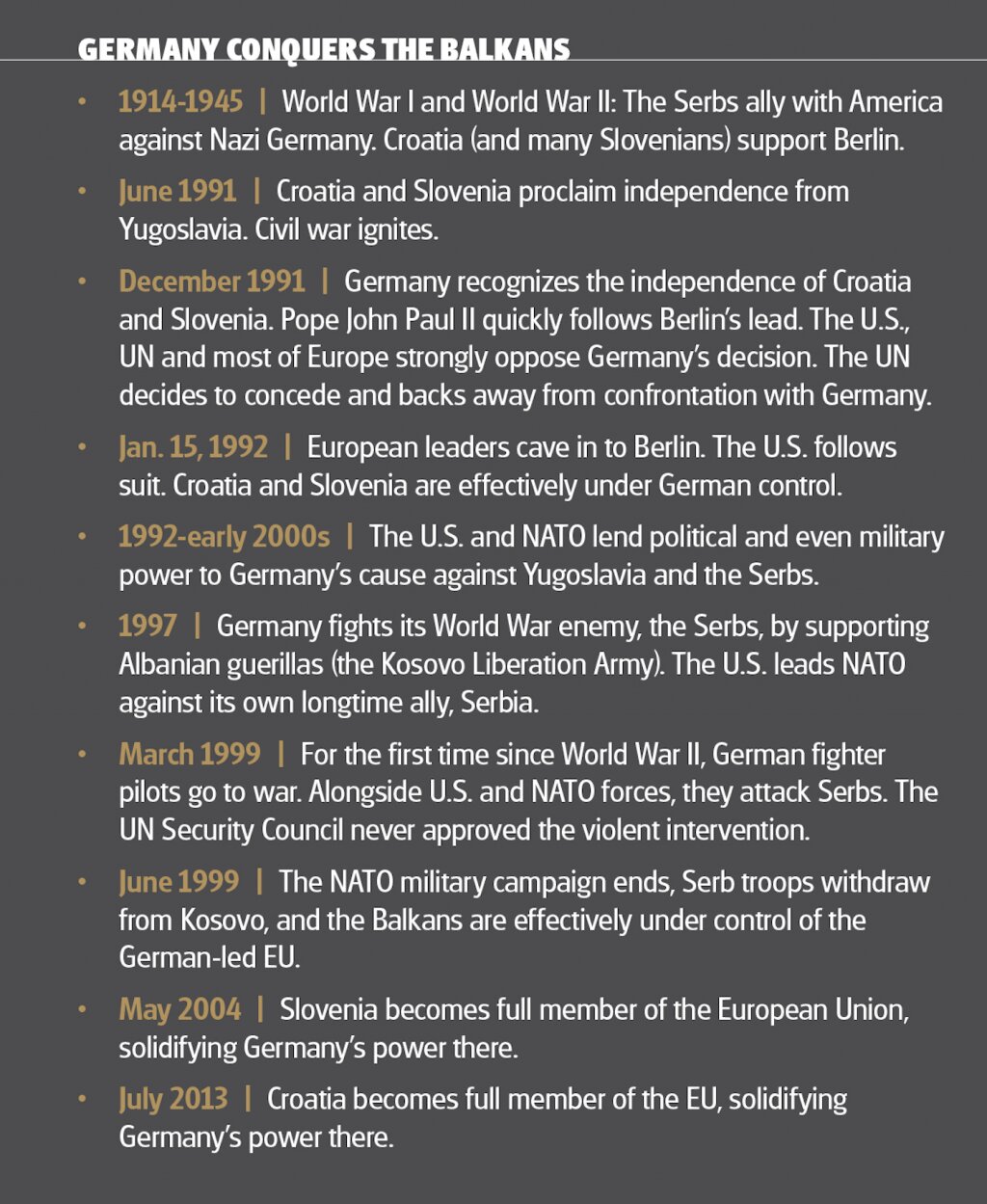
Yugoslavia had to be conquered, which Germany did in two phases:
- Disregarding warnings from major Western nations, it made a controversial move that stirred ethnic divisions in Bosnia: recognizing the sovereignty of Slovenia and Croatia.
- It stood up to the West until, eventually, major Western nations caved and gave military aid.
When the Dayton Agreement was signed on Nov. 21, 1995, Germany’s victory became official. Notably, the document established the office of high representative: the highest position in Bosnia. Under the Bonn Powers—named after the capital of West Germany—the high representative has the power to make and annul Bosnian laws, change the Bosnian Constitution and even appoint and remove public officials. His decisions are binding. The Bonn Powers immediately became controversial and weren’t used for a long time, but they are important.
The high representative is not a democratically nominated official. The highest power in Bosnia is not appointed by the will of the people, but by an international committee called the Peace Implementation Council Steering Board.
The establishment of this office cemented German control over Bosnia. In 2002, the European Foundation Intelligence Digest said:
The European empire is acquiring colonies fast. Currently engaged in negotiations with nato in order to take over the running of Macedonia, the European Union has acquired de facto control of Bosnia and Herzegovina to the extent that the new high representative, Lord Ashdown, has appointed a German and a French deputy but no American. This is the first time there has not been a United States deputy in the body which governs Bosnia. It means that the “big three” EU states are now in control of the former Yugoslav territory.
In recent years, a threat to Germany’s Balkan hegemony rose again. In response, although most news outlets glossed over it, Germany quashed the revolt using essentially the same two-phase strategy it deployed 30 years prior.
Phase One: A Controversial Move
On Nov. 7, 2020, Joe Biden was declared winner of the U.S. presidential election. Many believed Biden wanted more influence in the Balkans. The high representative at the time, Valentin Inzko, likely would have made this possible.
Inzko was a noncontroversial ruler. During his 12-year tenure, he was seen as more of an honored guest at ceremonies than an actual leader. Because of this, Bosnia’s ethnic tensions were relatively stable.
Since the Dayton Agreement, the board has tried to appoint uncontroversial leaders like Inzko. The board includes countries with many different ideologies, and each of its appointments were noncontroversial enough to avoid major public disagreements from its major member nations.
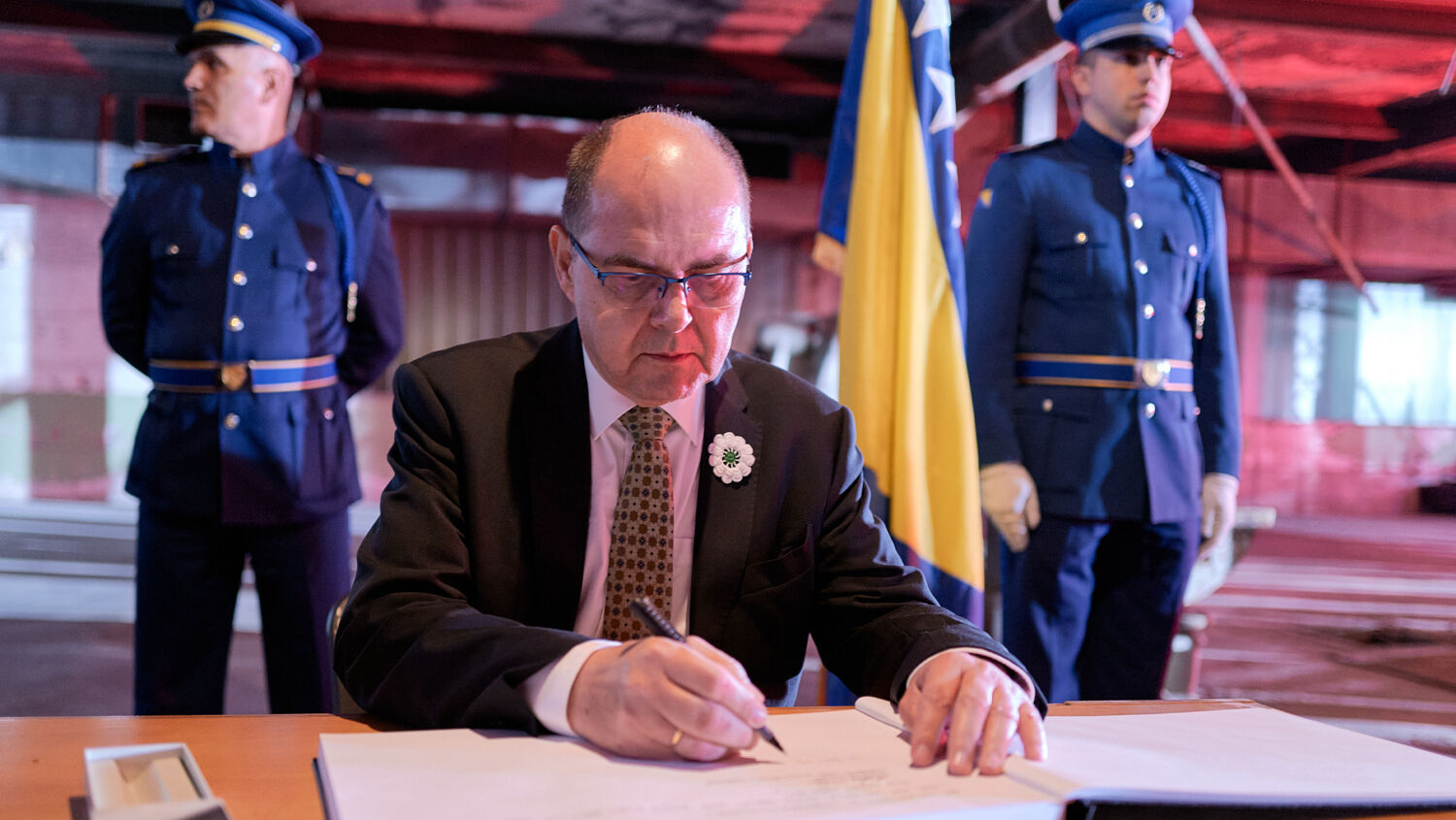
However, Germany did not want the U.S. to control the region. Fearful that Inzko would allow this, Germany’s ambassador to the United Nations hinted that the position might need to be strengthened, specifically mentioning the Bonn Powers. On Jan. 20, 2021—the day Biden was inaugurated—Germany nominated German politician Christian Schmidt to become the next high representative.
This move raised eyebrows. Many wondered why Germany wanted a powerful German leader over Bosnia. Faktor, a Bosnian news source, understood Germany’s plan:
[T]here is no credible evidence so far that Schmidt’s candidacy is the result of a German change of heart about what to do with the [high representative] …. Without any explanation from Berlin, the suspicion remains that Schmidt was nominated to preempt possible moves by the incoming Biden administration to reconnect with the Balkans, and especially Bosnia ….
Many commentators recognized that Schmidt’s nomination was a clear signal that Germany wanted to be the dominant force in the Balkans. Berlin would not allow the U.S. to fill that role. Faktor wrote: “The German nomination has opened the policy debate in the worst possible way, highlighting the lack of coordination among Western democracies and a strategic vacuum.”
In other words, Germany carried out phase one as it had a few decades prior. In a so-called lack of coordination, Berlin made a controversial move that stirred ethnic divisions in Bosnia.
The Royal United Services Institute (rusi), a British think tank, wrote of this in “Germany, Russia and the Gambit for Bosnia,” noting that Germany “has significant interests in Bosnia” and likely nominated Schmidt for a few reasons.
First, Schmidt wants Bosnia to join the European Union. Germany is the economic powerhouse of the union, so this addition would increase its power and weaken the threat coming from Russia and Bosnia’s ethnic Serbs.
Second, Schmidt has a great understanding of both Russia and Croatia. He has been referred to as a Russland-Versteher (Russia-understander). This is very important to Germany because the struggles in the nation largely revolve around the separation of Bosnians and Croats (who generally work together) and the Serbs (who are allied with Russia).
Germany has supported Croatia since 1991 and before that in both world wars. Schmidt is a great friend to Croatia. In 2013, he won one of Croatia’s highest-ranking decorations, the Order of Ante Starčević. Many believe he is biased toward Bosnians and Croats. Faz.net noted Schmidt “is accused of wanting to change the electoral law in favor of the Croats.”
After Schmidt’s nomination, phase two of Germany’s plan commenced.
Phase Two: The West Caves
Before the Bosnian War, almost nobody in the West wanted to recognize Croatia and Slovenia—except Germany. This move was controversial, and the West caved.
Before Biden’s inauguration, almost nobody in the West wanted to replace Inzko—except Germany. Again, the West caved.
Not only did the U.S. seemingly abandon its plan to become more involved in the nation, but Washington and its Western allies allegedly gave in to Germany’s plans during the Peace Implementation Council voting process.
Russia claims Schmidt was appointed without proper procedures, that the U.S. and Western allies simply agreed with Germany’s proposition without seeking consensus among the board or adequately considering other candidates.
While Russia’s claims should be taken with a grain of salt, a few factors could support it:
- Germany’s history in the region
- Only one other candidate was named for the position.
- No country has ever protested so strongly against a high representative appointment before.
Germany’s move is arguably the main cause of the political turmoil that followed in Bosnia.
The War for Bosnia
Ethnic tensions soared after Schmidt came to power on August 1. The leader of Bosnia’s Serbian region, Milorad Dodik, deemed Schmidt’s rule illegitimate. Dodik openly defied the Dayton Agreement by withdrawing from federal Bosnian agencies and even creating an illegal military. He and his Serb associates considered seceding from Bosnia and uniting with neighboring Serbia.
This all came to a head on July 1, 2023, when Schmidt annulled two laws Dodik was trying to pass and, more significantly, made it a criminal offense to defy the high representative’s authority. Regardless, Dodik moved forward with his proposed laws.
Tensions reached a new high two years later.
On August 1 this year, a Bosnian court sentenced Dodik to a year in prison and banned him from the presidency for six years for defying Schmidt’s rule. Five days later, the nation’s Central Election Commission stripped Dodik of his office. His prison sentence was eventually downgraded to a fine, but his ban from the presidency kept tensions high.
Many feared Bosnia was on the verge of another civil war. Dodik traveled to Moscow after his sentencing, giving the impression Russia would protect him. Bosnian federal police tried to arrest Dodik but were stopped by his powerful police force. Dodik vowed referendums to let Bosnia’s Serbs decide their future—a decision Schmidt likely would not tolerate.
The world, especially Europe, held its breath as it watched to see whether one side would cave or the region would be thrown into another bloody civil war.
Victory
On October 1, Dodik resigned, which Deutsche Welle called a “complete capitulation” to Germany. Trumpet writer Richard Palmer wrote of the story:
nato broke up Yugoslavia on the principle of self-determination—the belief that each nation-state should decide for itself its system of government and what state it is part of. Polls in Republika Srpska [the Serb area of Bosnia] indicate that a clear majority want to secede from Bosnia and Herzegovina and unite with Serbia. But apparently, self-determination doesn’t apply to the Serbs.
On November 23, Srpska will hold early presidential elections. Dodik is still very influential in the region and may not be totally out of the picture, but he will leave the presidency.
How This Affects You
The Trumpet is not taking a side in this conflict or condoning Dodik’s illegal activity. But German imperialism is something the entire world should be concerned about. Germany’s takeover of Bosnia—a small country in Eastern Europe—will affect you personally no matter where you live.
Germany started both world wars; the Bible abounds with prophecies saying it will soon start another. Our free booklet Germany and the Holy Roman Empire proves this in detail.
Revelation 17 prophesies that the Holy Roman Empire would rise and fall seven times. Verse 10 says, “And there are seven kings: five are fallen, and one is, and the other is not yet come ….” When this prophecy was revealed, Adolf Hitler—the sixth king—was in power. This means that the seventh king is still to come. Other prophecies reveal Germany will lead this empire.
In this context, it’s interesting to note Christian Schmidt’s ties to Karl-Theodor zu Guttenberg—a man who may lead this coming empire. Schmidt served as parliamentary state secretary in the Ministry of Defense under Guttenberg and played a notable role in Guttenberg’s work to rehabilitate the Bundeswehr (German army). In fact, when Guttenberg was scheduled to give a speech about military reforms in 2010 but had a last-minute change of plans, Schmidt filled in. When Guttenberg was hit with his plagiarism scandal, Schmidt stepped in to defend him.
Guttenberg’s career is full of attempts to revive the German military—a drastic change from the nation’s postwar guilt. According to revelations from a 2023 document published by a Srpska research center, Schmidt may be a great man to help in this.
- In 2007, Schmidt defended and honored a notable Nazi pilot.
- The year prior, a German official noted how Schmidt was in a group led by Nazi SS Gen. Hubert Lanz—a general who aided Germany’s invasion of Yugoslavia. The organization has not distanced itself from this gruesome history.
- The document outlined other ties to Nazi Germany.
We don’t yet know whether Guttenberg will lead the final revival of the Holy Roman Empire or whether Schmidt will play a role in its prophesied brutality, but we do know that Germany’s war for Bosnia is a sign that World War iii is coming. As Mr. Flurry notes in his booklet on the subject, “[T]he former Yugoslavia is, in fact, the first victim of World War iii.”
We must heed this prophecy now before it is too late. For more information, read Mr. Flurry’s free booklet Germany’s Conquest of the Balkans.


