

Emboldened by China, Putin Launches New Phase in War on Ukraine—and Beyond
Russian President Vladimir Putin, buoyed by high-profile meetings with Asian leaders in China and an earlier summit in the United States, is noticeably emboldened. And he is channeling his renewed confidence into a brutal new phase of the war on Ukraine—and beyond.
‘Axis of Upheaval’
From August 31 to September 1, Putin was in Tianjin, China, for the Shanghai Cooperation Organization summit—the largest in the group’s history. He held talks with Chinese General Secretary Xi Jinping, Indian Prime Minister Narendra Modi and more than a dozen other world leaders, representing nearly half of the global population. The main goals were to unite against U.S. leadership and work toward building a new global order. Some analysts called the summit an “axis of upheaval.”
Russia-China relations are at an “unprecedentedly high level,” Putin said after a bilateral agreement with Xi. Following talks with Modi, he called the Russia-India partnership “special, friendly and trusting,” adding that Russia “highly values” Indian support amid Western efforts to isolate Russia.
Putin also highlighted Shanghai Cooperation Organization members’ increasing use of their own currencies—rather than the U.S. dollar—in international trade. He framed the organization’s growing relevance as a shift toward “genuine multilateralism.”
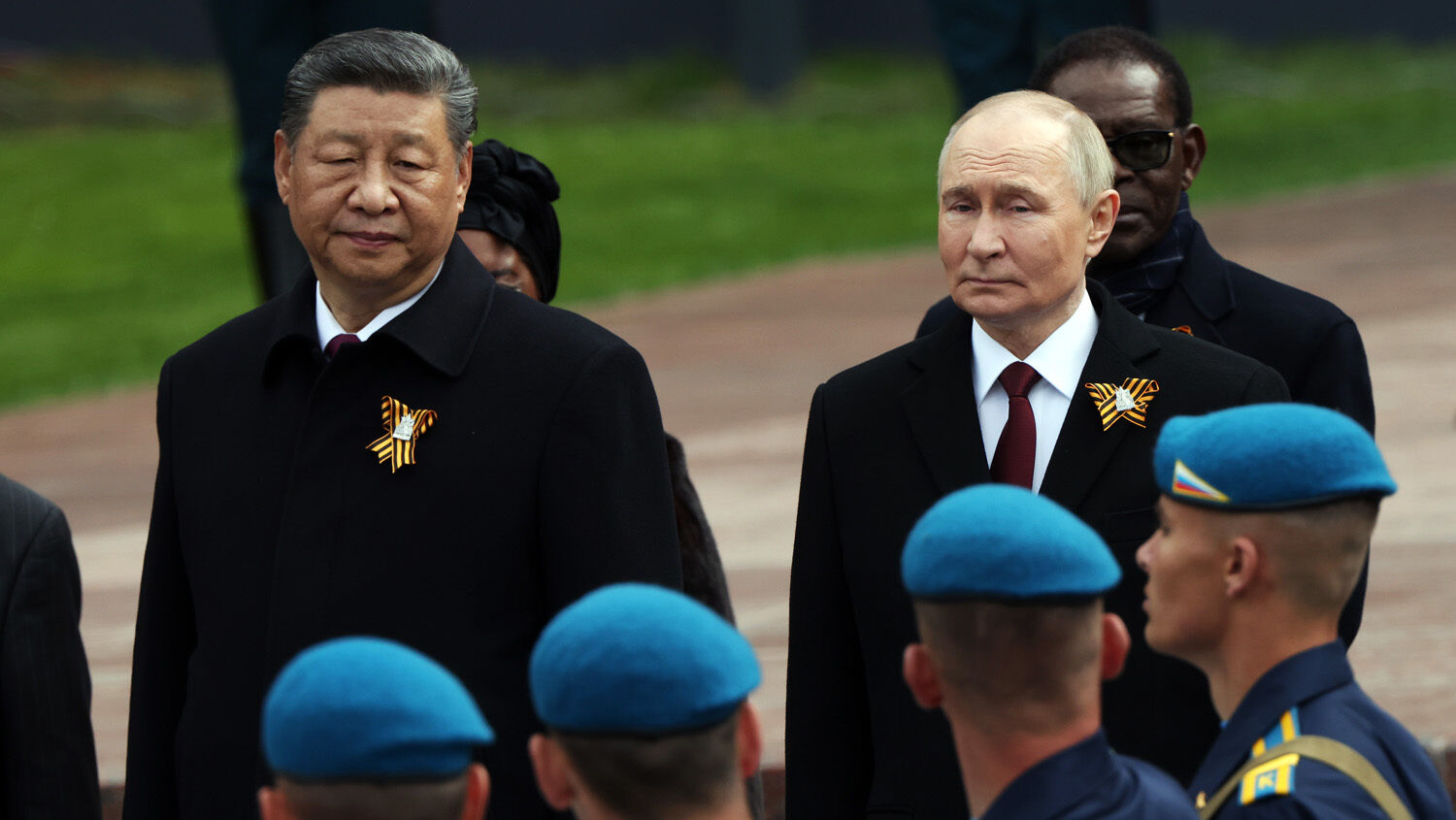
Footage from the event shows Putin beaming as he embraced his fellow strongmen and other cronies. He was luxuriating in clear evidence that Western efforts to turn him into a pariah have failed spectacularly.
Tanks in Tiananmen Square
From there, Putin traveled to Beijing, where he stood shoulder to shoulder with Xi and North Korean leader Kim Jong-un in Tiananmen Square, where they oversaw China’s monumental military parade.
The September 3 event marked the first time this trio has ever appeared together at an official public event. As they surveyed the columns of armory and troops, the three showed unified defiance against the current global order. “This could be seen as a watershed moment in the realignment of this Eurasian power bloc,” said Sari Arho Havren of London’s Royal United Services Institute. “Chinese diplomacy is always heavily choreographed, but there is substance here too in showing North Korea’s strategic value for China alongside Russia.”
China said it would reopen its domestic bond market to large Russian firms for the first time since the Ukraine war began. And it signed deals with Russia for two major gas pipeline projects that will keep China supplied with Russian energy and Russia supplied with Chinese cash—to keep funding its war.
As in Tianjin, footage of Putin at the Beijing parade showed a man brimming with pride and reveling in the camaraderie of his fellow dictators.
https://twitter.com/leandroOnX/status/1964253305527263453
The U.S. Summit Helped Too
Putin’s visit to China came two weeks after U.S. President Donald Trump applauded Putin and laid out the literal red carpet for him at a military base in Anchorage, Alaska. This pomp-filled reception marked Putin’s first visit to any Western country since he launched the full-scale war on Ukraine in early 2022, and it helped rehabilitate his image on the global stage.
President Trump told Putin Russia is “a big power … No. 2 in the world,” and later described their talks as “very productive.” After the summit, Trump backed off on earlier threats to impose new sanctions on Russia and make the nation face “very severe consequences.”
Putin “came to the Alaska summit with the principal goal of stalling any pressure on Russia to end the war,” said Neil Melvin, director of international security at the Royal United Services Institute. “He will consider the summit outcome as mission accomplished.”
Russia’s New Phase of War
Days after returning home from this diplomatic tour, buoyed with confidence, Putin oversaw Russia’s largest aerial attack on Ukraine of the entire war—with more than 800 drones and missiles fired.
This September 7 attack came amid a general increase in air assaults on Ukrainian nonmilitary targets. It would be notable enough simply due to the unprecedented number of weapons involved. But among the targets Russia hit during this barrage were Ukraine’s Cabinet of Ministers building in Kyiv and other government ministries. Russian hard-liners have long been pushing for strikes against “decision-making centers” in Ukraine. But they have not happened—until now.
Then on September 10, it became clear that Putin’s new phase of war was about more than Ukraine. That’s when his forces fired a barrage of modified drones, fitted with extra fuel tanks enabling longer distances, at Poland. Almost 20 of these breached Poland’s air space, some going more than 100 miles into the nato member’s territory.
Polish authorities closed four of the nation’s airports during the assault, including Warsaw Chopin Airport. With the help of nato allies, the Poles shot a number of suicide drones down, marking the first time members of the Western alliance have fired shots during Russia’s war.
“This situation brings us the closest we have been to open conflict since World War ii,” Polish Prime Minister Donald Tusk said. Poland also invoked Article 4 of the nato charter, requiring members to assemble to discuss the attack.
“Putin is testing us,” said former U.S. National Security Advisor John Bolton. “He wants to see if he can get away with saying, ‘Oh, it was just an accident, fog of war kind of thing.’ … I think this was a test of nato, and I think we need to respond accordingly.”
But the main response from the U.S. was to lift sanctions on the main airline of Russian puppet Belarus, which throws a major lifeline to Russian avionics and aviation. This reward seemed to further fortify Putin’s confidence. And three days later, he did it again—this time launching a drone into the air space of nato member Romania.
These recent Russian moves mark a significant escalation. They show that Putin is abandoning any pretense of negotiations and that he has been emboldened by displays of solidarity from Xi, Modi, Kim and others. He is full of resolve and self-assurance, knowing these men support him in his brutal war—and that President Trump will not stop him. All of this has prompted Putin to escalate with a new phase of intensified strikes on Ukraine and its government buildings, and more notably, the decision to expand beyond Ukraine and begin testing nato’s resolve in Poland and Romania.
Asia Stands With Putin
Much of the support Putin is now enjoying mirrors what we saw in 2014, when Russia first invaded Ukraine and annexed Crimea. At that time, the West assumed Russia could be isolated and would eventually repent. Instead, China and India stepped in, as they are doing today. They signaled that they were not opposed to Putin’s expansionism, maintained business as usual with Russia, and even increased trade. They continued meeting with him, conducting joint military drills with his forces, and lending him diplomatic support. Given that history, it should come as no surprise to see the same dynamic playing out again.
Trumpet editor in chief Gerald Flurry addressed this in our May-June 2022 issue in an article titled “Asia Still Stands With Putin”:
Western nations see the war as a clear example of Putin’s deadly despotism. But what about the East? Two of the largest, most populous, most powerful nations in the world are supporting Putin! This is a stunning fulfillment of a biblical prophecy!
From there, Mr. Flurry discussed a prophecy about a colossal group of Asian nations soon to emerge under Russian leadership. Revelation 9:16 reveals that this alliance will field an army of 200 million soldiers—far more than Russia could muster alone. But once you factor in China’s 1.4 billion people, India’s 1.4 billion and millions more from nations such as North Korea, it becomes easy to see how such a figure could be reached.
As the nations of Asia rally behind Putin, showcasing their loyalty to him and holding up his arms as he makes his stand against the U.S.-led order, this alliance is taking shape.
To understand more about the role of Vladimir Putin’s Russia in end-time events, and to know what lies ahead, read “Asia Still Stands With Putin.”


