

Magic Mushrooms: Medicine of the Future?
Coming from Canada’s West Coast, I sometimes half-joke I grew up in a war zone. The serene fjords and mountain peaks of southern British Columbia may not look like Baghdad or Mogadishu. But I refer to the war on drugs. Vancouver is notorious for its celebrated drug culture, especially regarding recreational marijuana, which Canada legalized in 2018.
In much of the Western world, it is easier to acquire a joint than a cigarette. Public marijuana consumption is no longer controversial. Now the debate has shifted to the health benefits and safety of another drug: so-called “magic mushrooms.”
Fungal ‘Fun’
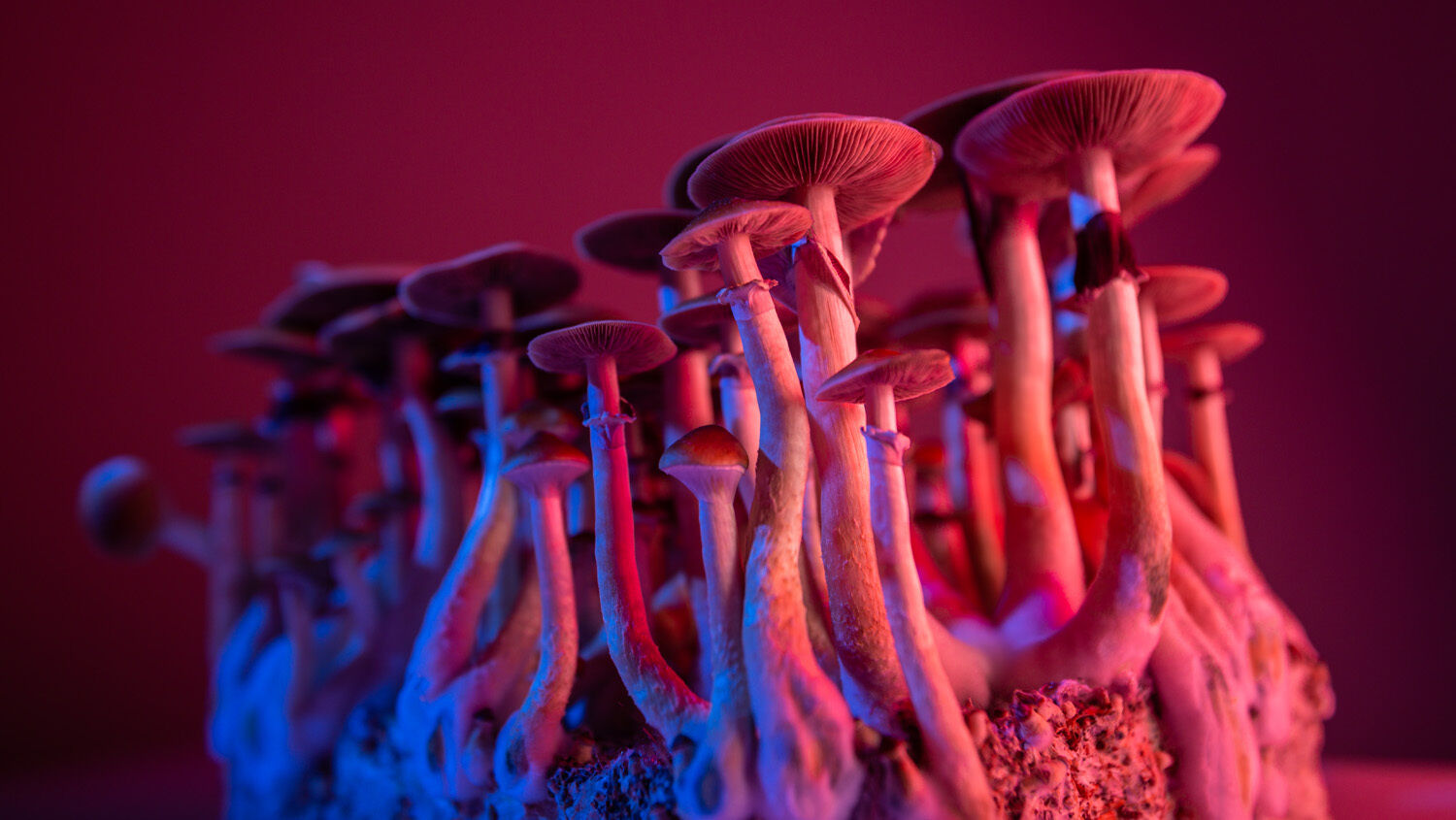
Also known as “shrooms,” magic mushrooms are defined as various species of fungi that provide a hallucinogenic effect when consumed. Most commonly it refers to fungi in the genus Psilocybe. These mushrooms produce the chemical psilocybin. When processed by the body, psilocybin creates hallucinogenic sensations. Medical professionals compare their effects to consuming lsd or peyote.
This may be an odd choice for a new public medicine. But multinational research sponsored by Compass Pathways, a British biotech company, claims psilocybin can make remarkable progress in treating major depressive disorders, including cases resistant to normal antidepressants. Other studies indicate psilocybin can also help with cluster headaches, anxiety, anorexia and even substance abuse. This has led the United States Food and Drug Administration to label psilocybin a “breakthrough medicine,” a classification meant to expedite review and potentially approval.
“I’m excited about the future of psychedelics because of the relatively good safety profile and because these agents can now be studied in rigorous double-blinded clinical trials,” Richard Isaacson, director of the Alzheimer’s Prevention Clinic at Florida Atlantic University’s Center for Brain Health, told cnn. “Then we can move from anecdotal reports of ‘I tripped on this and felt better’ to ‘Try this and you will be statistically, significantly better.’”
Psilocybin has a similar chemical structure to serotonin after processing in the body. Sometimes called a “happy hormone,” serotonin is one of the chemical signatures that regulate happy feelings. It also plays a role in functions like sleep and sexual arousal. There is a correlation between low serotonin levels and mental disorders like depression or anorexia.
Because of this, more and more jurisdictions have acquired shrooms. Oregon, Colorado and New Mexico have decriminalized medical psilocybin. Connecticut’s legislature is currently debating a similar measure. Voters in Washington, d.c., approved a 2020 measure that made the growth, distribution and acquisition of magic mushrooms the lowest priority for law enforcement. Sellers have taken advantage of this to create a booming industry. As Politico summarized, “In Washington, you can have mushrooms delivered to your door in less than an hour without worrying about running afoul of local cops.”
With decriminalization has come a large increase in usage. A May study by the Annals of Internal Medicine suggests use of psilocybin among U.S. adults in the past year increased from about 1 percent before 2019 to 2.1 percent by 2021. “That means more adults are now using psilocybin than cocaine, lsd, methamphetamine or illicit opioids, making it the second most-used drug behind cannabis,” wrote the Aspen Times, citing one of the study’s authors.
It isn’t only the U.S. experimenting. In 2022, Alberta, Canada, announced government standards for “psychedelic-assisted therapy.” Australia legalized the use of shrooms to treat depression in 2023. In the Netherlands, certain psilocybin fungi are perfectly legal for recreational purchase. The Czech Parliament is currently debating decriminalization for medical use.
These measures aren’t about prescribing small amounts with minimal change in mental functioning. Medical authorities expect hallucination as part of the therapy.
Bad Trip
Proponents would claim this is the exception rather than the norm. Psilocybin doesn’t have the same addictive properties as heroin or other drugs, and some research suggests a correlation between long-term hallucinogenic usage and a decrease in criminal behavior.
But that doesn’t mean it’s harmless. In case anybody needs elaboration what kind of hallucination shrooms can produce, here is an example recorded in a 2017 Vice article. A man traveling in Laos had a large sample of “mushroom pizza” at a local restaurant in a town famous as a drug center. This is what he felt in the aftermath:
We [went] back to this hut that we had rented and I spent the next six hours screaming. Nonstop screaming as loud as I could. I got locked in this weird psychological loop where I thought I was dead. I’d become convinced I was a dead body lying in a clearing in the forest and that these crickets I was hearing were surrounding my body. I was in the afterlife, and more than that I was in hell, and hell was an eternal loop where you’re forced to believe you’re alive just so you can go through the hell of realizing you’re dead again. I was so removed from reality at that point, I no longer knew I had done mushrooms. I had no idea I’d done drugs. It was so intense that there was no discernible difference for me between being awake and being asleep. … I was shaken for the rest of the trip and for six months after. I was having panic attacks and waking up in the night and leaving crowded places.
This may be an extreme example. But it is closer to the norm compared to tests cited by proponents, where controlled doses are administered in a lab-controlled environment. “[W]hile clinical trials were showing promising results,” the Guardian wrote last year, “emerging evidence suggests that people who take psilocybin outside these environments can experience harm, including anxiety, trauma, insomnia, continued visual distortion known as hallucinogen persisting perception disorder (hppd) and feelings of depersonalization.”
These side effects can linger far longer than most realize. Jules Evans of the Challenging Psychedelic Experience research project told the Guardian he has interviewed people “in terrible crises who say they had no awareness they could endure severe difficulties for days, weeks, months or years after.” Researcher Ed Prideaux told the Guardian that years after experiencing a heavy trip, “he still sees a ‘strange sparkle,’ melting wallpaper and other optical illusions. He said ‘basically everyone’ [among the habitual users he had contact with] in the psychedelic community has had at least one similar experience.”
This can have far more dangerous consequences than merely seeing “melting wallpaper” for years. Last October, Joseph Emerson was an off-duty pilot authorized to ride in the cockpit jump seat of a Horizon Air flight traveling from Everett, Washington, to San Francisco, California. He had taken shrooms two days before the flight, yet he was still so under the influence of the hallucinogenics that he tried to disable the plane’s engines at 30,000 feet through activating its fire-suppression system. Thankfully, nobody was hurt. He later said “nothing felt real” at the moment, thinking, “I know what those levers do in a real airplane, and I need to wake up from this.”
This is the substance lauded by health authorities for people with mental illness.
Seeing the Future
It wasn’t that long ago when marijuana was in the same category as shrooms. For most people, it was a harmful and rightly stigmatized substance. But some professionals touted its psychoactive properties as an untapped cure for mental and physical diseases. People saw laws throwing users in prison as unnecessarily harsh. It got decriminalized for personal use. Then it was legalized for medical purposes. Then it was fully legalized. Today, in too many parts of the world, it is the new normal—despite its harmful qualities.
How much longer will it take for shrooms to go the same route? When will society’s views change from magic mushrooms being a dangerous and illegal substance to something anybody should be able to buy for fun? How much longer before shroom shops pop up next to pot shops?
“We have developed a drug culture in America and Britain,” Trumpet editor in chief Gerald Flurry writes in No Freedom Without Law. “Drugs are increasingly mainstream and popular, moving well past the pockets within the big cities. They are taking over the lives of people of all income levels, all walks of life.”
“Many people would consider it freedom to destroy their lives with deadly drugs,” he continues. “That is not freedom! Instead they have become totally enslaved to drugs!” Mr. Flurry then cites 2 Peter 2:19 in the Revised Standard Version: “They promise them freedom, but they themselves are slaves of corruption; for whatever overcomes a man, to that he is enslaved.”
Galatians 5:19-21 lists “the works of the flesh,” or the fruits of a sinful lifestyle. In verse 20, listed among murder and heresy, is “witchcraft.” The original Greek word is pharmakeia. Thayer’s Greek Lexicon has the top two meanings of this word as “the use or the administering of drugs” or “poisoning.” The Amplified Bible, rendering the word as “sorcery,” states in the margin that it includes “such things as occult practices,” including “drug-induced trances.”
“We don’t talk much about the war on drugs today,” Mr. Flurry writes. “People don’t like to talk about losing a war. Many people began to see their own families and children caught up in drugs and felt they needed to tone down their approach. They didn’t want to be involved in a war so close to home.”
No Freedom Without Law was first published in 2001. The idea of legalizing recreational “soft drugs” like marijuana was still a foreign concept to many back then. Fast forward to 2025, and we’ve moved well beyond marijuana. Drugs that could “send people to hell” are now being embraced worldwide as a normal medical treatment for the mentally ill.
Today, society has moved past “toning down the approach.” It has even moved past embracing the problem. We now call it medicine rather than poison.
Root Cause
Giving people afflicted with depression drugs doesn’t solve their problems. It only provides a temporary escape, overloading the senses to the point where they cannot tell the difference between up and down. Does anybody expect lasting healing from mental illness by frying the mind?
Late theologian Herbert W. Armstrong was well-acquainted with many prominent businessmen of early 20th century America. He summarized in his booklet The Seven Laws of Success what the lives of his acquaintances were like:
Oh yes, of course there were pleasures, moments of excitement, periods of enjoyment. There were occasional thrills, temporary sensations of delight. But always they were followed by periods of depression. Always a gnawing inner soul-hunger returned. This in turn drove them to seek satisfaction in the thousand-and-one events in the world’s whirl of material pleasures and pastimes.
What Mr. Armstrong described is escapism. Drugs are the next level over from materialism. When every material thing hunted down cannot fill the “soul-hunger,” people in desperation resort to artificially stimulating their minds to feel “happy.”
Mr. Armstrong further explained that the fundamental cause for this “gnawing inner soul-hunger” is spiritual rather than material. But some material pursuits men try to fill their “void” with are far more destructive than others. Hallucinogens and other drugs are in that category. They fry the mind—the component of man that has everything to do with this spiritual void and how it could be filled. (Request a free copy of Mr. Armstrong’s book The Incredible Human Potential for more information.)
True satisfaction with life doesn’t come with increasing levels of mind-numbing escapism. It comes from understanding God’s purpose for human life and embracing that purpose. Serving people psychoactive drugs not only is a counterfeit; it turns people to the opposite direction.
“It is very difficult to keep God’s law,” Mr. Flurry writes. “But the problem isn’t with the law, it is with us. We need to change and conform ourselves to that law. We need to replace the wickedness of our hearts with the righteousness of God by writing God’s law in our hearts!”
Jesus Christ said it is the truth that sets us free (John 8:32). And He also said that God’s Word—His law as codified in the Holy Bible—is truth (John 17:17). True freedom does not come from accommodating sin. That only leads to greater slavery. True freedom means changing our nature so we keep the law—living, as Christ said, by every word of God (Luke 4:4). Christ said those words as He was overcoming the devil. And God wants everybody to overcome their personal demons—whether drug addiction or something else. That is why He gave His law—so we may be free.
Embracing drugs to forget one’s sorrows doesn’t provide real freedom. Even those who use it know deep down they’ll be returning to their problems as soon as the high is over. God promises freedom for those willing to embrace His way of life. But His way of life means resisting and overcoming sin—not giving into temptation. The choice is ours.
To learn more, request a free copy of No Freedom Without Law.


