

The Week in Review
Middle East
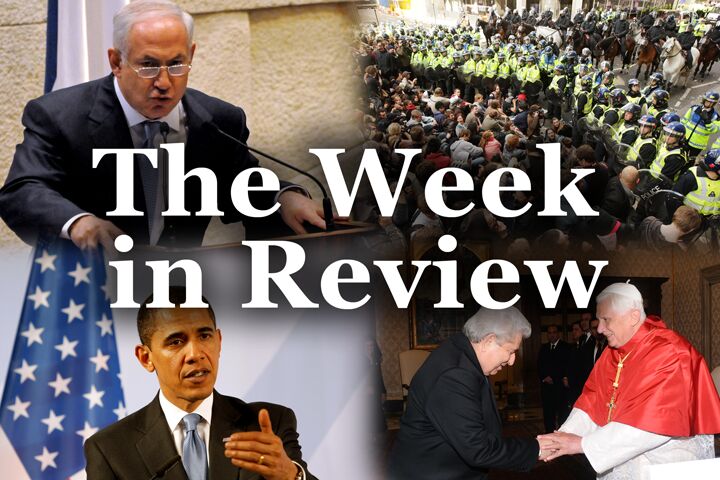
Benjamin Netanyahu was sworn in as Israel’s new prime minister on Tuesday after finally building a coalition, made up of right-wing and religious parties, along with the center-left Labor Party. The right-wing government opposes the division of Jerusalem, and Netanyahu has promised to confront extreme Islam and resist international pressure to give up territory. The new foreign minister, Avigdor Lieberman, has already stirred up controversy by saying Israel is not bound by the 2007 Annapolis agreement to start negotiations on establishing a Palestinian state. The stance of this government will no doubt deepen the fissure between Israel and America, and also hasten the fulfillment of end-time prophecies relating to Jerusalem. For more, read Stephen Flurry’s columns “The U.S.-Israeli Collision Course Is Near” (Dec. 26, 2008) and “The Battle for Jerusalem” (February 6).
United States President Barack Obama unveiled his new Afghanistan strategy on March 27, which calls for 4,000 extra troops in Afghanistan to train an Afghan military force, and $1.5 billion in aid per year over the next five years to assist Pakistan in fighting the Taliban. Both of these strategies are inherently flawed. Training an Afghan force provides the opportunity for hostile elements to infiltrate the force. As Stratfor points out, unless recruits are taken from those ethnic groups that foster the Taliban, the force will not be strong enough (March 30). Taliban sympathizers are sure to be recruited, making the force unreliable. As for the financial aid to Pakistan, while Islamabad will no doubt be happy to take it, Washington will be hard-pressed to see much return on its investment in a country where the military and security forces also largely sympathize with the Taliban.
Europe
Croatia and Albania officially became nato’s 27th and 28th members on April 1. nato has now entrenched itself in the Balkan Peninsula. Germany led nato to attack Yugoslavia back in 1999. Now it is cementing that conquest. For more information, read The Rising Beast—Germany’s Conquest of the Balkans.
Cypriot President Demetris Christofias met with Pope Benedict xvi on March 27. The two discussed Cypriot reunification. Cyprus is a strategically important location, and the European Union wants to control all of it. The division of Cyprus between the Turks and Greeks erupted in conflict in 1974, when Turkey invaded the northern part of the island. Watch for the pope and the EU to work to unify Cyprus and bring it under complete European control. For more information, read “Stepping Stone to Mideast.”
In Italy, a party founded by the political heirs of Benito Mussolini has merged with the conservative party of Prime Minister Silvio Berlusconi. On March 22, the post-fascist National Alliance officially fused with Berlusconi’s People of Freedom bloc. Despite claims to the contrary, this merger does not mean that fascist ideals have disappeared from the Italian political scene. Rather, this merger means pro-fascist politicians are now being accepted into mainstream Italian politics. The greatest danger to Europe is not the neo-Nazi thug who shouts and jeers at a soccer tournament. It is the well-dressed, right-wing extremist politician who sits in a position of power. The racist political activists of yesterday have become the respectable technocrats and politicians of today.
Asia
During remarks before the G-20 summit in London on Wednesday, Chinese President Hu Jintao vowed to ward off economic calamity by strengthening his country’s strategic alliance with Russia. “As the international financial crisis continues to spread, strengthening the Sino-Russian strategic partnership is of particular urgency and importance,” he said. In particular, the Chinese president called for an inter-governmental agreement on cooperation in the oil sector to be inked as soon as possible. Similar oil deals between Moscow and Beijing have already been signed. In February, officials from these two capitals signed an agreement wherein Russia would supply oil to energy-hungry China for the next 20 years. In exchange, China promised to lend Russia $25 million, which will help fund an extension of the new Siberian pipeline leading to the Chinese border. “What is happening right now with China is a logical development of reorientation of Russian politics and economy towards the East, which has been happening for the past five, six years,” said Evgeny Volk, who heads the Moscow office of the Heritage Foundation. This energy reorientation will undoubtedly cause Europe great concern, considering the fact that the Europeans currently buy most of their oil and natural gas from Russia. For information on how the Europeans will react to this concern, read “Russia Frightens Europe—and Fulfills Bible Prophecy.”
Africa, Latin America
On March 25, it was discovered that a U.S. federal law enforcement officer had been killed in Mexico for the first time in years. U.S. Marshals Service deputy Vincent Paul Bustamante’s body was “found in a canal with what appeared to be multiple gunshot wounds to the head,” Stratfor reported. The killing happened while Secretary of State Hilary Clinton was visiting Mexico, and increases the perception that the drug cartels can threaten even high-ranking U.S. officials, though the killing has not yet been linked to organized crime. The body was discovered March 25. On April 1, the United States agreed to pour an additional $550 million into border law enforcement.
Mexico itself has turned to the International Monetary Fund for help by opening a line of credit worth $47 billion. It is the largest country to do so. The peso has lost 45 percent of its value in just eight months; since half of Mexico’s imports come from the U.S., prices have gone up tremendously, and Mexico’s central bank has spent $21 billion trying to revive the currency. As the U.S. falls in both political and economic leadership, other countries are turning to globalization for help. The implications of a world united by globalism are profound and frightening. To understand why you should watch this trend, read “Taking Stock of Globalization.”
Anglo-America
Britain cannot sell its debt, the world learned on March 25. Over £100 million in long-dated gilts—the British equivalent of U.S. treasury bonds—failed to attract buyers as the government attempted to sell $1.75 billion of its debt. This is the first failed government bond auction since 2002, and comes right when British debt is climbing to unprecedented levels. British institutions have sold off a net £20.2 billion in government bonds, dumping £5.9 billion worth in the final quarter of last year alone. “Overseas demands for gilts may now be weakening,” Michael Saunders of Citigroup said, “and they were net sellers in January.”
Children in Britain are going to be seeing more abortion and pregnancy counseling ads on television if new rules proposed by advertising regulators are adopted. Sellers will also start advertising condoms before 9 p.m. as part of a shakeup of Britain’s rules on advertising. This amoral act will allow multimillion-dollar businesses to use slick advertising and access to younger minds to sell their lifestyles of promiscuity and abortion as lifestyles of choice.
More than 4,000 protesters clashed with police in London on Wednesday ahead of the G-20 summit there. More than 30 were arrested, and protesters vandalized the Bank of England and broke into the Royal Bank of Scotland. As financial problems and related conditions continue to grow worse, expect such bitter emotions and public disorder to grow more and more frequent and violent.


