

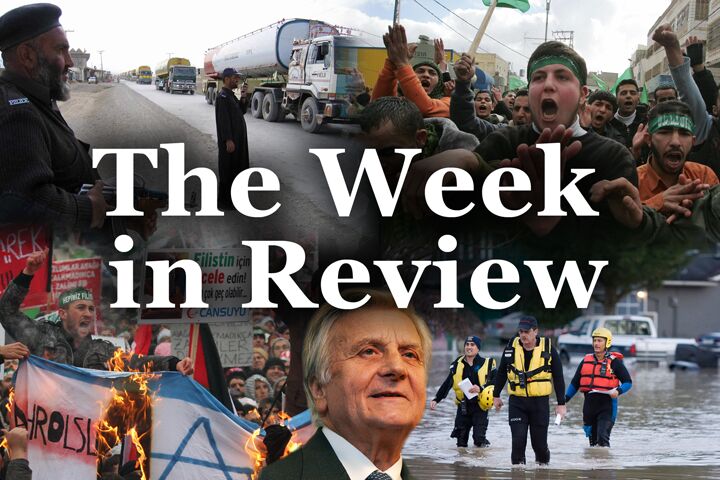
The Week in Review
Middle East
Israel continues its operation in Gaza even as it sent its lead negotiator to Egypt this week for talks on a ceasefire. While Palestinian rocket fire has decreased since the operation was launched three weeks ago, it is still continuing. About 25 rockets were fired at Israel on Thursday, wounding six people. Though Israeli forces advanced into Gaza City this week, Israel Defense Forces casualties have remained low—probably because so far the idf has avoided direct confrontation with Hamas.
While media reports put the Palestinian death toll at over 1,100, one must consider that all such figures come from “Gaza officials”—controlled by or party to Hamas. Based on past experience, Palestinian casualty statistics as reported by Hamas—or Fatah—absolutely cannot be trusted.
As world media fixates on Palestinian deaths blamed on Israel, little outrage is being expressed about the deaths of Palestinians at Hamas’s hands, including dozens murdered for suspected collaboration with Israel, and scores more who have been shot in the legs or had their hands broken. Neither is it commonly reported that Hamas is using Israel’s early warnings to Palestinian civilians to deliberately place civilians in the line of fire. A study by the Terror and Intelligence Information Center showed that when the idf drops flyers over Gaza population centers to warn of an impending attack, Hamas uses the warnings as “intelligence” to organize human shields. Hamas leaders themselves have boasted of using women and children in this manner to protect terrorists’ homes. Whether Israel goes ahead with the strike or not, Hamas wins: either tactically or in further demonizing Israel in the court of world opinion.
Also, Israel has allowed more than 1,000 truckloads of supplies into Gaza since the fighting started.
While many “moderate” Arab states are being restrained in their support of Hamas—or even passively supporting Israel—it is interesting to note which Muslim nations are coming out strongest in public support of Hamas: Iran (no surprise there), Turkey and Iraq. Turkey, ostensibly Israel’s strongest ally in the region, is showing its true colors—that it decidedly does not have Israel’s best interests at heart. The Turkish prime minister has placed total blame for the conflict on Israel, snubbed the Israeli prime minister and repeatedly and publicly made scathingly condemning statements against Israel, calling Israel’s actions a “crime against humanity.” Large, angry protests have filled the streets of cities across the country, including a rally last Sunday of 200,000 in Istanbul square. Iraq—at one time intended by the U.S. to be a base for pressuring Iran—is showing the extent to which its policies and international relations are being influenced, if not dictated, by Tehran. On January 7, Iraqi Prime Minister Nouri al-Maliki publicly called on Arab states to cut ties with Israel over the Gaza conflict. He called the Israeli counteroffensive in Gaza “a dreadful crime” and said that “we ask Arab countries and all Muslims to cancel their diplomatic relations and stop all contacts—private and public—with this murderous regime, which continues its painful aggression against peaceful, unarmed civilians.” Two days later, tens of thousands of Iraqis protested against Israel, and Shiite cleric Moqtada al-Sadr called for revenge attacks on the United States for being an ally of Israel.
Support for Hamas is also growing among Palestinians in the Fatah-controlled West Bank. Fatah-backed security forces have used tear gas to break up large pro-Hamas rallies in both Hebron and Ramallah, which has served to intensify resentment against Fatah. Through its assault on Gaza, Israel is in fact, unwittingly, securing Hamas’s future takeover of the West Bank. Simply by resisting Israel and surviving, Hamas’s popularity is now sky-high. Despite what might be considered a tactical loss, Hamas has gained an enormous strategic victory.
To Israel’s north, at least three Katyusha artillery rockets were fired from Lebanon into northern Israel on January 14—the second round since the Gaza hostilities began. Stratfor reports that it appears the rocket attacks are being carried out by Palestinian terrorists operating from refugee camps in southern Lebanon in an attempt to draw Israel into a two-front war.
In other news, U.S. Central Command chief Gen. David Petraeus traveled to Central Asia this week for talks with regional leaders on matters relating to the war in Afghanistan. Afghanistan—and by extension, Pakistan—is becoming a greater and greater problem for the U.S. Stratfor reports that U.S. military leaders are currently working on devising a new strategy to fight the war in Afghanistan, “where an insurgency led by Taliban and al Qaeda forces is intensifying and spreading deeper into neighboring Pakistan” (January 14). As part of this revised campaign, the U.S. is looking to establish alternative supply routes to decrease its reliance on Pakistan. The problem is, any alternative supply routes require the cooperation of Russia.
Europe
The news from Europe this week highlights the Continent’s economic woes. The European Central Bank lowered the eurozone interest rate to 2 percent, its lowest level ever, on Thursday. The cut is designed to stimulate Europe’s economies in the face of “worse than expected” economic indicators, according to senior economist at ing Peter Vanden Houte. All over the Continent, economies are hurting. Rating’s agency S&P has downgraded Greece’s credit rating from an A to an A-. The agency has warned Spain, Portugal and Ireland that it may lower their credit ratings also. Germany is also in trouble. Its export-led economy is suffering, and inflation reached 2.6 percent last year, the highest in 14 years. To help combat the situation, Germany passed a €50 billion stimulus package.
The European Central Bank (ecb) wants supervisory powers over international banks. Last week, ecb President Jean-Claude Trichet said the bank is considering taking on a bigger regulatory role. Only a couple weeks ago, Trumpet editor in chief Gerald Flurry wrote “Did the Holy Roman Empire Plan the Greek Crisis?”, about how the ecb and Germany would use this financial crisis to gain more power. This is beginning to happen.
The European Parliament is promoting abortion and giving same-sex couples more rights in a resolution it passed Wednesday. The resolution calls for European national governments to ensure women have the “right to reproductive and sexual health.” According to the Daily Mail, “Opponents claim the wording is a euphemism which is often used to include abortion on demand.” The resolution also calls for member states that allow same-sex unions to recognize similar unions made in other EU nations. This resolution will anger the Vatican. Not only is the legislation pro-abortion and pro-homosexual, it also calls for better access to contraception, which the Catholic Church opposes.
Asia
As Ukraine endured it 13th day without gas supplies on Tuesday, opposition parties began calling for impeachment proceedings against President Viktor Yushchenko. This is exactly the reaction Russian Prime Minister Vladimir Putin wanted when he ordered that all Russian gas taps to Ukraine be turned off. Many in Ukraine are blaming their pro-Western leaders for antagonizing Russia. They are increasingly looking to pro-Russian politicians like Viktor Yanukovich for solutions. Russia may turn out to be successful in using this gas crisis to pull Ukraine away from Europe and into the Russian sphere of influence. To learn more about the impact such gas cuts have on both Russia and Europe, read our July 2007 Trumpet article, “Russia: Triggering Europe to Unite.”
Relations between India and Pakistan are still deteriorating as a result of the devastating Islamist terrorist attack in Mumbai nearly two months ago. On Wednesday, the Indian Congress threatened to cut ties with Pakistan if it does not increase its investigative cooperation regarding the Mumbai attacks. Indian Army chief Gen. Deepak Kapoor went so far as to threaten military invasion if diplomatic and economic initiatives failed to produce action against those responsible for the attacks. This rising antagonism could well push Pakistan further into the arms of the Iranian mullahs, and India further into the arms of its East Asian allies. For more information on the roles both India and Pakistan will play on the world scene in the near future, read our March 7, 2006, article “India on the Rise” and our January 2008 Trumpet article “Pakistan and the Shah of Iran.”
Latin America/Africa
Last week, Venezuelan President Hugo Chavez expelled the Israeli ambassador from his country. This week, both he and Bolivian President Evo Morales broke diplomatic ties with Israel altogether as a protest against its military action in Gaza. Both Bolivia and Venezuela are developing relationships with Iran. In addition, according to the Associated Press, President Chavez is not convinced his country’s relations with the U.S. will improve when President-elect Barack Obama takes office. If Obama disrespects Venezuela, Chavez warned, Caracas will “continue our fight against imperialism.” He also claimed that the U.S. is plotting against him from Puerto Rico—saying, “One day, Puerto Rico needs to be liberated”—and threatened to expel a U.S. Embassy official—if he could find one: Chavez already expelled the U.S. ambassador to Venezuela in September. Anyone who thinks the anti-U.S. climate in Latin America is simply opposition to President Bush had better think again. For more on the anti-U.S. sentiment in Latin America, read “The Hidden Enemy in America’s Backyard” from the September 2008 Trumpet.
The director of the Zimbabwe Peace Project (zpp), who was seized from her home in front of family members six weeks ago for purportedly recruiting volunteers to topple President Mugabe’s government, detailed the abuses she suffered while in custody to a magistrate court on January 15: “I was abducted, kidnapped, tortured, assaulted,” she said while asking the judge for permission to see her doctor. “I work for a non-profit organization, and I am not involved in any political activity,” she said. “I repeatedly told the interrogators that I’m not a member of the mdc. I’m a human rights activist, currently employed by zpp. The objectives of zpp do not talk about toppling the government.” According to Human Rights Watch, 32 activists have been abducted under similar circumstances since October. Though meetings continue, no progress has been made in resolving Zimbabwe’s political disaster, and the power-sharing deal Mugabe made with the Movement for Democratic Change has not been implemented. The downward spiral continues.
Anglo-America
The Capitol is currently preparing for a momentous event: the 56th Inaugural. The incoming administration has been busily planning and coordinating every detail of the event, selecting from throngs of eager politicians, speakers, poets, entertainers, musicians and other individuals to compose the ceremonies. The president-elect’s choice for the religious figure to deliver the prayer during the opening day of his inauguration festivities? An openly practicing homosexual bishop. The Boston Herald reported on Tuesday that Barack Obama had chosen Gene Robinson to deliver the prayer, an attempt to soothe angry homosexuals offended by his pick of evangelist Rick Warren to deliver the invocation during the actual inaugural ceremony. The Inaugural Committee says that the intent is to celebrate America’s “diversity of faith.”
On Thursday, House Democrats broke out an economic recovery package of spending and tax cuts. The price tag is $825 billion, but may grow significantly larger by the time it is passed. The package centers on drastic increases in federal spending on education, Medicaid, public works and temporary increases in unemployment benefits meant to nip the Great Recession in the bud. Legislators are pushing to make the bill law by mid-February.
America continues to suffer a range of weather disasters. The Pacific Northwest is experiencing some of the worst flooding on record due to a snow thaw and a torrential 6 inches of heavy rain. Western North Carolina, meanwhile, is suffering its worst drought in over a century, even as its population grows dramatically. Blizzards hit North Dakota and New England this week, and wildfires broke out in Colorado.
Britain is currently grappling with the European Central Bank’s announcement last week that Britain couldn’t join the euro even if it wanted to. Britain was deemed unworthy of the euro because its public deficit is climbing at an unacceptable rate and the sterling’s exchange rate “is not yet sufficiently stable,” said Lorenzo Bini Smaghi, the ecb’s board member in charge of international affairs. Some experts predict the public deficit will hit 10 percent of gross domestic product in 2009. Fitch ratings agency predicts that the UK’s debt will jump from 44 percent of gdp in 2007 to 68 percent by late 2010. Writing for the Telegraph, Ambrose Evans-Prichard said, “It usually takes a war to do such damage.”


