

Germany Gambles on a Different Path for AI
The United States and China are heavily investing in artificial intelligence infrastructure and research—with much to show for it. Germany so far is implementing a different strategy, however, one which avoids “the trillion-dollar investment gamble by the world’s two largest economies” (Deutsche Welle).
Not investing billions in AI could also be a gamble. A nation that doesn’t might lose out and leave its economy at the mercy of foreigners.
The U.S. has dominated the global order for 80 years. But tech like AI “could present an existential threat to nation-states—risks so profound they might disrupt or even overturn the current geopolitical order,” writes Mustafa Suleyman in his book The Coming Wave.
Europe and Germany look like they’re being left in the dust, unable to compete with China, let alone the U.S. But could they simply be trying a completely different AI strategy?
A Big Gamble?
Artificial intelligence is more than dancing robots. It could soon determine a nation’s prosperity and military power. These advances “open pathways to immense AI-empowered cyberattacks, automated wars that could devastate countries, engineered pandemics, and a world subject to unexplainable and yet seemingly omnipotent forces” (ibid).
Three years after Suleyman released his book, Anthropic has built an AI model called Mythos that can launch “immense AI-empowered cyberattacks.” Apparently, it was so powerful that Anthropic decided to set aside its quest for profits and keep the model contained.
But what if others develop similar capabilities? That’s one reason the U.S. is investing more money than any other nation. It’s also one reason it blocked Anthropic from deploying Mythos and its slightly tamer version, Fable.
Could China produce similarly dangerous models? Last year, the Chinese AI app DeepSeek went viral for reportedly building competitive AI models at much lower cost and energy consumption than major U.S. firms. Even though China has less money to spend, its companies have fewer moral concerns and fewer regulations. What’s more, its vast domestic and foreign surveillance apparatus provides it with vast amounts of data to draw from, and they’re unafraid to copy foreign rivals.
But China’s strength is also its weakness. Many inside and outside of China don’t trust the Chinese government with their data and business if they can find alternatives.
Despite that, China has done a remarkable job keeping pace with the U.S. America is vastly outspending China—but they’re not leaving the Chinese in the dust. America has a lead, but does it justify its huge spending?
American investors and companies are throwing billions at anything related to AI, which begs the question: Is it all just a bubble? There are legitimate concerns, as Trumpet writer Robert Morley wrote in “America’s Artificial Economy.” The crux of the issue is, will America’s gamble pay off?
Motley Fool warned on March 8, “High debt levels in AI infrastructure build-outs and stretched market valuations near historic peaks are risk factors that investors can’t ignore.”
If the AI gamble fails, the U.S. stock market will suffer a painful loss, and the U.S. could lose its AI edge.
Will Europe Lose Out?
While America and China have been competing, Europe seems to have fallen behind.
“The European Union is losing the global ‘AI race’ on nearly every key metric except regulation,” EuroNews wrote on January 27. “While China and the United States invest billions in infrastructure, talent, start-ups, labs and research, Europe remains focused on rules. Policy burdens and fragmentation across 27 member states create major hurdles: Progress is inconsistent, talent leaves, and capital goes elsewhere.”
The EU’s InvestAI initiative aims to construct up to five AI gigafactories, each expected to produce more than 100,000 advanced AI chips. It is steadily increasing its investment, but on a much smaller scale than the U.S. But some are optimistic.
Germany’s Deutsche Telekom is pioneering compact data centers, aimed at industry and factories, not consumers. This “aligns directly with Germany’s broader industrial AI ambitions, tailoring AI to the country’s niche—manufacturing—rather than consumer-facing, where the United States and China have the clear lead,” wrote Deutsche Welle.
Germany is targeting the manufacturing sector to gain an advantage over the U.S. and China—and with some success.
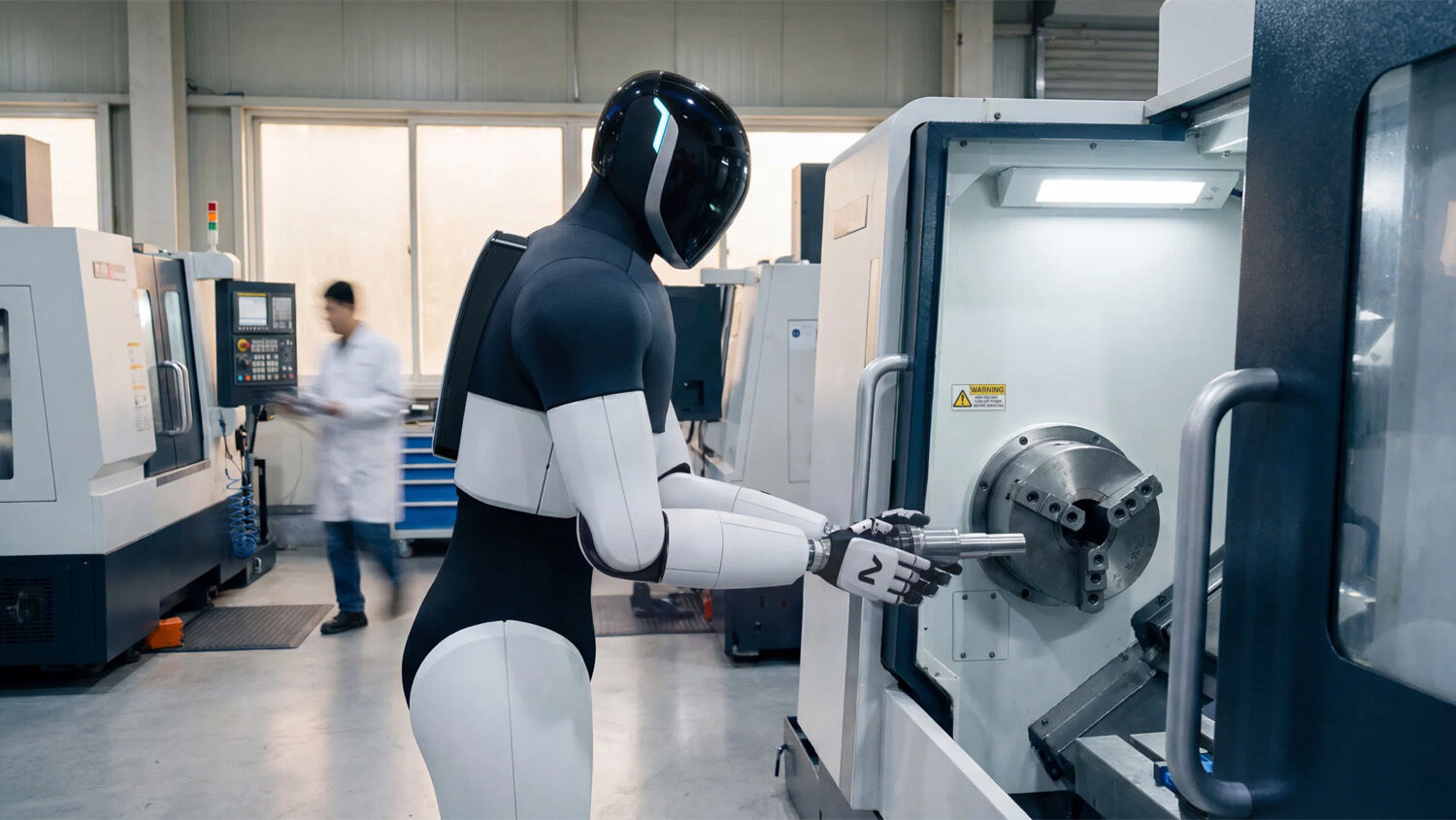
Earlier this month, Neura Robotics, a German firm, raised $1.4 billion from investors including Amazon, Bosch and nvidia. The company already has an order backlog of $1 billion for its AI-powered humanoid robots designed to perform tasks currently done by humans and intends to scale production to millions of units by 2030.
This is exactly what former German Economics Minister Karl-Theodor zu Guttenberg (a man the Trumpet watches closely) said Germany must do. In a television interview with Puls 4-Talk on July 28, 2019, he said:
Artificial intelligence is still something Europe could shape. We have a well-established industry, which still has to become far more connected to the new technologies. But once this happens, it will develop a totally different field of power than a purely technological or digitalization firm.
Seven years later, Guttenberg is frustrated but remains optimistic. In his June 11 newsletter, he wrote:
[T]he picture is more nuanced than the collective frustration would suggest. Anyone who looks not just at headlines but at data, investment flows and institutional decisions will see a continent that is more technologically advanced than it realizes.
He gave a few examples, citing recent reports:
- Europe has more than 40,000 funded tech companies, around 4,000 firms with annual revenue exceeding $25 million, and more than 1,200 companies with $100 million in revenue or a valuation in the billions.
- There are 413 European tech companies valued at over $1 billion, 4.6 million people employed in the tech sector, an ecosystem value of $3.8 trillion, and more than 27,000 founders starting new ventures in Europe in 2025 alone.
These figures are all much smaller than in the U.S., but it shows that Europe is not stagnant. Germany especially has enormous growth potential:
- Nearly 50 German start-ups have eclipsed $1 billion in valuation since 2014.
- It is the fourth-most-funded tech nation in the world, raising $8.5 billion over the past 12 months and recording 315 percent growth in the defense tech sector.
“Germany is thus not only Europe’s largest industrial hub but is also increasingly becoming a major tech and deep-tech hub,” he wrote. He admits that Europe has “real weaknesses,” such as “capital depth, scale and the pace of deregulation.” He wrote:
But it has long had real strengths as well: a broad research base, industrial depth, a growing start-up scene, deep-tech expertise and—surprise!—in some areas, even a newfound strategic self-confidence. … [E]ven skeptics should acknowledge this: the political effort to turn the German state back into an enabler seems realistic.
Will Germany’s strategy help it avoid the AI gamble and come out on top? Bible prophecy suggests it will.
Will Germany Surprise the World?
In 2024, Trumpet editor in chief Gerald Flurry warned in “The Unknown Future of Artificial Intelligence”:
America will be blindsided by German military technology. The Germans are moving fast, and in some ways they are already ahead of America. What we see in the news is only a fraction of what is going on behind the scenes, I am sure. Winston Churchill warned, “Beware! Germany is a country fertile in military surprises.” The Bible warns that the biggest surprises are yet ahead!
As Mr. Flurry explained, a German leader will arise and use Europe’s untapped potential. Daniel 8:23 reads: “And in the latter time of their kingdom, when the transgressors are come to the full, a king of fierce countenance, and understanding dark sentences, shall stand up.”
Mr. Flurry explained: “The expression ‘dark sentences’ comes from the word haidah, which means riddle, difficult, question, parable (Theological Wordbook of the Old Testament). I believe this expression could also mean difficult technology. Gesenius’ Hebrew-Chaldee Lexicon defines ‘dark sentences’ as ‘twisted, involved, subtlety, … fraud, … enigma.’ To many today, AI is such an enigma.”
If Germany can harness the dark powers of AI, it could give it the critical edge in an economic war against the U.S., followed by a military war.
Notice that this leader will arise “when the transgressors are come to the full.” This is the real reason Germany is prophesied to take the lead. God is angry with America’s sins! No technological edge will save it from God’s wrath. He raised nations to punish ancient Israel, and He will do the same to America today.


