Iran: Is This the Real Deal?
Iran: Is This the Real Deal?
Good morning!
Yesterday morning, President Trump promised to hit Iran “very hard tonight.” By last night, he had canceled the strikes and announced a deal would be signed as soon as this weekend.

- This is at least the eighth time since the conflict began on February 28 that Trump has publicly set a deadline for military action against Iran and then abandoned it. Eight times in 15 weeks. Every second week.
Iran is proving itself highly skilled at stringing the Trump team along.
- It knows the president yearns for a splashy deal and is masterfully playing this against him. It pushes and provokes as far as it can, then feints at concessions just in time to keep talks going.
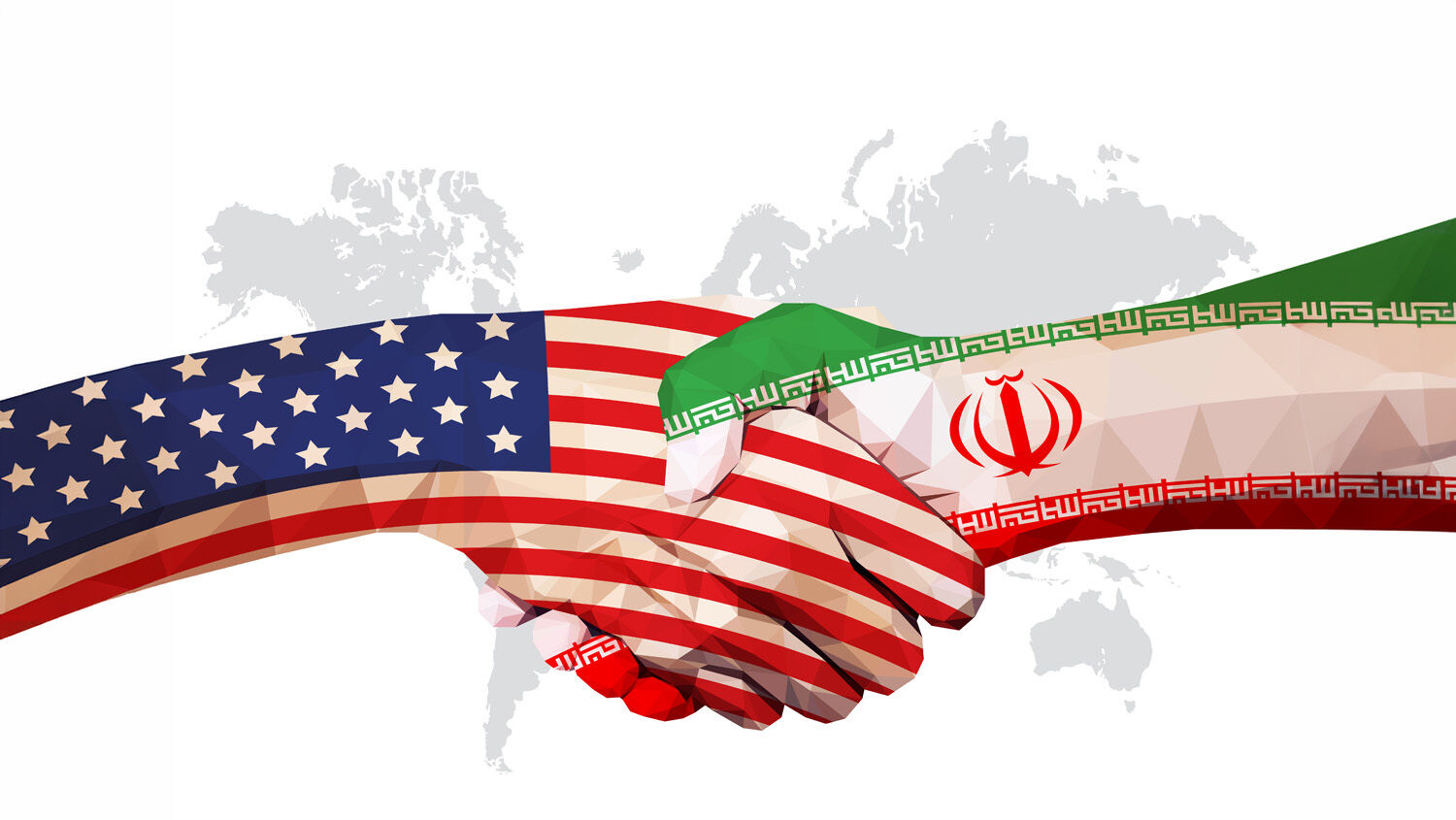
This is the game Iran has played for decades. It led to Barack Obama’s disastrous Iran nuclear deal. Now, remarkably, it is drawing President Trump, who canceled the Obama agreement, into making an eerily similar deal.
Under the current proposal, both sides reopen the Strait of Hormuz, the U.S. lifts sanctions and releases billions in frozen Iranian funds, Iran commits to a moratorium on enrichment, and a 60-day ceasefire buys time for further talks. Israel is not a party to the agreement.
- It’s Obama’s nuclear deal reborn: promises now, cash up front, concessions later.
- The Telegraph: “At best, it seems, Iran has agreed to talk about another Obama-style moratorium on enrichment and committed again not to developing nuclear weapons …. In return, Mr. Trump will gradually lift sanctions, as Mr. Obama did, and return the regime’s $24 billion in frozen assets. In short, it is a geopolitical Groundhog Day.”
We should not be surprised. As Melanie Phillips wrote in her column this morning, the Iranian official who negotiated the Obama deal literally wrote the book on this. Phillips wrote:
In his 2025 book, The Power of Negotiation, Iran’s foreign minister, Abbas Araghchi, advocated endlessly repeating Iran’s demands until its opponent “gets numb” and surrenders on the grounds that “he who gets tired and bored quickly will lose.”
- Delay is not failure; it’s the strategy. America threatens, Iran haggles, America relents, Iran wins time—and time is all a nuclear program needs.
Yesterday morning, in a Fox interview where he was pledging “bigger” and “more powerful” strikes, President Trump made a telling statement: that he has always wanted to take Kharg Island, Iran’s main center of oil exportation, but added:
I don’t know that America has the stomach for it, to be honest with you. You’d make a fortune, but I don’t know that America has the stomach. I think they’d like to see us come home.
He is right. After decades of costly, inconclusive military adventurism, Americans are war-weary.
- And Trump’s itch to deploy military power merely as a negotiation tactic isn’t yielding results that will change anyone’s mind. His whipsawing between strikes and signing ceremonies is making it worse.
- America is proving Araghchi right: He who gets tired and bored quickly will lose.
Watching this spectacle unfold, I keep coming back to the curses spelled out in Leviticus 26:19-20: America’s pride in its power is broken, and it is spending its strength in vain.
And Iran’s radical regime lives another day to fulfill its role as the prophesied “king of the south.”
Why Elon Musk Is the World’s First Trillionaire
Elon Musk’s net wealth now utterly dwarfs anyone who came before him. Bill Gates? Jeff Bezos? Paupers.
Musk’s net worth skyrocketed to over $1 trillion thanks to SpaceX’s ipo yesterday. This made shares available to the general public, and investors snapped them up, raising $75 billion for the company.
- The SpaceX ipo more than doubled the previous record, set by energy giant Saudi Aramco in 2019, which raised “only” about $30 billion.
- Priced at $135 per share, SpaceX is currently valued at $1.8 trillion.
- Musk’s SpaceX stock is worth $866 billion. Add in his Tesla stock and other assets, and his personal net worth is now $1.1 trillion.
Is SpaceX really worth that much? Plenty of companies have started with great public enthusiasm and huge valuations, only to crash down to Earth later.
- SpaceX is losing a lot of money—almost $5 billion in 2025, and $4.3 billion in the first quarter of 2026. Most of those losses come from its xAI artificial intelligence business, which merged into SpaceX last year.
- Starlink is profitable, generating $4.4 billion in profit in 2025. But the satellite Internet business is worth a small fraction of that $1.8 trillion valuation.
Investors often judge business value by looking at its price-to-sales ratio. Amazon’s current valuation, for example, is about 3.5 times the company’s annual sales. Microsoft’s ratio is around 9.3.
- SpaceX’s value is nearly 100 times its sales—ludicrously high.
But can you put a price on space? SpaceX conducted 165 Falcon 9 rocket launches and around half of all U.S. national security launches last year. No other private company is better positioned to dominate space. Its gigantic Starship model, advancing rapidly through its development phase, is the largest and most powerful rocket ever made, by mass, thrust and payload.
- Last year, in a conservative estimate, scientists said the moon had $1 trillion in precious metals.
- nasa estimated that one asteroid—16 Psyche—contains $10 quintillion of metals at current market values. That’s 10 million trillion, or the equivalent of the entire economic output of the world for about 100,000 years.
- Much further afield are even more ridiculous numbers. The planet 55 Cancri e is believed to be composed of about one third diamond. Priced the same way rough diamonds are today on Earth, it contains $26.9 nonillion in wealth: $26,900,000,000,000,000,000,000,000,000,000.
This is clearly silly: SpaceX will not be mining diamonds from 55 Cancri e in the near future. But its giant ipo reflects both public excitement about science, technology and space and more serious considerations of how mankind could eventually tap just some of the wealth out there.
“Lift up your eyes,” declares the cover of our May-June Trumpet magazine. Gerald Flurry wrote about “God’s Space Program”:
What nasa and other space projects are doing is exciting. They lift our eyes upward and stir our hearts. But God wants us to have an even more inspiring vision: His space program!
God says in Isaiah 45:18 that He created Earth and the heavens “to be inhabited.” He created nothing in vain. He is preparing man to work with the wealth and resources on Earth first, and then to go out into the universe. All that wealth out there will not sit useless forever: He will use it.
Sinn Féin Exposes Its Immigration Hypocrisy
Protesters filled the streets in Northern Ireland this week, rioters torched wheelie bins, cars, buses and homes, and many demanded an end to mass immigration. The far-left, Catholic-aligned Sinn Féin party spoke out on the matter—and voters reacted.
One fifth of Irish voters support Sinn Féin, the most recent Ireland Thinks poll on June 4–5 for the Sunday Independent found. That’s slightly more than Fine Gael and Fianna Fáil. And that was before the dramatic events of this week.
- Sinn Féin is associated with the Irish Republican Army, a paramilitary-terrorist group active from 1969 to 2005.
- Its popularity hit 37 percent in 2022, but discontent over its approach to mass immigration has eroded its support.
Sudanese national Hadi Alodid attempted to behead Stephen Ogilvie on June 8 in a Belfast street, and residents reacted with three days of protests and rioting.
- Many Ulster Loyalist politicians reacted by condemning mass immigration, which was facilitated by the nation they are loyal to: the United Kingdom.
Yet Mary Lou McDonald, leader of Sinn Féin—which advocates separation from the UK—conspicuously refused to do so and instead condemned the reaction.
- She characterized it as “racist intimidation and violence” and alleged that it was “orchestrated by loyalists and far-right thugs.” She was trying to distance her party from the rioting, but her attempts to label people who are concerned about immigration and terrorist beheadings as “far-right thugs” may backfire.
“Nationalists did not join in the rioting that erupted in loyalist areas of Belfast on Tuesday night, but it would be naive to pretend that they do not share many of the same concerns. After a hundred years of banging the drum for tribal exceptionalism, Sinn Féin’s response to the rise in immigration has been to enthusiastically embrace the vision of a multiethnic, multicultural Ireland. Some wags have joked that Sinn Féin’s new policy is: ‘Brits Out, everyone else in.’”
—Eilis O’Hanlon, Telegraph, June 11
Sinn Féin was founded in 1905 to establish “a national legislature endowed with the moral authority of the Irish nation.” It was hijacked by radical Marxists in the 1960s.
Today, Sinn Féin wants Northern Ireland to secede from the United Kingdom and form a socialist republic with the Republic of Ireland. Toward this end, it hypocritically supports rioting against the so-called British occupation of Northern Ireland while condemning protests against mass immigration.
- This discrepancy has alerted many Irish to the fact that Sinn Féin cares even more about Marxism than about the Irish heritage it claims to champion.
- UnHerd columnist Aris Roussinos and others are predicting that Catholics and Protestants could unite against the type of mass immigration that Ireland’s Marxists are pushing for.
To the south, the Catholic-dominated Republic of Ireland rebelled against Britain in World War I, declined to join the Allies in World War II, and is now a willing member of the European Union.
- Bible prophecy indicates that in the near future, the Irish, who descended from the Israelite tribe of Dan, will actually help a new Catholic European superpower invade Britain, which descended from the ancient Israelite tribe of Ephraim.
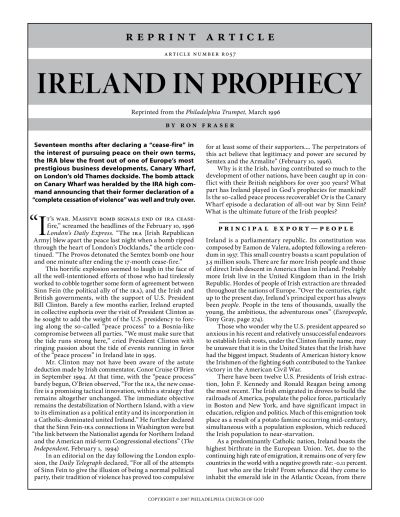
In the May 1996 Trumpet, late Trumpet writer Ron Fraser pointed to prophecies in Genesis 49:17 and Jeremiah 8:16-17 as evidence that Ireland may support the EU military. Read “Ireland in Prophecy” to learn more. The current unrest in Ireland could end up turning the nation even further against the United Kingdom.
IN OTHER NEWS
U.S. plans withdrawal of warships, aircraft from Europe: Two senior European officials confirmed that the U.S. is planning to withdraw military assets from its European allies, the New York Times reported today. The German media had previously reported similar details. According to the Times, the number of F-16 and F-15E fighter jets will be reduced from about 150 to 100, maritime reconnaissance aircraft from 26 to 15, and aerial refueling tanker jets from 8 to 0. These reductions, along with U.S. troop withdrawals and relocations, leave Europe in a difficult strategic position. “nato’s main problem is that, as long as Trump is president, there is no longer any faith that the U.S. would come to the Europeans’ aid in an emergency,” said Anton Hofreiter, a German lawmaker from the Green Party. Watch for Germany to use this growing distrust in the U.S. to its advantage and center Europe’s military strategy around its own.
Germany is a top refugee destination: Germany is the second-largest host country for refugees, after Colombia, according to a United Nations Refugee Agency “World Refugee Report” released yesterday. A total of 2.7 million refugees resided in Germany as of last year, 2.1 million of whom were Ukrainian, Syrian and Afghan. An additional 400,000 refugees have become citizens since 2016. The influx of refugees, beginning in 2015, has pushed Germany toward radicalization and a stronger, urgent craving for decisive Germany-first leadership.
Poll: Majority don’t want Netanyahu to run for reelection: Sixty-one percent of Israelis ages 18 and above do not want Israeli Prime Minister Benjamin Netanyahu to run as a candidate, compared to 35 percent who do, a May 31–June 5 poll by the center-left Israel Democracy Institute shows. Fifty-seven percent of Jewish-Israeli respondents and 83 percent of Arab-Israeli respondents said Netanyahu shouldn’t run. Prime Minister Netanyahu is running regardless. The poll surveyed only 753 people, below the usual benchmark of 1,000 that many analysts consider representative, but it indicates that the prime minister faces an uphill battle to remain Israel’s leader.