

Russia Is Redirecting the War Into Europe—One Drone at a Time
“War is closer than ever,” Lithuanian Prime Minister Inga Ruginiene said after being forced to shelter in an underground bunker in her nation’s capital last month.
She and thousands of other Lithuanians moved to protected locations on May 20 after unauthorized attack drones entered their airspace, setting off air raid sirens and prompting authorities to scramble nato jets and issue evacuation warnings.
But it turned out that the drones weren’t flying in from an enemy nation. They were Ukrainian units that Russian operatives had hijacked midflight. This was the latest in a string of Russia hijacking Ukrainian drones and redirecting them toward Ukraine’s nato partners.
“… Russia has found a way to commandeer them,” the Telegraph wrote, “and use them for its own war goals—not by shooting them down, but by making them believe a lie.”
The Russians accomplish this high-tech deceit through a combination of jamming and spoofing.
Jamming involves sending out a powerful electronic noise that overwhelms a drone’s gps receiver and effectively blinds and deafens it. Once confused, the drone enters a search mode, seeking new guidance signals. Russian systems then “spoof” the drone by feeding it false positioning data. The data they use makes a drone in Ukrainian skies interpret its position as being deep inside Russian-held territory. The drone then attempts to correct its course by turning west and north—back toward the area where it thinks the line of contact lies. But since it was actually already far west of Russian-held territory, the false data prompts it to fly out of Ukraine altogether and deep into nato skies.
“Everyone is listening to the signals from the satellites out in space, the global navigation satellites, and unfortunately, we, the public, all use unencrypted open signals,” Ramsey Faragher, head of the Royal Institute of Navigation, told the Telegraph. “That means it’s very easy to decode them and use them, but it’s also very easy to write software that can broadcast perfectly good-looking fake versions of those signals.”
Since March, Russia has used this tactic to violate the territory of Estonia, where one drone crashed and nato jets were scrambled to destroy another, and Latvia, where a drone damaged an oil facility. Lithuania is the latest addition to that list.
This development is significant because it threatens to dull a key battlefield edge that Ukraine has enjoyed for months.
The Buzz of Modern Warfare
In the early months of Russia’s full-scale war on Ukraine, the battlefield looked far more conventional. Tanks, armored columns, mechanized infantry and artillery duels were the main drivers of the conflict, with fighter jets and bombers also playing a significant role.
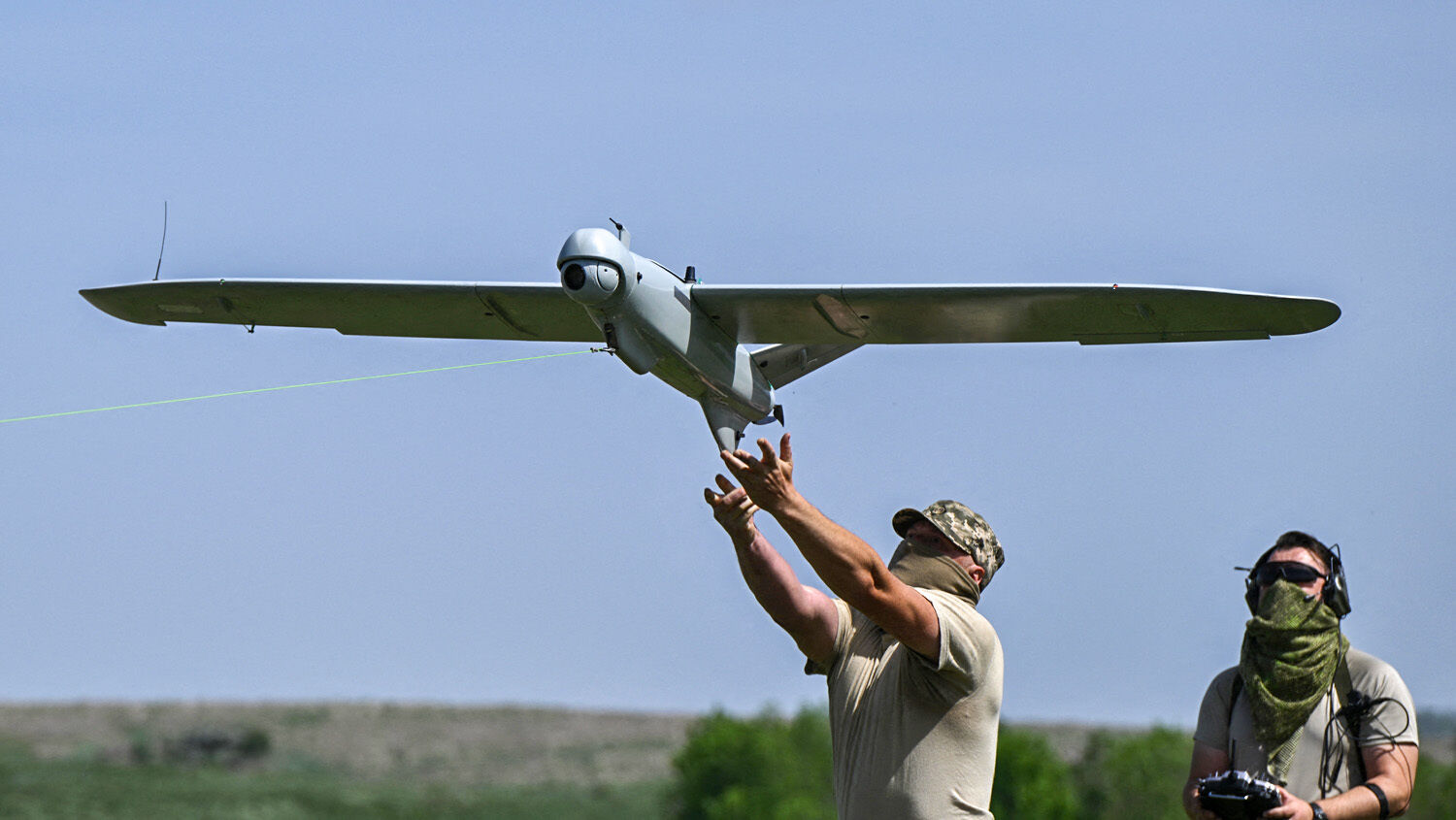
But over the last two years, the war has undergone a dramatic transformation. Today small, inexpensive drones dominate reconnaissance, target acquisition and even direct strikes.
Where Ukraine once had to send men into the fury of Russian fire, its operators can now strike from afar. A lone operator miles from the front can fly a machine beneath the radar and deliver a payload with deadly precision. An enemy position that once required a costly assault can be destroyed without a single Ukrainian soldier setting foot near it.
Drones have altered the very geometry of combat. This technological shift has allowed Ukraine to punch far above its weight against a larger and more powerful adversary for many months. Analyses show that by the end of 2025, around 70 percent of Russian losses in key areas were caused by drones.
But the new Russian tactic shows that Ukraine is not the only side adapting and innovating.
By hijacking drones midflight and redirecting them toward other European nations, the Russians are turning one of Ukraine’s greatest strengths into a vulnerability.
This does not mean the 4½-year war is over. Ukraine is already adapting again, increasingly deploying fiber-optic drones that unspool miles of wire as they fly and cannot be jammed. They are also using more and more AI-guided drones that rely on cameras and terrain-recognition software, and are far less dependent on vulnerable gps navigation.
‘Reshaping Europe’
The war remains far from resolved. But for the people of Europe, these recent incidents are deeply alarming. Instruments of war are spilling across their borders, violating their airspace, triggering air raid sirens, igniting fires on their territory, and driving their political leaders to seek cover. They are deploying their fighter jets to defend their sovereign skies.
The war for them is, as Ruginiene said, “closer than ever.”
Trumpet editor in chief Gerald Flurry has warned for years that Russian aggression and dictatorialism would terrify the peoples of Europe and catalyze their unification and militarization. For more than two decades, he has issued this Bible-based forecast. It is now well underway, not just in Eastern Europe but across the Continent. As the war keeps moving closer and raging more violently, the Europeans will invest even more in firepower and military preparedness. The Scriptures show that the effects of this rearmament will be unleashed on the world with breathtaking force.
To understand, read Mr. Flurry’s article “Russia’s War on Ukraine Is Reshaping Europe.”


