
Is the U.S. Constitution Based on the Bible?
Is the U.S. Constitution Based on the Bible?
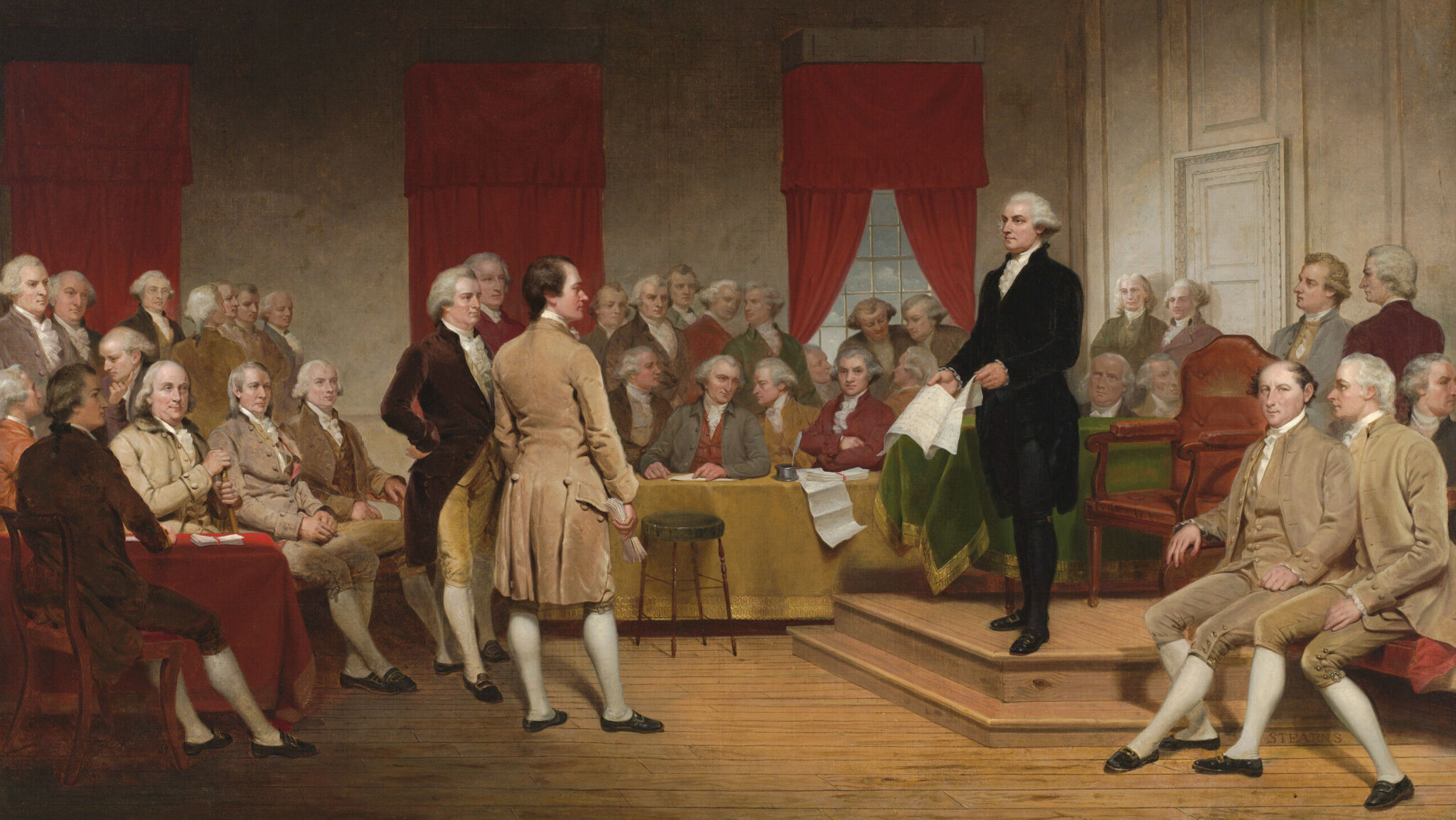
The United States is one of the world’s youngest major nations, yet it possesses the world’s oldest continuously functioning written national constitution. Written in 1787, this document has endured while dozens of other nations have cycled through new ones, even as they have tried to replicate its principles and its success. Since that time, France has adopted roughly 15 constitutions, Thailand more than 20, Venezuela around 26, and the Dominican Republic at least 32.
What explains the U.S. Constitution’s remarkable durability? How did it help lay the foundation for the most powerful, prosperous and free nation in modern history?
Trumpet publisher Gerald Flurry addressed this subject in his Key of David program “The Bible and the Constitution.” “Many people today hate the Constitution, and yet it’s one of the most noble documents ever on this Earth,” he said, “… because it was established by many principles of the law of God.” Its authors “were firmly rooted in divine law, and of course, that certainly saturated much of the Constitution. Now, that’s why this document is much more important than most foundational documents of other nations” (March 16, 2018).
These statements reflect a vital but overlooked truth that many would challenge or dismiss. The Constitution’s text of only about 4,500 words contains no direct scriptural quotes and makes no explicit references to Bible verses. It establishes no national church or theocracy. God is mentioned only once: “the year of our Lord one thousand seven hundred and eighty-seven.”
So how is the Constitution based on the Bible? Or is it?
New Israel
Let’s start at the beginning. America’s Founding Fathers wrote the U.S. Constitution, but the spiritual and intellectual foundation for the nation was laid by their great-great-grandfathers. Why did these early settlers leave Britain and other parts of Europe? Why risk everything and bring their families across storm-tossed oceans to a strange land that promised hardship and threatened starvation and death?
For freedom. Not the “freedom” of self-gratification, nor even of economic opportunity, but the most important freedom of all: freedom of mind. The freedom to think, to believe and to worship. Freedom from a society they viewed as sinful; freedom from religious persecution. The freedom to follow their religious convictions justified the risks.
Where did those religious convictions come from? The Holy Bible. Johannes Gutenberg had invented his printing press around 1450. Christopher Columbus had reached the Americas in 1492. And the first English translation of the complete Bible printed and available en masse had appeared in 1535. The King James Bible was completed in 1611.
In the early 1600s, Englishmen could read the Scriptures for themselves. Many became so moved, so convicted and so inspired by the Bible that they forsook houses, lands, family and all else to leave the Old World for the New. In fact, many took the risk because they sought the opportunity to establish a society patterned after biblical principles.
As William J. Bennett writes in Our Sacred Honor, “What made this country different from all others was a prevalent belief that God played a direct and active hand in founding a people. Like the Jerusalem of old, America’s ‘New Jerusalem’ was to become God’s promised land to the oppressed—an example to all humankind.”
This identification with ancient Israel helped shape the American character from the start. The Pilgrims, the Puritans and other early settlers actually viewed their journey as a modern exodus.
They may not have known that they themselves were, in fact, descendants of ancient Israel (request our free book The United States and Britain in Prophecy, by Herbert W. Armstrong, for the proof), but America’s founding generations certainly likened America to a “new Israel.” They saw themselves as a covenant people departing an oppressive world and entering a new promised land under God’s providence. This is why they gave a litany of cities, towns, mountains, rivers and other landmarks biblical names from ancient Israel: Bethlehem, Bethel, Canaan, Eden, Goshen, Hebron, Jericho, Jerusalem, Mamre, Moriah, Pisgah, Rehoboth, Salem, Sharon, Shiloh, Zion and many more. These names expressed a deep conviction that America was a land under God’s special care and that its people were heirs to the promises and principles of the Bible.
More than a century after the Mayflower made landfall at Plymouth Rock in 1620, this Hebraic influence remained strong. Samuel Langdon, who graduated from Harvard alongside Samuel Adams and later served as the college’s 11th president, wanted to make Hebrew, which was almost extinct, an official language in America.
Like the early colonial governors before him, Langdon pointed people to the law of God to anchor and guide the new nation. In his famous 1788 election sermon titled “The Republic of the Israelites: An Example to the American States,” he declared: “The Jewish government … was a perfect republic. … Let us, therefore, look over [the Israelites’] constitution and laws. … They had both a civil and military establishment under divine direction, and a complete body of judicial laws drawn up and delivered to them by Moses in God’s name. … Instead of the 12 tribes of Israel, we may substitute the 13 states of the American union ….”
Langdon and many other leaders of the founding era saw the ancient Israelite republic under Moses as the ideal model for America. This biblical framework—emphasizing rule of law, moral governance and accountability to God—profoundly shaped the culture in which the U.S. Constitution was written.
A Written Covenant
The tendency of early Americans to equate themselves with the children of Israel is central to understanding the genesis of the U.S. Constitution. Great Britain had no single written constitutional document. Its system of government had evolved over centuries through common law, charters, statutes and precedents. In contrast, the American colonists, steeped in biblical thought, deliberately sought to codify political order in written covenants.
This practice mirrored God’s own covenant with ancient Israel.
“Ye have seen what I did unto the Egyptians, and how I bare you on eagles’ wings, and brought you unto myself,” God told the Israelites upon delivering them from Egypt. “Now therefore, if ye will obey my voice indeed, and keep my covenant, then ye shall be a peculiar treasure unto me above all people: for all the earth is mine: And ye shall be unto me a kingdom of priests, and an holy nation.” The elders of Israel replied, “All that the Lord hath spoken we will do” (Exodus 19:4-8).
Moses then carefully recorded the full terms of the covenant in writing. This act of inscription was pivotal: What had been spoken became a fixed, public, written document that bound both God and the people.
This established a foundational principle: Legitimate human communities are formed through voluntary consent to agreed-upon, codified terms rather than through submission to a tyrant’s arbitrary will. God had more power than any tyrant, and He directly and actively led the nation with unquestionable authority, yet He established His relationship with the Israelites as a covenant. This was a highly unusual, even revolutionary development in ancient Israel compared to the surrounding nations.
At America’s founding, the pilgrims took this biblical model seriously. When the Mayflower arrived at Cape Cod in 1620, its passengers signed the Mayflower Compact “in the presence of God,” solemnly agreeing to form a “civil body politic” and to enact “just and equal laws” for the general good of the colony. This was one of America’s first written covenants, and it was directly inspired by the biblical pattern established at Sinai.
Of course, the one-page Mayflower Compact was not a full constitution, but it set a powerful precedent.
That compact directly inspired the Fundamental Orders of Connecticut. Drafted at the urging of Puritan preacher Thomas Hooker, this document is widely regarded as the first written constitution in the Western world to create an independent government. It unified the frontier towns of Windsor, Hartford and Wethersfield into a self-governing commonwealth on Jan. 14, 1639. This historic document is the reason Connecticut’s official nickname is “The Constitution State.”
While it contained no direct chapter-and-verse Scripture citations, the Fundamental Orders repeatedly appealed to “the Word of God” and “the rule of the Word of God” as the ultimate standard for justice and governance, reflecting the deep conviction that legitimate civil authority must rest on divine law. (To this day, all 50 U.S. state constitutions have at least one reference to God.)
Today about 97 percent of the world’s nations have a written constitution. Thus one can easily assume this is simply the normal way governments operate. But the majority of these documents are relatively recent attempts to imitate the success of the U.S. Constitution. Amazingly, even the people who directly benefit from the principles of this Constitution and those like it don’t realize that its principles of the rule of law and legitimate authority coming from the free consent of the people traces back to the Holy Bible.
Rule of Law
Written constitutions are invaluable in establishing the rule of law. They set fixed limits on government power, define the rights of citizens, and provide standards against which rulers can be held accountable.
The Bible powerfully illustrates this principle. The laws God recorded in Scripture are intended to govern everyone in the nation, from king to judge to citizen to immigrant. The king was to write out a personal copy of the law, read from it daily, and obey it faithfully (Deuteronomy 17:18-19). God Himself is the Lawgiver, and He decides what laws His people must be subject to, not the whims of any human leader.
Even God Himself is subject to His own law! Jesus Christ lived in the flesh in perfect obedience to it, never violating the smallest point (Hebrews 4:15). So committed is God to the rule of law that He subjected His sinless Son to crucifixion to pay the penalty we incur for breaking it (Romans 6:23). Rather than compromise one whit with His law, God paid that dear price so He could extend forgiveness to repentant sinners. Truly, He is the supreme Author of the rule of law.
Early American settlers united this biblical understanding with their political thinking. Paul Johnson expressed this truth in “No Law Without Order, No Freedom Without Law” (Sunday Telegraph, Dec. 26, 1999). “The rule of law, as distinct from the rule of a person, or class or people, and as opposed to the rule of force, is an abstract, sophisticated concept,” he wrote. “[T]he essence of the rule of law is its impersonality, omnipotence and ubiquity. It is the same law for everyone, everywhere—kings, emperors, high priests, the state itself, are subject to it. If exceptions are made, the rule of law begins to collapse.”
This biblical conviction that law must be supreme and impartial (and written) became a cornerstone of the U.S. Constitution. James Madison, the father of the Constitution, captured this insight in Federalist No. 51: “But what is government itself, but the greatest of all reflections on human nature? … In framing a government which is to be administered by men over men, the great difficulty lies in this: You must first enable the government to control the governed; and in the next place oblige it to control itself.”
Studying the history of ancient Israel, Greece, Rome and other civilizations, the founders realized that these societies ultimately collapsed partly because they failed to conquer human nature and preserve the rule of law as opposed to the rule of force. They, therefore, sought to develop a system that, while powerful enough to protect and regulate the people, divided power among branches, balancing centers of power to check one another and to restrain any one leader or branch from abusing its power. They enumerated the powers of each part within the government and specified that all powers not explicitly mentioned belonged to state and local governments or to the people themselves. And they sought to preserve individuals’ God-given rights and give them a measure of self-rule by empowering them to elect representatives within the government.
This realistic view of human nature—drawn directly from the Bible’s teaching on the sinfulness of man—became one of the most important reasons for the Constitution’s remarkable endurance.
Yet the founders’ system of checks and balances are more directly traceable to the governing structures of the Roman Republic than to ancient Israel. This is a major reason why we see the checks and balances the founders established being circumvented today. No system of checks and balances, however cleverly designed, can long survive a people who reject biblical standards of self-control and virtue.
Equal Justice
One of the Bible’s most revolutionary teachings is equal justice. In a world dominated by kings, pharaohs and rigid class systems, where rulers often determined the law according to their own will, the God of Israel declared that all human beings are created in His image and likeness (Genesis 1:26-27): “all men are created equal.”
Because every person bears God’s image, no individual—regardless of wealth, status or ethnicity—has greater inherent value than another. From this primary principle flow repeated commands for impartial justice: one law for both native and stranger (Leviticus 24:22; Numbers 15:15-16), no “respect of persons” in judgment (Deuteronomy 16:19), equal treatment for rich and poor alike (Exodus 30:12-15).
These biblical laws profoundly influenced the development of Anglo-American law and political thought. English philosopher John Locke wrote that there should be “one rule for rich and poor, for the favorite at court and the countryman at plow.” These principles also helped shape the ideals embraced by America’s founders as they established a nation grounded in the principle of equal justice under law. Political scientist Donald S. Lutz found in a landmark study that Locke was the fourth-most cited source among America’s Founding Fathers—behind the Bible, Baron de Montesquieu and William Blackstone.
The Declaration of Independence declares that all men are endowed with specific, unalienable rights, not by the government but by their Creator. This profound truth enabled America to eventually abolish the institution of slavery.
Although the U.S. Constitution initially left the issue of slavery largely to the individual states, President Abraham Lincoln—echoing Proverbs 25:11—described the Declaration as “an apple of gold” framed by a “picture of silver.” He believed the Constitution was designed to protect the Declaration’s central truth about human equality. Lincoln used the constitutional amendment process the founders established to ensure there was “one manner of law … for the stranger, as for one of your own country.”
That vision was realized through the 13th and 14th Amendments. The 13th Amendment, ratified in December 1865, permanently abolished slavery and involuntary servitude throughout the United States. The 14th Amendment, ratified in 1868, advanced the principle of equality further by declaring all persons born or naturalized in the United States to be citizens and guaranteeing that no state could “deprive any person of life, liberty or property, without due process of law; nor deny to any person within its jurisdiction the equal protection of the laws.” These two amendments embedded the biblical ideal of impartial justice more deeply into America’s constitutional framework.
President Lincoln emphasized the Bible’s indispensable role in guiding the nation. In 1864, when a group of African-Americans presented him with a Bible, he replied: “In regard to this great Book, I have but to say, it is the best gift God has given to man. All the good the Savior gave to the world was communicated through this Book. But for it, we could not know right from wrong.”
Free Enterprise
The Bible also lays a strong foundation for free enterprise and economic liberty, bedrock principles that helped fuel America’s unmatched prosperity. The Eighth Commandment (“Thou shalt not steal,” Exodus 20:15) and the Tenth (“Thou shalt not covet,” verse 17) clearly affirm property rights. These commands would be meaningless without the assumption that people can own possessions.
America’s founders drew on this biblical heritage and explicitly rejected socialism and all systems that undermine property rights. In A Defense of the Constitutions of Government of the United States of America, John Adams wrote, “The moment the idea is admitted into society that property is not as sacred as the laws of God, and that there is not a force of law and public justice to protect it, anarchy and tyranny commence. If ‘Thou shalt not covet,’ and ‘Thou shalt not steal,’ were not commandments of heaven, they must be made inviolable precepts in every society before it can be civilized or made free.”
This biblical view of property and economic liberty was powerfully reinforced by the Scottish moral philosopher Adam Smith. His landmark 1776 work, The Wealth of Nations, arrived in America just months after the Declaration of Independence and was widely read by the founding generation.
Smith argued that when individuals are free to pursue their own interests within a framework of justice and limited government, an “invisible hand” directs resources in ways that benefit society as a whole. He strongly opposed mercantilism, monopolies and excessive state interference, a view that aligned closely with the biblical emphasis on honest dealing, voluntary exchange and personal stewardship.
Thomas Jefferson called The Wealth of Nations “the best book extant” on political economy. Alexander Hamilton engaged deeply with Smith’s ideas while shaping early American economic policy.
The Constitution reflected this understanding in powerful ways. The Fifth Amendment declares: “No person shall be … deprived of life, liberty or property, without due process of law; nor shall private property be taken for public use, without just compensation.” This clause placed strict limits on the government’s power to seize or redistribute wealth. The Contract Clause (Article i, Section 10) further protected the right to make and enforce private agreements. The Commerce Clause created a vast national marketplace free from state tariffs and barriers. These provisions rejected the European model of state favoritism, instead establishing a constitutional order protecting private property, honest contracts and voluntary trade.

Religious Freedom
The right to freely exercise your religion is widely considered America’s “first freedom.” It is the very first right guaranteed in the First Amendment of the U.S. Constitution. Yet despite the common assumption that this principle is purely a product of Enlightenment secularism, its deepest roots are actually biblical.
In the Old Testament, God made a marriage covenant with Israel (Isaiah 54:5; Jeremiah 2:2; 3:1–20; 31:31–32). This made Israel more than a nation—it made Israel God’s Church. In fact, the first chronological mention of a “church” in the Bible is Acts 7:38, which refers to “the church in the wilderness” at Sinai.
Yet the Israelites were unfaithful to their marriage vows, and God issued them a bill of divorce (Jeremiah 3:8). Even so, the prophets foretold that God would not abandon His people forever. One day He would renew the relationship and establish a new covenant (Jeremiah 3:14–18; 31:31–34; Hosea 2:14–23).
Jesus Christ came to proclaim this New Covenant. Contrary to what much of mainstream Christianity teaches, however, the New Covenant will not fully come into force until the marriage ceremony between Christ and His Church (Revelation 19:6–9). This profound truth means that God is not actively guiding modern Israel in the same way He guided ancient Israel. America is a nation, but it is not a church.
The distinction between civil and church authority is made clear in the New Testament. Jesus declared, “No man can come to me, except the Father which hath sent me draw him …” (John 6:44). True faith is a personal, voluntary response to God’s calling. The Apostle Peter reinforced this when he said, “Repent, and be baptized every one of you …” (Acts 2:38). An infant cannot consciously choose to follow Christ. Entry into the New Testament Church requires voluntary repentance as a precondition to a believer’s baptism.
This understanding led early Baptists to insist that civil government should enforce justice and the rule of law but must never coerce the human conscience. Baptist pioneer John Smyth (1570–1612) wrote in his final year of life, “The magistrate is not by virtue of his office to meddle with religion, or matters of conscience, to force or compel men to this or that form of religion, or doctrine: but to leave Christian religion free, to every man’s conscience … for Christ only is the King and Lawgiver of the church and conscience.”
The Constitution left religion to individuals, where it belonged. It prevented the government from restricting the free exercise of the nation’s varying Christian denominations. Its First Amendment states: “Congress shall make no law respecting the establishment of religion, or prohibiting the free exercise thereof”—and they weren’t thinking about Islam, Buddhism, Sikhism or other religions. George Mason’s proposed text for the amendment shows where they were coming from a little better: “All men have an equal, natural and unalienable right to the free exercise of religion, according to the dictates of conscience; and that no particular sect or society of Christians ought to be favored or established by law in preference to others.”
This was a Christian nation. Not in the way that the Holy Roman Empire was a Christian empire that forced everybody to be Catholic Christians on pain of death. Not even in the way that the Anglican Church was the official church of England. But in the sense that Americans and their leaders were heavily influenced by freely practicing what they believed about Christianity, which was, overwhelmingly, non-Catholic Christianity.
Many colonial-era Americans faced severe persecution, including imprisonment and exile, for declaring that the king had no right to force people into the state church. Roger Williams (1603–1683) was a Baptist who fled persecution by Puritans in Massachusetts. He taught that civil government should enforce the second tablet of the Ten Commandments (commandments five through ten, which enumerate duties to man) but had no authority over the first tablet (commandments one through four, listing duties to God). Because of these beliefs, he founded Rhode Island as a refuge for religious dissenters. It was the first colony in America to guarantee full religious liberty.
One of those who crossed the Atlantic for that freedom in the mid-1600s was a leader of God’s true Church, a Sabbath-keeping Christian from London: Stephen Mumford. No other place on Earth offered Christians like Mumford the freedom that Rhode Island did. In fact, it was the only place such a church could exist.
A century later, this principle helped shape America’s founding. Baptist preacher and evangelist John Leland worked closely with Jefferson and Madison to secure religious liberty in Virginia. Their efforts produced the Jan. 16, 1786, Virginia Statute for Religious Freedom, which became the model for the protection of religious liberty in the First Amendment.
The Constitution does not mention God, but some states wanted to honor God in their constitutions. In fact, all states honor God in their constitutions. And the U.S. Constitution intentionally left them free to do that. To this day, there are more than 100 references to God in the state constitutions of all 50 states. Not just “in the year of our Lord,” but statements like this: “We, the People of the state of California, grateful to Almighty God for our freedom, in order to secure and perpetuate its blessings, do establish this Constitution.” That is on the books to this day. The U.S. Constitution leaves individuals and even states free to serve God without interference or coercion from the federal government.
This concept of religious freedom doesn’t come from Islam or from Catholicism. It comes from Americans having heard and read their Bibles and believing that God gives each man free choice and that it is wrong for other men or governments to deny them this right. This keeps exercise of religion free from, separate from and above the national government.
The founders practiced a variety of religious beliefs to varying degrees: They were Anglicans, Congregationalists, Dutch Reformed, Lutherans, Presbyterians, Quakers. Some were Deists, yet even they believed in a God very similar to the Christian God. They realized that none of these denominations was obviously His one true Church that should be established above all others. And they could see from history that mixing even a Christian church with the government would result in the corruption of both.
Also, if they left men free to worship God—if their worship was not dictated or limited by the government—then the true worship of God was far likelier to flourish in America than anywhere else in the world. And that is exactly what happened: In this country, God was able to establish His true Church, from its early colonists right up to the present day. (To learn this inspiring history, request your free copy of The True History of God’s True Church, by Gerald Flurry.)
Righteous Character
The Constitution is a practical attempt to implement foundational biblical principles in the U.S. government. Popular sovereignty, individual rights, limited government, separation of powers, checks and balances, republicanism, federalism—these are the seven principles of the Constitution, and they are based on the framers’ understanding of “the laws of nature and of nature’s God.”
George Washington acknowledged that the Constitution wasn’t perfect, but he wrote that it was “the best that can be obtained at this epoch” and that it “approaches nearer to perfection than any government hitherto instituted among men.” This form of government and the obedience of the people to it and to the Bible shaped the nation and enabled it to receive unprecedented blessings from God: the greatest combination of wealth, power and freedom in human history.
America’s founders established limited government to protect people from the evils of human reason wielding massive power. They wanted to check tyrants, unjust judges and other corrupt, biased and misguided leaders.
They knew, however, that this would create an enormous amount of freedom for the people. That is why founder after founder emphasized that it was crucial for the individual to govern himself and be accountable to God. The individual had to voluntarily obey the Bible’s laws.
Before the constitutional convention, Benjamin Franklin wrote to friends, “Only a virtuous people are capable of freedom. As nations become corrupt and vicious, they have more need of masters.” After the convention, he was reportedly asked by a woman what sort of government had been created. His reply: “A republic, madam, if you can keep it.” In his First Inaugural Address, George Washington famously stated, “The foundations of our national policy will be laid in the pure and immutable principles of private morality.” In his Farewell Address, he said, “Of all the dispositions and habits which lead to political prosperity, religion and morality are indispensable supports.” John Adams was equally direct: “It is religion and morality alone which can establish the principles upon which freedom can securely stand.”
Why was the Constitution written only for a moral and religious people? Alexis de Tocqueville answered this question powerfully in his classic Democracy in America. After traveling the United States in the early 1830s, the French observer concluded that religion and morality were essential to the republic’s survival. The Constitution granted Americans sweeping liberty to do as they pleased, but only biblical faith and moral conviction kept them from doing what was immoral or unjust. Without the restraints of a higher spiritual law, liberty quickly descends into license and anarchy, which destroys true freedom.
The founders understood this danger. They reemphasized religion and morality because they knew that no system of checks and balances could survive a people who rejected self-control and virtue.
America today is proof that their fears were justified. Private morality has crumbled. The public is choosing corrupt leaders. The government is doing exactly what the founders tried to prevent: growing larger, absorbing more and more of our national resources, gaining power and gnawing away at individual freedoms. In 1 Samuel 8, the Prophet Samuel specifically warns about this dangerous tendency in human-led government. The founders were surely aware of this warning and tried to prevent it. But as we have abandoned the Constitution, it is happening anyway.
The late Herbert W. Armstrong wrote in Mystery of the Ages that “there was one super-important quality that even God’s creative powers could not create instantly by fiat—the same perfect, holy, righteous character inherent in both God and the Word!” This is because such “holy and righteous character is the ability in such separate entity to come to discern the true and right way from the false, to make voluntarily a full and unconditional surrender to God and His perfect way—to yield to be conquered by God—to determine even against temptation or self-desire, to live and to do the right.”
God influenced America’s founders to give us a nation utterly unique and precious. It is a nation heavily influenced by His divine law, a nation in which we have the freedom to make “voluntarily a full and unconditional surrender to God and His perfect way.” The choice is left to each one of us. If we choose to reject God and His law, America’s fate will be the same as that of ancient Israel: besiegement, invasion and enslavement (Leviticus 26; Deuteronomy 28).
America’s current trend toward lawlessness is confirming a bitter lesson that has been proved time and again throughout human history: a nation can thrive only by upholding and obeying the law of God!
Americans should thank God for their blessings and look forward to the day when the sun won’t be setting on them—as is sadly happening today—but will rise on a new day. In that day, God will extend those blessings, and abundantly more, across the borders of America and far beyond—and all nations, all peoples, will live under a perfect government, authored and established by God Himself.


