

Germany Learns Faster From the Ukraine War Than Russia Does
For some, war is a horrific tragedy. For others, it’s a game. They view battles and regional wars as a playground to test military strategies and equipment. History is full of such examples.
Referencing the Spanish Civil War (1936–1939), William Manchester wrote in The Last Lion: “Mussolini sent Franco over 60,000 troops. The führer directed Göring to take the first steps in what became a half-billion-mark program, shipping tanks, warplanes and artillery, all accompanied by German technicians. One of the führer’s motives was to use the Iberian Peninsula as a proving ground for the Reich’s new weapons.”
At the time, Adolf Hitler was not seen as a brutal mass murderer, so the world paid little attention. Few suspected he was testing weapons for a bloody conquest that would result in the deaths of millions.
The reality is that weapons must be tested. Those who fail to gain an advantage in weaponry risk losing their nation.
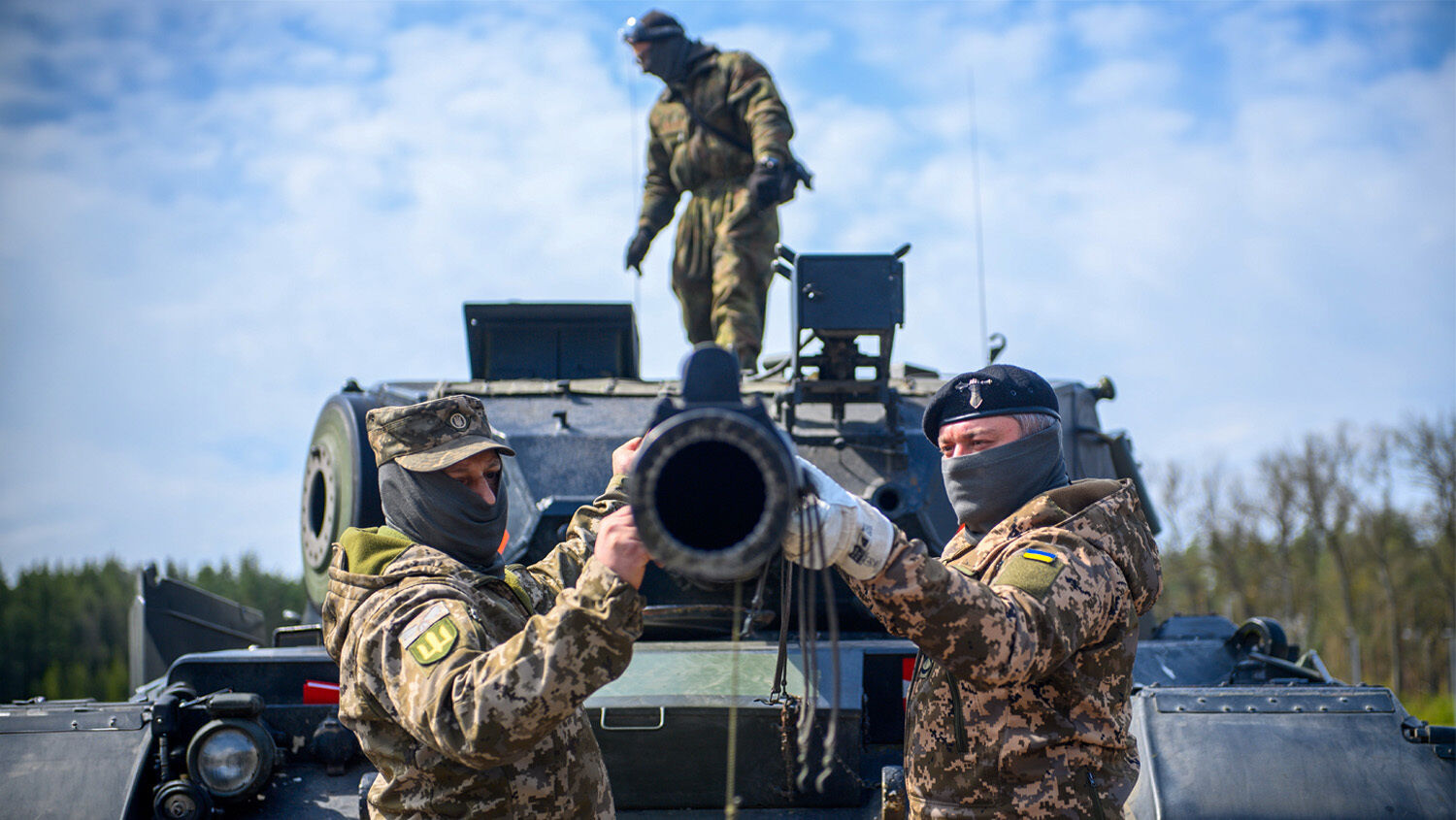
Thus, it should come as no surprise that Ukraine is also a major testing ground for weaponry. However, some may be surprised by the nation that is gaining the upper hand.
Germany’s ‘Aid’ for Ukraine
Since “the discontinuation of most U.S. aid last year, Germany has assumed the role of Ukraine’s ‘biggest supporter’ for the first time at the beginning of a new year,” German Aid to Ukraine reported on January 6.
Many feared the withdrawal of United States support would give Russia the advantage on the battlefield. However, the reverse happened.
In February, Ukraine regained more territory than it lost, the New York Times reported.
“To put it plainly, Russia’s 2026 operations have not been going well,” Mick Ryan, an Australian military expert, wrote on April 21, “and Ukraine is performing well on the front line, in its deep strike operations and in its diplomatic efforts. Ukraine appears to have built strategic momentum this year.”
Germany certainly plays a role in that and perhaps more so than first meets the eye.
Germany is the “number one country in the world in terms of security assistance to Ukraine,” Ukrainian Defense Minister Mykhailo Federov wrote on social media on May 11. That day, he met German Defense Minister Boris Pistorius in Kyiv to sign the “Brave Germany” program, which allows the flow of funds and information between defense companies, the military and government agencies.
Pistorius said that “the main focus is the joint development of cutting-edge unmanned systems across all ranges, particularly in the area of deep strike.”
Ukraine’s ambassador to Germany, Oleksii Makeiev, told Tagesspiegel on May 19 that Ukraine is receiving “more military aid than ever before” from Germany, and while the details of Germany’s support for Ukraine are no longer publicly disclosed, Germany has “increased it both quantitatively and qualitatively.”
Ukraine appears happy with German military support, even though it hasn’t delivered critical weapons such as the Bundeswehr’s Taurus cruise missiles and previously delayed weapons deliveries when Ukraine needed them most. Makeiev said that while the German Taurus model would indeed be particularly well-suited for certain military objectives, “the discussion has shifted due to our own innovations.”
By withholding critical weapons, Ukraine was forced to be innovative—and that’s where Germany benefits most.
The “German-Ukrainian relationship is not a one-sided one,” Makeiev said, referring to a possible joint production with German and other European companies that could replace U.S. Tomahawks (the U.S. government recently canceled plans to station them in Germany).
“The EU and nato are increasingly realizing that they urgently need Ukraine and its military capabilities to keep Russia in check on the European continent,” Makeiev said.
Germany quickly seized the opportunity to learn from the Ukrainian battlefield.
Less than a year after Helsing was founded in Germany in 2021, Russia began its full-scale invasion of Ukraine, prompting Helsing to start operating on the battlefield. In 2024, Helsing signed a deal with the Ministry of Strategic Industries of Ukraine to incorporate artificial intelligence into Ukraine-made drones and other unmanned aerial vehicles. That same year, Helsing started to mass-produce its own drones and deliver them to Ukraine.
The German government knew the benefits. Pistorius said at the time: “We are in close dialogue with our Ukrainian partners and will be able to draw conclusions for the Bundeswehr on how this type of drone can be used effectively. This will also help us to develop our own drone capabilities.”
Helsing now delivers hundreds of drones to Ukraine every month.
One may think all of this is done to help Ukraine. But Trumpet editor in chief Gerald Flurry explained in “AI and the End of ‘Mutually Assured Destruction’”: “[U]ltimately, this is not about Ukraine winning against Russia. Ukraine has become a ‘lab’ to prepare for much larger wars!”
For four years, Ukraine has been unable to end this war, no matter how many Russian soldiers it has killed. Russian President Vladimir Putin has little regard for the lives of his soldiers.
Ukraine has also been unable to attain military superiority over Russia—mainly because Russia can escalate the war all the way to using nuclear weapons.
Russia Versus Germany
Both Russia and Germany, via Ukraine, are learning immensely from the war. “[T]he world’s first full-scale drone war continues to evolve at a rapid pace with both adversaries innovating on an almost daily basis. While neither side has been able to achieve a decisive advantage, Ukraine’s mid-range strike campaign has allowed Kyiv to regain the upper hand. The challenge now for Ukraine will be to stay one step ahead as Russia responds.”
Perhaps the Russian side lives in the delusion that it has the technological edge because it has been gaining more territory. It probably believes that the advances in military technology and strategy, as well as the conquest of Ukraine, are worth the sacrifice of their soldiers. But if you look at the current battlefield as a testing ground for military strategy for Germany and Russia, you would have to say Germany is advancing much faster.
Even though Germany is not directly involved in the war, its military industry and defense budget are rising faster than Russia’s. Direct comparisons with Russia are hard to make—Russia has access to cheaper labor and resources; Europe has more advanced technologies—but observations from the battlefield and numbers give us a general idea.
According to an April report from the Stockholm International Peace Research Institute, Russia’s military spending grew by 5.9 percent in 2025 to $190 billion, or 7.5 percent of its gross domestic product.
At the same time, Germany’s military budget rose by 24 percent to $114 billion or 2.3 percent of gdp. It plans to double its military spending again by 2029. European nato members together far outspend Russia, totaling $559 billion.
By closely cooperating with Ukraine, dozens of military AI start-ups have been flourishing in Germany since 2022. Helsing is on the verge of being valued at $18 billion this year.
The established industry is also benefiting. Rheinmetall’s share price increased roughly 20-fold since the outbreak of the war in Ukraine in February 2022 to its peak in October 2025.
The Ukraine war is also moving the Russian military closer to its goals, but it has been a slow grind.
The Russian forces that invaded Ukraine four years ago would be cannon fodder on the Ukrainian battlefield today. For Russia to become a military superpower that can rival the U.S., it must not only conquer Ukraine but also learn vital strategies and rapidly accelerate innovation.
While Russia is burning through its military budget on the battlefield, Germany stores it in its arsenals. In the short term, this means Germany’s cooperation with Ukraine and its European partners is making it more ready for a large-scale war than Russia.
Germany’s Lead Prophesied
As Mr. Flurry proved in “Germany’s Secret Deal With Russia—Exposed,” these two countries have a common goal: amass power to challenge the U.S. Bible prophecy reveals that Germany will achieve this goal much faster than Russia. Here is what the late Herbert W. Armstrong said:
They have things coming along, my friends, that will wipe human life off the face of the Earth. And we have madmen still in power with no check from the people over in the Kremlin; the people of Russia have no check on their masters in the Kremlin. And I want to tell you that another power is on the way now, rising up in Europe and rising up right out of Germany, that is coming back again. And it is going to rise so fast that it’s going to get the jump on Russia while the Russians are so slow. This system that is rising up in Europe is going to rise up so fast that it will beat them to the draw, as we say, and will actually attack us here in the United States before the Russians do.
That, my friends, is prophesied. That, my friends, is as certain as the rising and the setting of tomorrow’s sun.
Revelation 13 reveals that Germany’s military advances will astound our world (verse 3). Only by analyzing Germany’s military activities through Bible prophecy can you understand where world events are leading.
Our booklet He Was Right shows how Mr. Armstrong based his forecast on the sure word of Bible prophecy. If you study it thoroughly, you will not only understand the world better but also why God has recorded these prophecies for our day.
“Watch Germany!” Mr. Flurry warned in “Germany Is Arming for World War III.” “You need to realize what is about to happen. They are talking about peace, but they are about to start a war like this world has never seen! Many biblical prophecies tell you this.”


