A Delicate Dance: Trump Visits Xi
A Delicate Dance: Trump Visits Xi
Good morning!
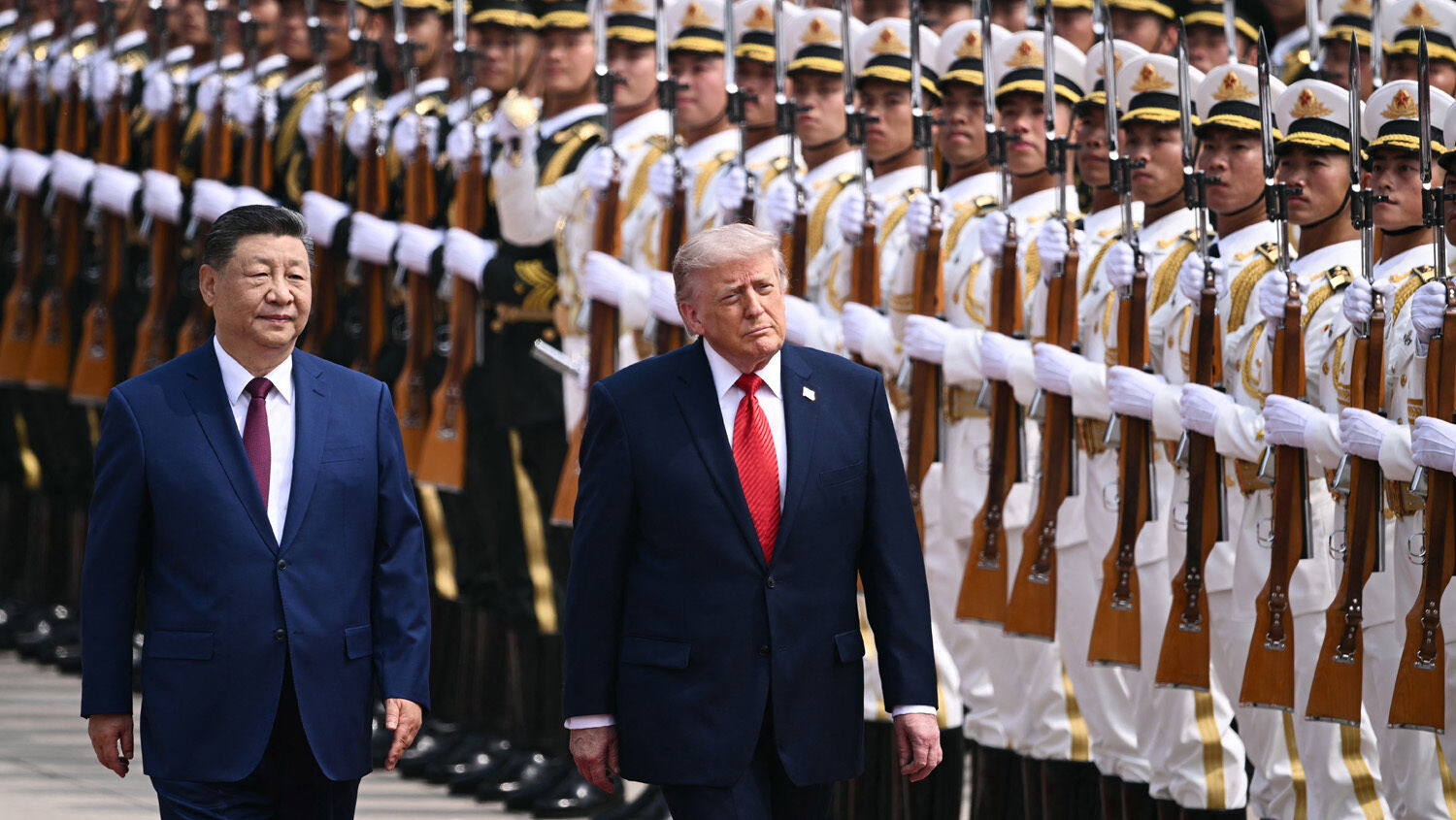
President Donald Trump received an ostentatious, red-carpet welcome in Beijing yesterday as he began his first state visit to China since 2017—including a military honor guard, a brass band and a formal arrival ceremony at the Great Hall of the People. Trump was kind, telling General Secretary Xi Jinping, “It’s an honor to be your friend.” But he knows he’s dealing with a dangerous rival.

- Stakes are high in this meeting between arguably the world’s two most powerful countries.
- The meeting’s backdrop includes recent revelations of Chinese spying and infiltration of America, cybertheft of AI and military secrets, continued supply of fentanyl precursors that fuel the U.S. addiction and overdose crisis, and strategic purchases of American farmland and properties near military bases.
- The loaded discussion agenda includes trade imbalances, tariffs, rare-earth exports, fentanyl precursors, AI safeguards, Taiwan and the Iran conflict threatening the Strait of Hormuz. Both sides need concessions and hold significant leverage against the other.
1) The Taiwan flashpoint: In a two-hour closed-door meeting, Xi reportedly told Trump that “the Taiwan question is the most important issue in China-U.S. relations” and warned that U.S. mishandling the issue could cause “clashes and even conflicts, putting the entire relationship in great jeopardy,” China’s foreign minister said.
- The U.S. has continued supplying Taiwan with defensive weapons, including a record $11.1 billion arms package approved in December that includes rocket systems, drones and missiles. Just last week, Taiwan’s parliament approved a $25 billion defense budget focused largely on purchasing U.S. weapons.
- The question of whether Trump will concede anything on Taiwan looms.
2) The Iran war: Both leaders agreed that Iran must not develop nuclear weapons and that the strait should remain open to global shipping. Their respective positions are complex:
- The throttling of the strait is concerning for China, the world’s largest oil importer, with as much as half of its crude supply transiting Hormuz routes. It has reserves, but they won’t last forever.
- China has close ties with Iran and is providing significant military support during the war. Trump’s team is overlooking the latter to use the former, actively seeking help to pressure Iran.
- This gives China bargaining power: cooperation on Iran in exchange for concessions on Taiwan, trade tariffs, tech restrictions or rare earths.
3) Trade: Economic friction and barriers between the two countries are rife, and the leaders hope for some resolution:
- Trump hopes to rebalance bilateral trade by reducing or suspending tariffs in exchange for China boosting purchases of U.S. agriculture, energy and aircraft, while further opening its markets to American firms. He also might try to hammer out extended access to Chinese rare earths and critical minerals essential for EVs, defense and tech.
- The president brought with him business leaders such as Elon Musk, Jensen Huang and Tim Cook, whose companies have major business interests tied to manufacturing, technology sales and supply chains. He wants to show that U.S. companies support practical economic cooperation.
President Trump loves a deal. Expect both countries to emerge claiming success. Just what that means, and what sort of geopolitical and prophetic effects it will have, we will watch closely in the weeks and months ahead.
Starmer Even Closer to the Brink
British Health Secretary Wes Streeting resigned today, increasing the pressure on Prime Minister Keir Starmer to step down. “Where we need vision, we have a vacuum. Where we need direction, we have drift,” Streeting said.
- Streeting is a leading candidate to replace Starmer. However, he refrained from firing the starting gun on a leadership challenge.
How Britain will choose its next prime minister:
- The Labour Party holds a majority of seats in Parliament, and whoever leads the majority party is the prime minister. (Each political party decides for itself how leaders are chosen and challenged.)
- To challenge Starmer, a candidate must have the support of 20 percent of Labour M.P.s, in this case, at least 81 members.
- Labour Party members can only trigger a leadership election by backing a specific individual. Starmer himself can also trigger a challenge by resigning. This is what Streeting and others are calling on him to do.
- Candidates must also have support from the trade unions, or from 5 percent of the wider party members. The Labour Party and trade union members vote on the successor using ranked ballots.
The turmoil is provoking political upheaval. Interest on British government debt has risen well past the dangerous level that pushed Prime Minister Liz Truss out of office. Traders fear a further-left-wing candidate will win and worsen the nation’s financial situation with yet more borrowing and spending.
“You could have something of a knee-jerk reaction if someone like Andy Burnham or Angela Rayner comes in. … If you lose the bond markets, good night, UK,” warned Ariel Bezalel of Jupiter Asset Management.
Britain is clearly going through a long-prophesied leadership crisis. Starmer has lasted less than two years so far, the nation’s sixth prime minister in only 10 years.
- Britain has switched from the Conservatives to Labour. It has burned through its first Catholic prime minister and its first Hindu prime minister. If Streeting wins, it will get its first homosexual prime minister.
The nation’s leadership crisis has everything to do with being cut adrift from its anchor. To understand, read “What Happened to British Leadership?”
Somehow, Hamas Is Still Standing
Over six months after United States President Donald Trump declared a ceasefire between Israel and Hamas, the peace he promised has yet to materialize. The ceasefire supposedly required Hamas to give up its weapons and its control of territory—it was meant to mark the end of Hamas’s rule in Gaza. In this regard, it has failed.
- Apart from releasing Israel’s hostages, Hamas has essentially ignored almost every term of the ceasefire.
- Israel recently suggested restarting the war to finish off Hamas, Axios reported yesterday. But Trump and his Board of Peace objected.
President Trump thought the war with Iran, one of Hamas’s two main sponsors, would have also spelled the end of Hamas. With Iran preoccupied with U.S. and Israeli attacks and blockades, its ability to support Hamas is reduced.
- “The more Iran is weakened,” Trump said, “the more Hamas is weakened.”
This strategy hasn’t borne much fruit, either. Seeing Iran hold its ground and the U.S. somewhat backing off has apparently emboldened Hamas.
- An Arab diplomat told the Times of Israel, “Not only is Hamas emboldened by Iran’s ability to withstand the war, but it is seeing the importance of holding onto your cards for as long as you can.”
- The war may have even pushed Hamas closer to Iran. Qatar has sheltered Hamas leaders in the past, but those leaders gave it little support when it was bombed by Iran. Sources speaking with the Free Press suggest Qatar has dropped its role as a mediator between Israel and Hamas and has evicted most of the terror group’s leaders. This may mean Hamas needs to rely on Iran even more.
The director general of the Board of Peace, Nikolay Mladenov, has plans to implement its new government for Gaza and start training its new Gazan police force without dealing with Hamas, Axios’s sources claimed. The Board of Peace hopes to make this public in June.
- Put another way, the Board of Peace is unable to force Hamas to comply and is afraid to confront it.
- One official from the board told Axios, “We made a lot of progress from a year ago, but this is not how we wanted the Gaza situation to develop. Nobody wants two Gazas.”
When President Trump announced the Gaza plan last year, many in America, Israel, the Arab world and elsewhere felt optimistic. Based on biblical prophecy, the Trumpet instead stated, “This deal will not bring ‘eternal peace.’” That prediction is proving correct.
IN OTHER NEWS
Germany boosts trade with Eastern Europe: Germany traded $165 billion with Eastern Europe and Central Asia in the first quarter of this year, 16 percent more than the $142 billion it traded with the United States and China combined over the same period, Handelsblatt reported yesterday. Germany is building up its trade relations with Eastern Europe, reducing its reliance on the U.S. and China while empowering its ambitions to build a third global superpower.
Austria twice scrambled jets to intercept U.S. military aircraft: Austria scrambled fighter jets on May 10 and 11 to confirm that the U.S. military aircraft approaching and entering its airspace matched the type its government had approved. The details of the verification are unclear, and Austria will address the issue through diplomatic channels, Defense News reported. Austria has closed its airspace to any U.S. aircraft involved in the Iran war; ensuring compliance was likely the reason for the interceptions. This highlights growing distrust and disagreement between America and its European “allies,” which was prophesied in the Bible.
Netanyahu’s secret visit: Israel’s Government Press Office announced yesterday that Prime Minister Benjamin Netanyahu “secretly visited the United Arab Emirates, where he met with U.A.E. President Sheikh Mohammed bin Zayed.” The report claimed the “visit has led to a historic breakthrough in relations between Israel and the U.A.E.” This follows reporting that Israel lent the U.A.E. some of its most sensitive defense technology during the war. Israel is increasingly relying on the U.A.E. for security, but Bible prophecy warns that trusting other nations over the God of Israel is a fatal trap.
New Fed chairman Warsh faces the inflation quandary: Kevin Warsh was sworn in yesterday as the 17th chair of the Federal Reserve. The Senate confirmed the 56-year-old former Fed official, chosen by President Donald Trump, in a mostly party-line vote. Warsh takes charge amid the Iran war, high gas prices and rising inflation. President Trump has pushed hard for the Fed to lower interest rates, largely to increase borrowing, investment, hiring and consumption. To make this possible, Warsh plans to sell some of the bonds the Fed owns. This could help lower mortgage rates and other long-term rates and open the door to cutting the main short-term interest rate. However, as long as the U.S. government keeps running trillion-dollar deficits, it will be nearly impossible to keep both interest rates and inflation low at the same time.
Inflation rises again as fuel prices climb: Inflation surged to its highest level in nearly three years in April, up 0.6 percent from March and 3.8 percent year-over-year, according to government data. The sharp rise was driven largely by gasoline prices, which jumped 5.4 percent in a single month and 28.4 percent over last year, with the national average now $4.50 per gallon. The ongoing war with Iran has disrupted key oil shipping routes, pushing energy costs higher. This pressure is also raising prices for food, rent and other everyday essentials, adding strain to governments, businesses and household budgets nationwide. Stock markets reacted negatively, with the Dow dropping about 0.5 percent as investors worry that high inflation may delay interest rate cuts.
California taxes buy inmates iPads—for sex sins: City Journal reported yesterday that California’s program to grant the state’s 90,000 prisoners smart devices has enabled the recipients to consume pornography and even groom minors. One man imprisoned for sex crimes against a 12-year-old girl continued to contact her through the device. One serial killer on death row told the New York Post the restrictions are easy to bypass. As Trumpet managing editor Joel Hilliker wrote yesterday regarding Congress’s continuing sex scandals, the more one looks at what the government is doing behind closed doors, the more evils come into view.