

Germany Is Openly Hostile to the U.S.
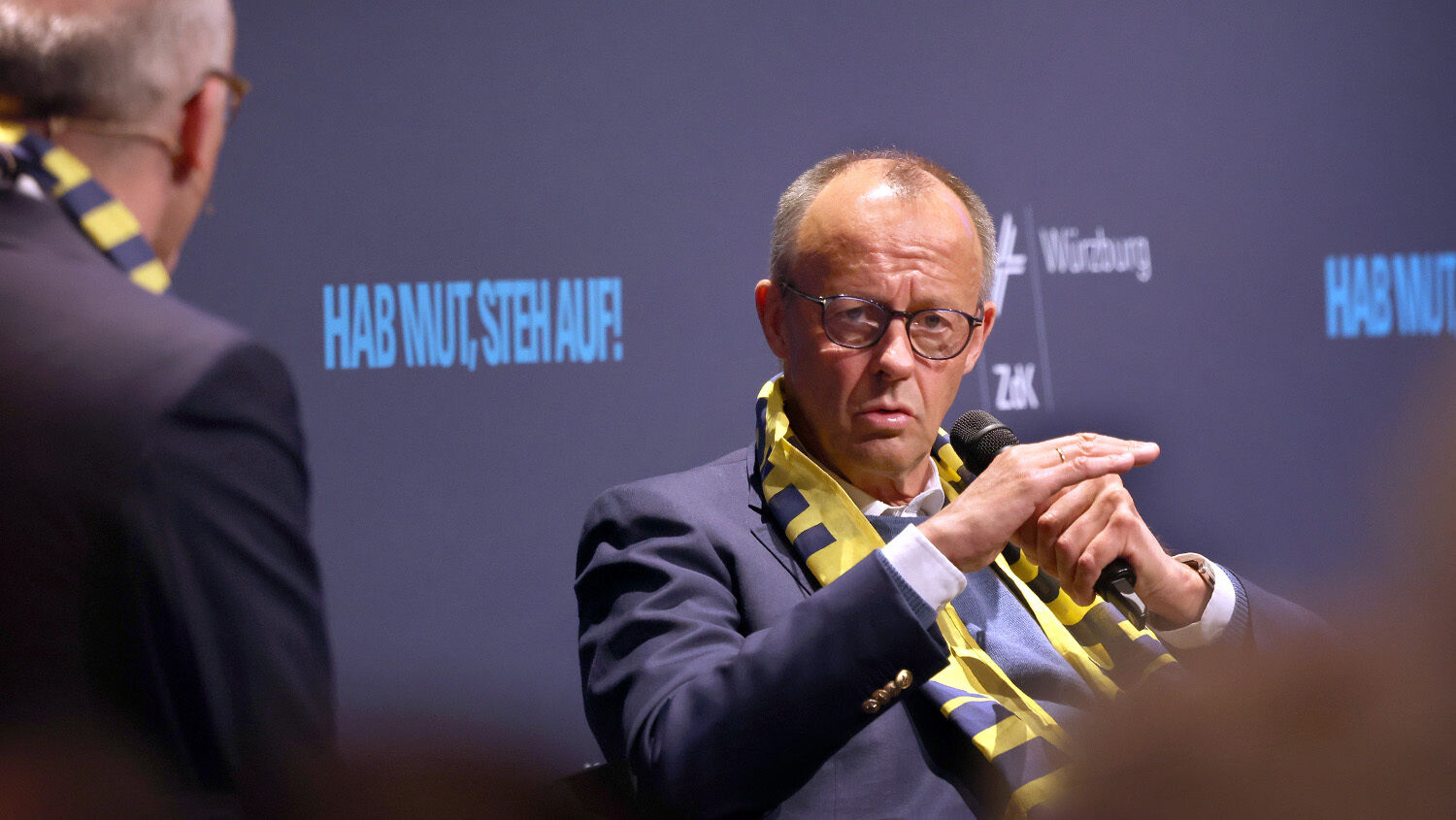
Germany is ending its 80-year tenure as a United States ally and reprising its role as an open adversary. On May 15, German Chancellor Friedrich Merz said he “would not recommend to [his] children today that they go to the U.S. to get an education and to work,” a comment which was met with applause at a Catholic Congress. Part of his reasoning was the “social climate that has suddenly developed” in the U.S.
In other words, the U.S. and Germany have a rift in social values. He added that he’s a “great admirer of America” but his “admiration is not increasing at the moment.”
Two years ago, that statement would have been unimaginable—a German leader openly ridiculing the U.S. and presenting Germany as morally superior? Germany has not been so flagrantly at odds with the U.S. since 1945.
Merz’s disdain for America is not limited to Germany; the rest of Europe is of a similar mind. Former Italian Prime Minister Mario Draghi even described the U.S. as “adversarial” at a May 14 acceptance speech for the prestigious Charlemagne Prize.
Failing Military Alliance
Trans-Atlantic relations have been noticeably weak since the start of the year, when European forces prepared to fight American forces in case of an invasion of Greenland. But Merz delivered the final blow on April 27 in Marzburg, Germany, when he said that “Americans clearly have no truly convincing strategy” with Iran. He added that the U.S. is being “humiliated” by Iran.
On May 1, President Donald Trump’s administration announced it would withdraw at least 5,000 American soldiers from Germany over the next six to 12 months and canceled the planned deployment of American long-range Tomahawk missiles to Germany.
Germany used to prepare with America for war against Russia; now—as its April 22 military strategy brought out—Germany is preparing for that alone. Germany and the U.S. used to conduct joint operations; now Germany wants no part in securing the Strait of Hormuz with America, even as it prepares a separate mission with European powers.
Last month, the European Union tested its mutual defense clause, ensuring its ability to defend itself without the U.S. There is even disagreement over Cuba: On April 21, Merz said the U.S. has no justification to invade Cuba, including the current blockade.
The overall message is clear: Germany is no longer pretending to be America’s friend.
Economic Blackmail
On May 7, President Trump threatened a 25 percent tariff on EU car exports (which would disproportionately hit Germany) if it did not ratify the July 2025 EU-U.S. trade deal by July 4. This forced the EU to agree to a 15 percent tariff on all exports to the U.S., including cars. That is a significant jump from the 2.5 percent levied on car exports prior to Trump’s second term.
However, the EU’s ratification of that trade deal is far from the end of Germany and America’s trade tensions. German member of European Parliament Bernd Lange, who negotiated the European side of the deal, stated: “There is a suspension mechanism if the U.S. does not abide by the deal, a monitoring mechanism for the impact on our economy, provisions for unjustified tariffs on certain products, an expiry date for the legislation, and strong involvement of the European Parliament.” He also threatened that the U.S. must “stick to the deal or face countermeasures.”
Tariffs are one of the largest points of friction between the two. In January, when the Trump administration threatened tariffs on several EU nations (including Germany) for their support of Denmark in the Greenland crisis, it provoked some in Germany, such as Vice Chancellor Lars Klingbeil, to consider using the EU’s Anti-Coercion Instrument, also known as the “trade bazooka.” This is an economic weapon designed for use against a nation threatening the sovereignty of an EU member nation. If implemented, it would have effectively cut off all trade with the U.S.
America: Enemy of Germany
In the May 7 edition of his Neuland Newsletter, former German Defense Minister Karl-Theodor zu Guttenberg, whom the Trumpet watches closely, stated that “Europe must reach a position in which it cannot be blackmailed—neither with tariffs nor with troop lists,” a comment clearly directed at the U.S.
“The message is: Security continues to exist—but only for good customers,” he said, almost calling the U.S. a criminal enterprise, charging people for security.
“In this logic, customs duties, threatening gestures and base issues are not slips, but instruments of a policy that treats alliances as business models. Loyalty is a variable option, available at a price surcharge.” He views America as a malignant business partner; in his eyes, hostility against it is justified. He believes Europe must stop appeasing America and start resisting.
Guttenberg isn’t the only German with an unfavorable view of America. Sixty-five percent of German citizens believe America poses a threat to global peace similar to China and Russia, according to a February Allensbach survey. Just 10 years ago, as many as 62 percent of Germans viewed America as a reliable ally, according to Pew Research. It’s worth noting that those numbers are from before the Iran war.
Guttenberg presented European independence from America as a positive for the trans-Atlantic alliance, stating “the alliance would be worth no less, but more: because two sides work together, which decide for each other by their own strength.” How could two nations work together if they have different goals, if they “decide by their own strength”? Eventually disagreements will lead to conflict.
Conflict Is Coming
Germany’s hostility against the U.S. is prophesied to get much worse. Plain Truth editor in chief Herbert W. Armstrong wrote in 1980:
You may be sure the West European leaders are conferring hurriedly and secretly about how and how soon they may unite and provide a united European military force so they can defend themselves! … And so they will no longer have to give in meekly to Russia! And who will they blame for their humiliation and their necessity now to have a united Europe, with a united government, a common currency and a common military force as great or greater than either the ussr or the U.S.A.? They will blame the United States! And when they are strong enough to assert themselves, [they] will first attack Britain for standing firm with the United States, and then they will return a lot of hydrogen bombs the U.S. has stored now in Europe!
One of the biggest obstacles to open hostility has already been crossed: Public opinion is shifting against the U.S. which frees the German leadership to enact the agenda it’s been planning since the end of World War ii. Mr. Armstrong warned of what we now see in Germany on May 9, 1945:
We don’t understand German thoroughness. From the very start of World War ii, they have considered the possibility of losing this second round, as they did the first—and they have carefully, methodically planned, in such eventuality, the third round—World War iii! Hitler has lost. This round of war, in Europe, is over. And the Nazis have now gone underground. … Now a Nazi underground is methodically planned. They plan to come back and to win on the third try.
To learn where this rift is leading, read “Atlantic Rift” in our booklet He Was Right.


