

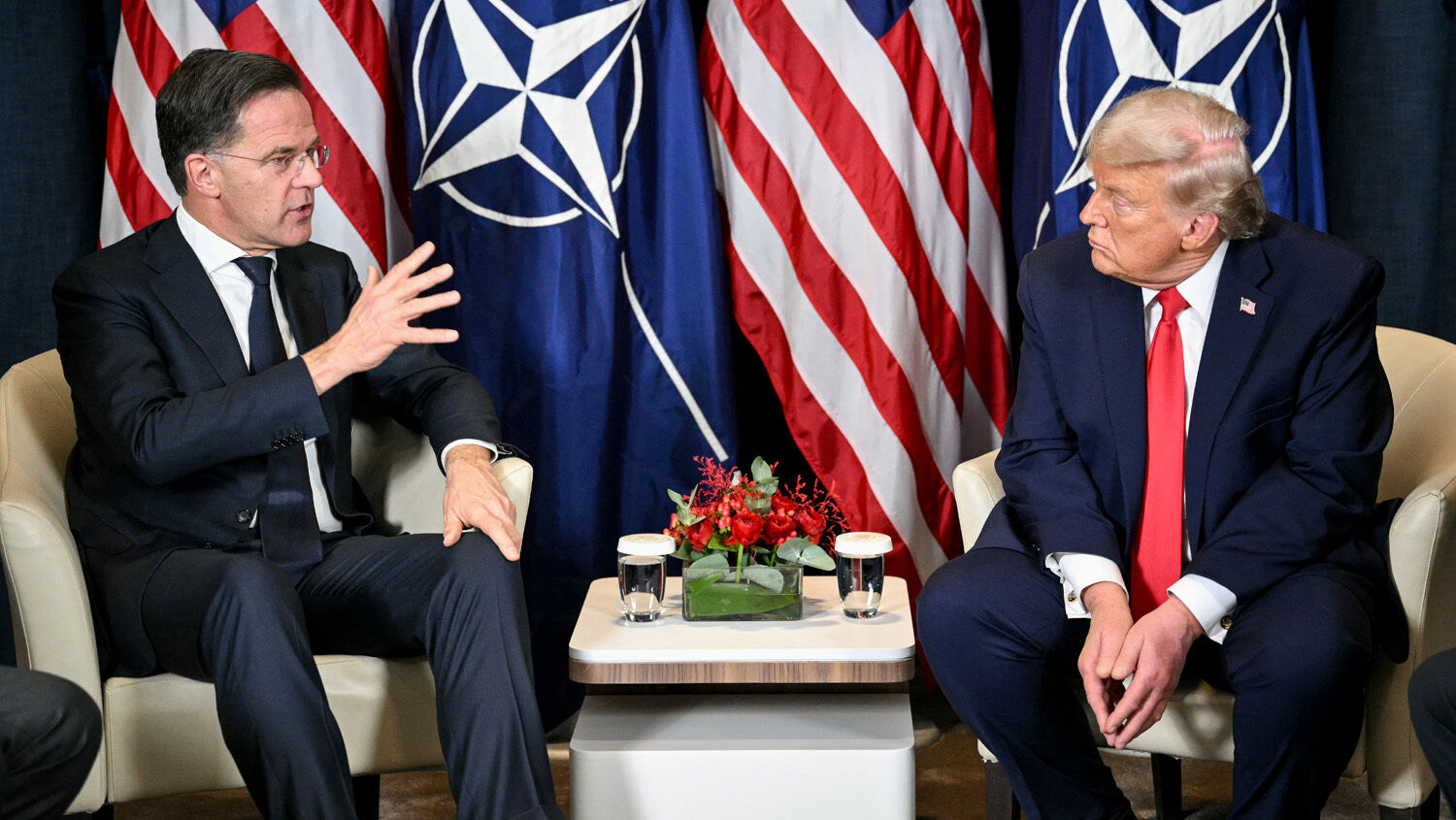
Did America and Europe Almost Get Into a War?
On Monday, United States President Donald Trump blamed the fight over Greenland for nato’s split. “[I]t all started with Greenland,” he said. “We want it. They don’t want to give it to us—and I said, ‘Bye-bye.’”
The fight over Greenland caused more than just the loss of U.S. faith in the alliance. In January, Europe was preparing to fight the U.S. over Greenland based on details released last month—showing that war between Europe and America is not a far-fetched possibility.
What Happened in January?
When President Trump discussed the idea of annexing Greenland last summer, Denmark prepared for a military operation on the island with other European Union member states. The operation’s timetable was greatly sped up when Trump captured Venezuelan leader Nicolás Maduro on January 3, according to Danish broadcaster DR. As they saw it, the U.S. had already violated international law once—what would stop it from acting on its Greenland ambitions?
On January 9, after several cryptic comments about taking Greenland, President Trump stated that if the U.S. couldn’t have Greenland the easy way, the U.S. would have to take it the hard way. Four days later, on January 13, the Danish military was ordered to prepare to defend Greenland. On January 16, a small dispatch of Danish, French, German, Norwegian, Slovenian and Swedish soldiers were sent to the island for a military “exercise.” In the following days, heavily armed Danish fighter jets and French naval assets were sent into the region. This was all done under the guise of a nato operation, but it was obviously meant to deter the U.S. from attacking Greenland.
An attack would automatically mean the end of nato and war with Europe. It was a tripwire of potentially nuclear proportions.
They called it an “exercise” for a reason. “It’s a game about doing something that looks normal and is easy to explain. But it’s also not difficult to understand if you notice the right details. Hence the word ‘exercise.’ The title itself must not be unnecessarily provocative to the Americans,” DR stated. In other words, Denmark (and its European allies) wanted to subtly threaten the U.S. with the prospect of war.
It was far from just a normal military exercise, though; they were prepared to fight. The soldiers brought blood from blood banks in Denmark in case they saw combat and were wounded, DR revealed on March 19. They also brought explosive devices so they could blow up runways in Nuuk and Kangerlussuaq, making it harder for the U.S. to invade. Those are not normal supplies for a military exercise. They were ready for the real possibility of war. Soldiers were given a standing order to fight back if attacked, which could be explained away as standard practice, but still meant an order to potentially strike U.S. troops in the event of an invasion.
The immediate aftermath almost led to a trade war between the powers. On January 17, Trump threatened to put tariffs on Denmark and the nations that sent troops to Greenland. Some European officials, including German Chancellor Friedrich Merz, proposed the idea of unleashing the EU’s “trade bazooka” to retaliate, a measure that would allow them to cut off all American access to the European market. Trade wars are dangerous because they tend to lead to hot wars.
On January 21, Trump disarmed the situation, at least in the short term, by stating he would not use force to take the island in a speech at the World Economic Forum. Negotiations between Denmark, Greenland and the U.S. to discuss increased U.S. presence on the island were also announced.
War Is Brewing
“This is not over. Trump is here for three more years,” stated a “high-ranking source in the Danish security apparatus” in March, according to DR. That comment gives insight into Europe’s thinking. The Greenland crisis was just the beginning of what will grow into a violent relationship.
America is no longer a friend of Europe. On March 15, Danish Prime Minister Mette Frederiksen stated that America was no longer her country’s closest ally. The Danish public’s view has markedly shifted against the U.S. “In Copenhagen a few weeks ago, I was shown a Danish app that tells users which products are American, so that they know not to buy them. At the time it was the most popular app in the country,” the Atlantic’s Anne Applebaum wrote on March 17.
Europe has used Greenland as an excuse to break from the U.S. The EU signed several momentous trade deals to further that aim, including the mercosur agreement on January 17, an agreement with India on January 27, and an agreement with Australia last month to secure crucial minerals. Germany is also deepening its relations with the Gulf states to decrease dependence on U.S. oil. These deals had been in the works for years, yet they were all signed recently. Clearly, a fire was lit at the start of the year, pushing the EU to make progress.
It has also cost the U.S. influence among Arctic nations. The Norwegian prime minister commented in March: “We are Arctic nations, and the Arctic perspective when it comes to security: how we are going to look to that security inside the trans-Atlantic alliance, how we are going to secure critical dependencies of our economies as we develop our societies further, how we are going to protect our values as open, liberal, modern democracies, in a world where autocratic forces are moving ahead and are weaponizing critical resources.”
In Europe’s view, America is now as big a threat to its way of life as Russia and China. The Iran war has poured fuel on that fire. Last month, France, Italy and Spain blocked the U.S. from using their bases to launch strikes. Does that seem like a strong alliance?
“We have not been in such a situation since April 1940,” a Danish defense source told the Telegraph on March 19, referring to America’s calls to annex Greenland in a clear reference to Nazi Germany’s invasion of Denmark. In his eyes, World War ii was repeating itself with a role reversal.
In World War ii, America and Germany fought over Greenland due to its incredibly important strategic location. If Germany had been able to secure the island, it would have used it as a launchpad to invade North America, and the U.S. wouldn’t have been able to collect weather data from the island, which helped the D-Day invasion. Is it possible that Europe, unquestionably led by Germany, has similar designs for Greenland today? It would explain why Europe was willing to risk war over it.
The Nazis were officially defeated in World War ii, but many of them went underground to prepare for the next round. Control of Greenland could be part of their plans.
The Break of NATO
“You’ll have to start learning how to fight for yourself; the U.S.A. won’t be there to help you anymore, just like you weren’t there for us. Iran has been, essentially, decimated. The hard part is done. Go get your own oil,” President Trump said last week.
That’s not a popular message. It sows a lot of doubt in nato. The Greenland situation showed Europe a real alternative to the U.S.-led nato: Article 42(7) of the EU Treaty, which acts much like Article 5 of nato, obligates member states to help other member states who are attacked. Several EU officials, such as Defense Commissioner Andrius Kubilius and European Commission Vice President Kaja Kallas, brought up this clause when Trump threatened to annex Greenland, which is technically EU territory as part of the commonwealth of Denmark.
An alliance isn’t secure if its members are preparing for war against the founding member. The Greenland crisis was a harbinger of what the future holds for the Europe-America relationship based on Bible prophecy. To be clear, World War iii won’t be started by events in Greenland; however, it has exposed and widened the rift in the Atlantic “alliance,” which will lead to war.
Plain Truth founder Herbert W. Armstrong warned of this scenario, as we highlighted in He Was Right:
[Mr. Armstrong] was right that America would lose its alliance with Europe. The friendship between the U.S. and Europe is not what it appears to be. Who would have thought, after the savagery of World War ii, that America and Germany would become allies? Yet soon after the smoke from that massive conflict cleared, Washington and Bonn laid the foundation for a close partnership. The United States established the Marshall Plan to rebuild Western Europe, especially Germany, and the North Atlantic Treaty Organization was launched, binding Europe and North America into a military alliance.
Rebuilding Germany after World War ii was a major mistake. America hoped to buy Germany’s friendship. Instead, it essentially funded its own destruction. He Was Right continues:
Biblical prophecy shows that this union was destined, from the beginning, to end in ruin. The fraying of the trans-Atlantic relationship we see today is the advancement of this inevitable ruin. Herbert W. Armstrong had studied the Bible scriptures elucidating that truth. Under his guidance, the Plain Truth understood that the trans-Atlantic alliance would eventually rupture. “Economic recovery masks deep divisions that must eventually rip asunder the Atlantic alliance,” the Plain Truth wrote in September 1983. In the decades since that article was written, the prophecy has greatly accelerated toward its fulfillment.
Not only is nato on its deathbed, but the prospect of war between “allies” has been brought to life. The formerly unthinkable has become plausible. The Bible prophesies that the next world war will see a European superpower led by Germany destroy the United States. Greenland might be used in that war.
For more information, read “The End of NATO.”


