

Is the Sahel About to Fall?
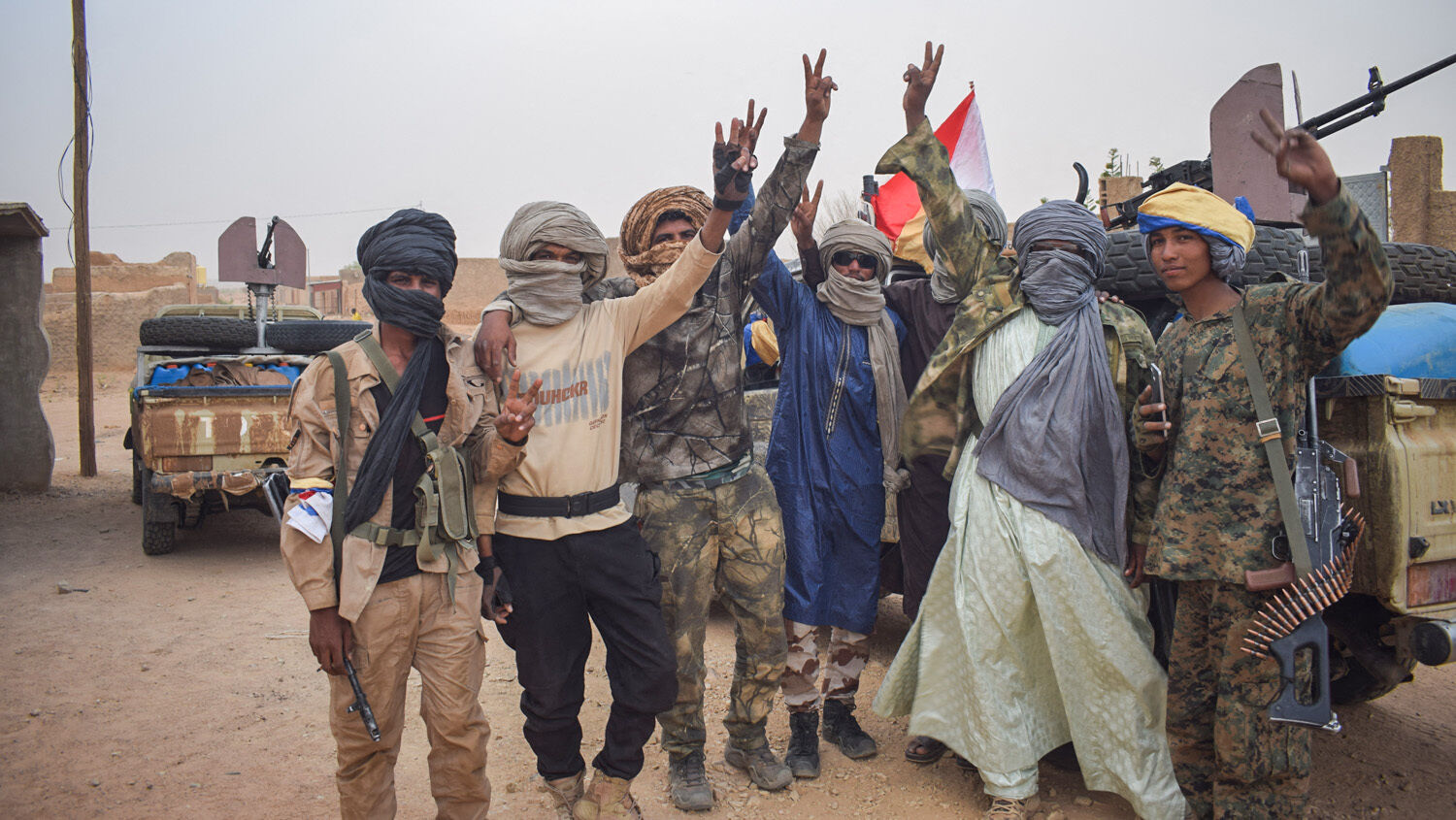
Mali exploded into violence on April 25, when a major, coordinated terrorist offensive erupted across every major region of the country at essentially the same time. This in a country over five times larger than the United Kingdom. This was the largest Malian anti-government offensive in over a decade.
The main culprit behind the attacks was Jama’at Nusrat al-Islam wal-Muslimin (jnim)—al Qaeda’s most significant African affiliate besides Somalia’s al-Shabaab. However, one particularly shocking aspect of this offensive is the fact that jnim joined forces with the Azawad Liberation Front (fla). The fla is not a terrorist group but merely seeks independence for the Tuareg ethnic group. The fla is actually a rival of jnim, but the two united against their common enemy last year and have wreaked havoc on the Malian government over the past few weeks. To add insult to injury, the Islamic State in the Sahel (known as IS-Sahel), though not part of the jnim-fla union, took advantage of the violence to launch its own attacks. It claims it seized two camps.
Perhaps most significantly, the rebels retook Kidal. Mali often cited its 2023 capture of Kidal, a former jnim stronghold, as proof it could contain the terrorist threat. It can no longer make that claim.
Overall, the situation is terrible for Mali. A suicide bomber killed Mali’s defense minister, and footage shows insurgents using advanced weaponry owned by the state—meaning parts of Mali’s defenses have been completely overrun.
Perhaps the worst part about Mali’s situation is its lack of foreign backers. In fact, it may have just lost its most significant supporter.
In 2023, Mali kicked out French and American soldiers and invited Russia to be its top security partner. Mali began hosting troops from the Russian mercenary Wagner Group, now called the Africa Corps. Russian troops have helped Mali fight terrorism for years, but these attacks were an embarrassment.
The day after the attacks, the Africa Corps confirmed it had struck a deal with the insurgents to allow its departure. It seems this departure was negotiated before the attacks were launched; jnim pledged not to attack Russians if they stayed out of the way. The Africa Corps left behind a lot of military equipment.
Russia suffered this embarrassing loss even though it has more troops in Mali than in any other regional ally—about 1,000. One senior Malian officer accused Russia of betraying Mali.
Mali seemingly has no friends in this struggle. Its close allies Burkina Faso and Niger stayed out of the situation. In 2023, the three nations withdrew from the Economic Community of West African States (ecowas) to form their own anti-terror alliance, the Alliance of Sahel States. Even though the union was essentially made to fight terrorism, when the jihadists warned Burkina Faso and Niger to stay out of Mali, they complied. And because Mali is no longer in ecowas, that group sent no more than a statement condemning the offensive. Relations with other neighbors have also deteriorated since Mali and Niger began accusing them of supporting terrorism. Similarly, Mali began accusing Algeria of working against it in 2024, so it’s unlikely Mali will receive any help from the north.
Since these attacks broke out, an all-too-familiar situation has developed. Rebel forces announced a total siege of the capital city of Bamako three days later. jnim’s last siege of Bamako, which lasted from September to January, nearly brought the country to its knees before it was eased.
The world now holds its breath to see whether Mali will fall to terrorists.
Even worse, this problem may be more widespread than just Mali. jnim is threatening the entire region.
Zoom Out
Mali, Burkina Faso and Niger are all doing a terrible job fighting the region’s terrorist problem.
Fifty-one percent of all terrorist-related deaths worldwide and one fifth of attacks came from the Sahel in 2024, according to the Global Terrorism Index (gti). The index says the region is “the global epicenter of terrorism.”
Concerning Burkina Faso, the Economist claimed over 66 percent of jihadist-linked deaths in the region happen here. Sixty percent of the country is currently controlled by jnim, and according to Crisis Group, jihadists are active in 11 of the 13 Burkinabe provinces. Thirty-nine towns are under siege by terrorists, affecting 10 percent of the population. War on the Rocks cited factors like these last year to warn that “Burkina Faso … is dying.”
The situation in Niger is similar. gti ranks Niger as the third-worst country on Earth when it comes to incidents of terrorism. Terrorist forces are working to encircle Niger’s capital to take control of the country. The government is responding by pulling troops back to the capital. Although this solidifies defenses in Niamey, it allows other areas to fall much faster. Niger’s military has largely stopped operating in the provinces of Tillaberi and Tahoua. Warfronts reported that the IS-Sahel presence in this region is very similar to how the Islamic State looked in the Levant before it was kicked out. IS-Sahel may also be working with jnim in Niger. This seemed to be the case in a January 29 attack that resulted in terrorists taking the capital airport, roaming around for a few hours, and leaving before the government could prepare a counterattack.
(Click here to see an interactive map showing areas of terrorist control across these three countries.)
This problem could spread to neighboring nations. There have been outbreaks of violence in Benin, Nigeria and Togo. In addition, some believe terrorists may have already entered Ghana and the Ivory Coast.
It’s going to be very difficult for Russia to help stop this spread. It’s been estimated that Russia has only about 100 troops in both Niger and Burkina Faso. That’s only a 10th of the 1,000 soldiers who failed to protect Mali from jnim’s latest offensive. Russia can’t devote many troops to the region because of having to devote many of its resources to Ukraine and because the fall of Syrian dictator Bashar Assad made it much more difficult for Russia to reach its African allies.
There’s another factor helping the terrorists recruit new fighters—the governments they’re fighting. In many cases, the federal governments of Sahel states are more brutal to their own people than the terrorists are.
The Armed Conflict Location & Event Data Project (acled) and Human Rights Watch recently reported that Mali’s and Burkina Faso’s federal forces have killed twice as many civilians as jnim and IS-Sahel combined. acled also reported that government and Russian forces were responsible for 77 percent of civilian deaths in the two years before the April 25 attacks. There have undoubtedly been more government-inflicted deaths than reported. The Russian forces helping these governments are reportedly violating civilians’ human rights even more. The situation is likely similar in Niger.
It also seems the federal killings are done on an ethnic basis. Foreign Policy said that in Mali and Burkina Faso, over 50 percent of deaths came from the Fulani ethnic group, even though it makes up only 10 percent of Mali’s population and 14 percent of the Burkinabe. When given the choice between fighting terrorism and fighting the government, many are siding with the jihadists.
The Threat
If terrorists win control of Mali, it could spell disaster for the region. The Council on Foreign Relations described Mali as “the linchpin of West Africa” and “an increasingly important theater of great power competition in the Sahel and Africa more broadly.” Events in Mali affect the rest of the region. It also notes that Mali is a mineral-rich nation, adding to its significance.
The recent jihadist attack could embolden terrorist groups in surrounding nations to ramp up attacks, as it did IS-Sahel. It’s also possible IS-Sahel and jnim could put aside their differences to more efficiently topple the Malian government.
Should Bamako fall, it’s unlikely the fighting would stop. Chances are jnim, IS-Sahel and the fla would turn on each other. This could lead to a unified international campaign against the jihadists.
The situation is full of unknowns, but every option seems terrible.
One can’t even say with confidence whether the Malian government will fall. Though it suffered major losses on April 25, it is fighting back. In addition, though multiple Russian bases negotiated a withdrawal with jnim, others stayed to fight. On May 6, Russia retook a base temporarily overrun by IS-Sahel.
However, these attacks raised serious concerns about Russia’s ability to defend the Sahel. Mali is rumored to be looking to replace Moscow as its chief security partner.
Currently, there’s no indication that Russia plans to leave the region anytime soon. But there’s also not much indication it will send in the necessary forces to stop or even dampen this problem. It’s likely, especially with the factors discussed earlier, that Russia will be pushed out of this theater sooner or later.
That begs the question: Who could replace Russia as the Sahel’s new security guarantor? Warfronts answered that question: “Almost everybody.”
What Happens Next?
There’s much speculation about the future of this region, but Bible prophecy may give insight into what tomorrow looks like for the Sahel.
The biblical book of Daniel contains prophecy for “the time of the end” (Daniel 11:40). One can easily prove this refers to our time today.
Verses 40-43 prophesy of a coming clash between “the king of the south” and “the king of the north,” which our free booklet History and Prophecy of the Middle East proves refers to radical Islam led by Iran and a coming united European military force. The end of this passage specifies that African nations Egypt, Ethiopia and Libya will fight in this clash, but they are not the only African powers discussed here.
“Whirlwind” in verse 40 indicates other African nations will play a role in this conflict. In his free booklet Germany’s Secret Strategy to Destroy Iran, Trumpet editor in chief Gerald Flurry shows how this refers to the king of the north surrounding Iran and its allies. This indicates African nations around Egypt, Ethiopia and Libya will soon side with Europe.
Russia is not included in this prophecy. It will not be a major player in this region for much longer.
Based on these verses, Mr. Flurry has warned that we will soon see a scramble for influence over African nations from Iran and Germany. The stage may already be set for this coming eruption.
Iran is moving into Africa. Through its Yemeni proxy, the Houthis, Tehran is spreading its influence throughout the Western shores of the Red Sea. The Houthis have allied with al-Shabaab, which is affiliated with al Qaeda. Even though Iran and al Qaeda are ideologically at odds, it seems they’re willing to ally for strategic reasons. “Ideological differences don’t matter when strategic interests align,” said Danny Citrinowicz, a fellow at the Institute for National Strategic Studies’ Iran Program and former head of the Iran desk at Israel’s military intelligence research division.
Right now, jnim is much further from Iran than al-Shabaab. But when Libya is in Iran’s camp, could we see a similar strategic alliance with Iran?
Or could Europe firmly reestablish itself in this region? Before it was kicked out, France did a much better job at repelling the terrorist threat than Russia is, and France still has assets in neighboring countries. If the opportunity arose, it seems safe to say Europe would be glad to reenter the region. Gaining control of this region could contribute to the coming “whirlwind” attack.
We don’t know which side these countries will end up on, but Bible prophecy shows that the implications of what’s happening in this region could affect the entire world. God wants us to watch this region. What’s happening in the Sahel could set the stage for incredible fulfillments of Bible prophecy.
To learn more about these prophetic forecasts, read Mr. Flurry’s article “Watch Algeria!”


