
The Moon Mission and the Overview Effect
The Moon Mission and the Overview Effect

Reid Wiseman said he is “not really a religious person.” But aboard a United States Navy recovery ship on April 10, he asked for a service chaplain to visit for a few minutes. “There was just no other avenue for me to explain anything or to experience anything,” he said. “And when that man walked in—I’d never met him before in my life,” but at the mere sight of someone who professed to represent the God of the Bible, “I just broke down in tears.”
Commander Wiseman and his three crewmates had just launched in a 32-story rocket, hammer-thrown their spacecraft around the globe, sling-shotted 350,000 miles, beheld Earth, witnessed the far side of the moon, watched Earthset, felt the three-dimensional depth of the galaxy, traveled farther from Earth than any human beings ever, and came back at 24 times the speed of sound to splash down in the Pacific Ocean. These four Artemis ii astronauts all experienced a remarkable expansion in their perspectives.
Perspective
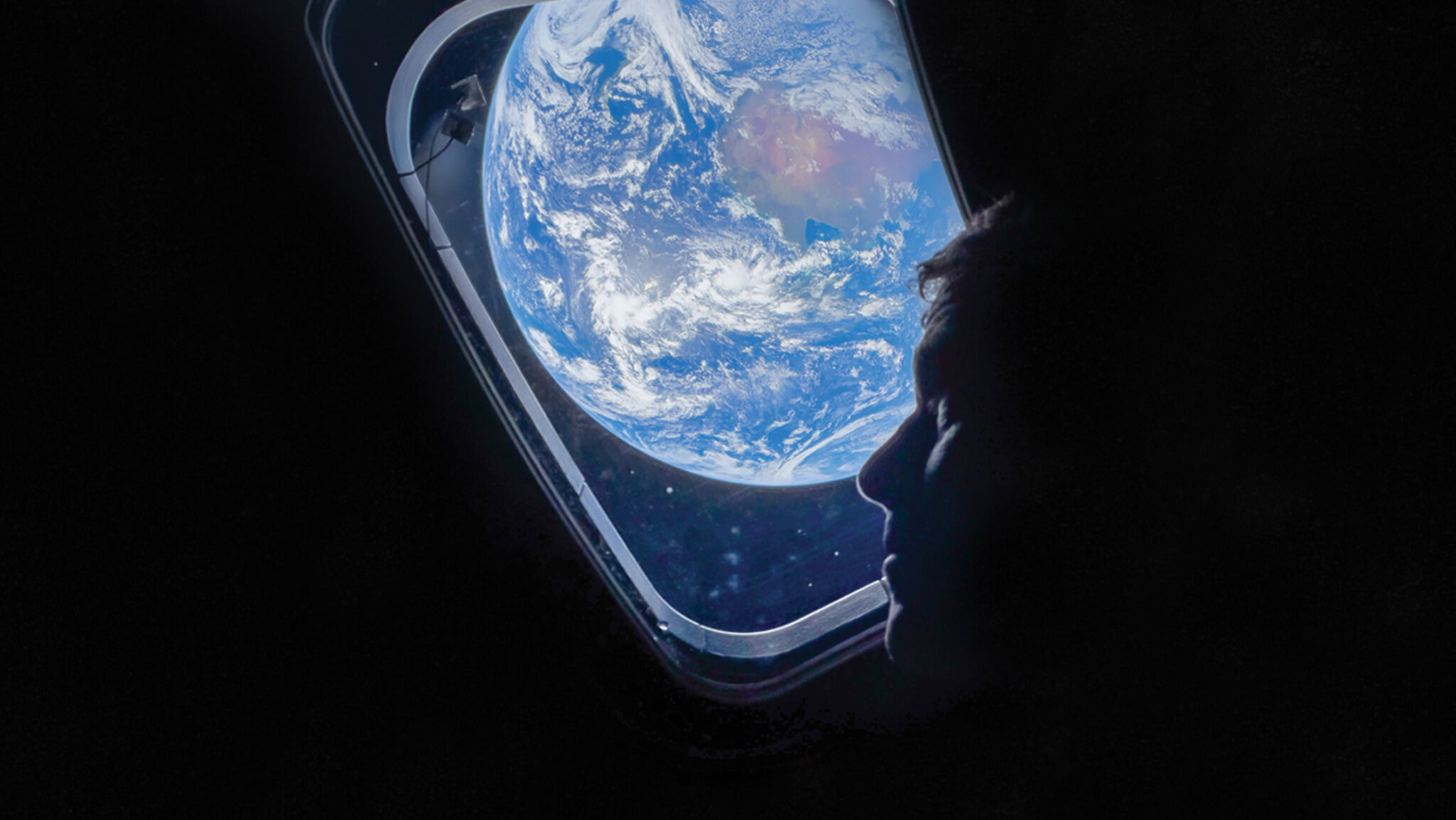
What is your perspective? Physically your viewpoint is somewhere around five feet above the ground, and on a flat plain, you can see about 3 miles to the horizon. If you climb a 1,000-foot hill, you can see for 38 miles. What a difference! From a 10,000-foot mountaintop, you can see for more than 120 miles; from an airplane window at 30,000 feet, more than 200 miles. Below, the tiny trees and miniature houses give you perspective on how small you yourself must look—and are. The first space tourists have reached altitudes of 50 miles, seeing 800,000 square miles of Earth at once, or 364 miles, viewing 9 million square miles. The moon astronauts saw the full circle of the Earth, about 99 million square miles.
“As we are so far from Earth and looking back at the beauty of creation, I think that, for me, one of the really important personal perspectives that I have up here is, I can really see Earth as one thing,” pilot Victor Glover said. “And you know, when I read the Bible and look at all of the amazing things that were done for us, who were created …. You guys are talking to us because we’re in a spaceship really far from Earth, but you’re on a spaceship called Earth that was created to give us a place to live in the universe, in the cosmos. Maybe the distance we are from you makes you think what we’re doing is special, but we’re the same distance from you, and I’m trying to tell you—just trust me—you are special. In all of this emptiness—this is a whole bunch of nothing, this thing we call the universe—you have this oasis, this beautiful place that we get to exist, together. … This is an opportunity for us to remember where we are, who we are, and that we are the same thing, and that we’ve got to get through this together.”
As the spacecraft approached its farthest distance from Earth, just before going out of radio contact as it passed behind the moon, Glover said, “As we continue to unlock the mysteries of the cosmos, I would like to remind you of one of the most important mysteries there on Earth, and that’s love. Christ said, in response to what was the greatest command, that it was to love God with all you are. And He also, being a great teacher, said the second is equal to it. And that is to love your neighbor as yourself.”
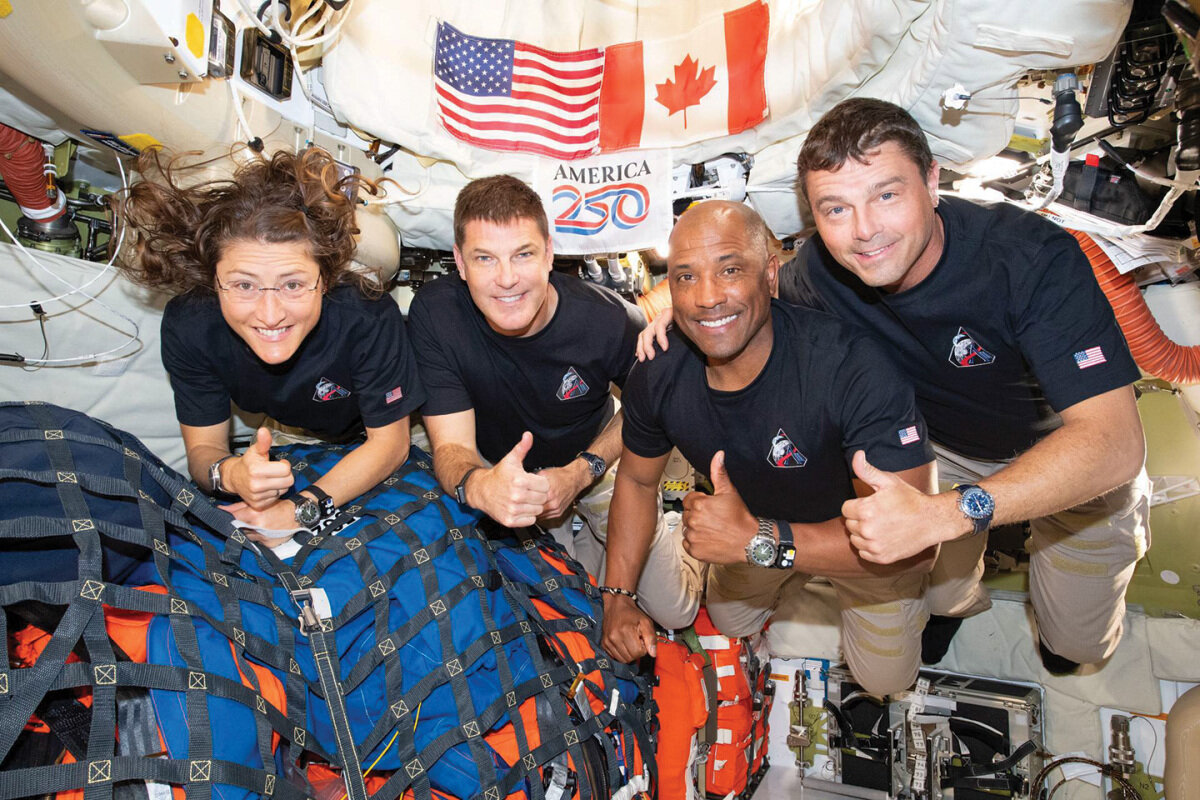
For 10 days in April, humanity looked up again. And there were four of us looking down, carrying human intelligence, perspective, songs, bursts of laughter, tears, care, emotion, grief, friendship, love and “moon joy” out into the blackness and back home again. And they urged us to understand something.
Others who went into space have had similarly profound experiences. In fact, it has a name: the Overview Effect.
Oasis in Infinity
Wiseman’s remark connecting what he had just experienced to the God of the Bible came in response to a reporter’s question about the Overview Effect. Recalling how an Apollo 14 astronaut had such a profound experience that he devoted the rest of his life to learning about human consciousness, the reporter pointed out that each of these moon astronauts had mentioned similar sentiments during the mission. “Do any of you feel as though you had an experience [of] this sense of universal connectedness: Did you experience a shift in consciousness, somehow?”
The response was Yes!
The man who organized the first national conference on the Overview Effect called our home planet an “oasis against the backdrop of infinity.”
One space tourist, age 90, was in space for less than five minutes, barely enough to see the curvature of the planet, and he came back filled with emotion, struggling to get out the words through the tears. He managed: “I hope I never recover from this. I hope that I can maintain what I feel now. I don’t want to lose it.” “All of a sudden, the blue was down below, and the blackness of space,” he said a few days later, still in awe. “Now, space is interesting: The universe lies there. But at that moment, in that big window, it was only black and ominous, and that was death, and this was life, and everything else just stood still for a moment. I was overwhelmed with the experience, with the sensation of looking at death and looking at life.”
One Apollo astronaut said you experience “an explosion of awareness” and an “overwhelming sense of oneness and connectedness … accompanied by an ecstasy … an epiphany.”
The first humans to see the full disk of the Earth, the crew of Apollo 8, actually read Genesis 1 out loud to humanity.
The Overview Institute says when you see Earth from space, it “is immediately understood to be a tiny, fragile ball of life, hanging in the void, shielded and nourished by a paper-thin atmosphere.”
No wonder this moves people—and so many of them are also moved by the Bible without even knowing why.
Like physical elevation, elevating your spiritual viewpoint also helps you grasp reality far better.
Consider God’s vantage point: “For as the heavens are higher than the earth, so are my ways higher than your ways, and my thoughts than your thoughts” (Isaiah 55:9). God inhabits eternity; His character is perfect. He created energy, gravitation, thermodynamics, electromagnetism, quantum mechanics and radiation. He made light, atoms, mass, moons, planets, stars and galaxies. He formed bacteria, tarantulas, octopuses, peacocks and orangutans. And He made you and me in His own image. How vast is His understanding! Meanwhile, we are made from dust; we lead brief lives; we are distractable and self-absorbed.
Yet remarkably, God wants to lift us out of our tiny world and share His transcendent thoughts and all-encompassing perspective with you and me!
Look up! See the stars. Feel that awe and wonder and transcendence. Get the big overview, and let your wonderment and ambition soar toward those stars because you were created to go and bring life to planets that orbit them!
Cosmic Perspective
At this point, physical life exists in only one place in all the universe: the place where God renewed the surface, said Let there be light and planted it with life. If you compare the Earth to a basketball and the moon to a tennis ball, the farthest humans have gone away from it is 23 feet. This planet is so precious and important. Understand the overview, though, and you realize that it is just a launchpad!
God sees this view all the time. He “sitteth upon the circle of the earth, and the inhabitants thereof are as grasshoppers …” (Isaiah 40:22). Consider His perspective on the conflicts that divide us and the need to create one global society with a united will, a world of real peace!
It takes the 200 to 400 billion stars within this galaxy to complete one revolution around its center point about 250 million years. And this is but one galaxy in a universe that contains some 2 to 3 trillion galaxies.
God has a name for every last one of the hundreds of billions of stars that compose each of those trillions of galaxies (Isaiah 40:26). Why? Because He created all those stars, and the planets that orbit them, for a marvelous purpose!
God wants us looking up at the heavens—but not to get distracted by a bunch of physical matter. Verse 26 says, “Lift up your eyes on high, and behold who hath created these things …”! See the Creator, and behold His cosmic ambitions. He is rocketing toward those ambitions by what He accomplishes in the lives of His people today.
The closer we are to things on Earth, the more caught up in life’s niggling trivialities we are. But the more we elevate our thinking, the more we will experience a type of that Overview Effect: the needed perspective and sense of awe, wonder and transcendence.
The Apostle Paul had a far-reaching spiritual perspective. “Set your affection on things above, not on things on the earth,” he wrote (Colossians 3:2).
To “set your affection” requires you to be intentional and to work at it, day after day. Coming to think like God takes real effort, and even then, you need God’s Spirit. We are only scratching the surface of “the breadth, and length, and depth, and height … which passeth knowledge,” “the deep things of God” (Ephesians 3:16-19; 1 Corinthians 2:9-10). We always have more spiritual work to do to ascend above the pulls of the flesh, the lust of the eyes, the allure of the world, the weeds of distraction—and to think like our infinite Creator.
Overview Effect author Frank White says that from space, you don’t see the sun in a blue sky. You see it as a star in a black sky. “So you are seeing it from a cosmic perspective.”
A cosmic perspective is difficult to achieve with our eyes only five feet above the ground, but it is exactly what we need.
You exist in a creation that proves the reality of the Creator and His love. You were created to have a relationship with that Creator. You are here on Earth to learn to see what He sees. God wants us to look up at the heavens, to see the galaxy in 3-D. Why?
Isaiah 40:26 says, “Lift up your eyes on high, and behold who hath created these things …”!
There is a reason why the rockets, the clouds, the blackness, the brightness, the humanity, the stars stir deepest awe in us.
“And God said, Let us make man in our image, after our likeness ….”
See your Creator. Behold His cosmic ambitions—for you!
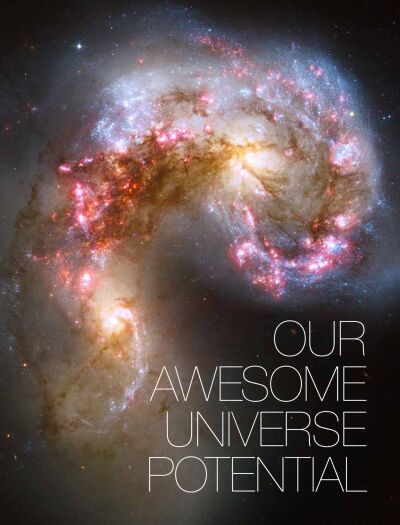
The Hubble Space Telescope is one of the greatest developments of modern science. Human beings, made in the image and likeness of God, are probing deeply into the universe as never before observing the Creator’s handiwork. Those Hubble pictures should give this whole world a great deal more hope not only because those countless awesome galaxies point us to their Creator and His limitless power. It is also because, when understood according to the revelation in the Bible, they expand our understanding of the incredible human potential God has given us!


