

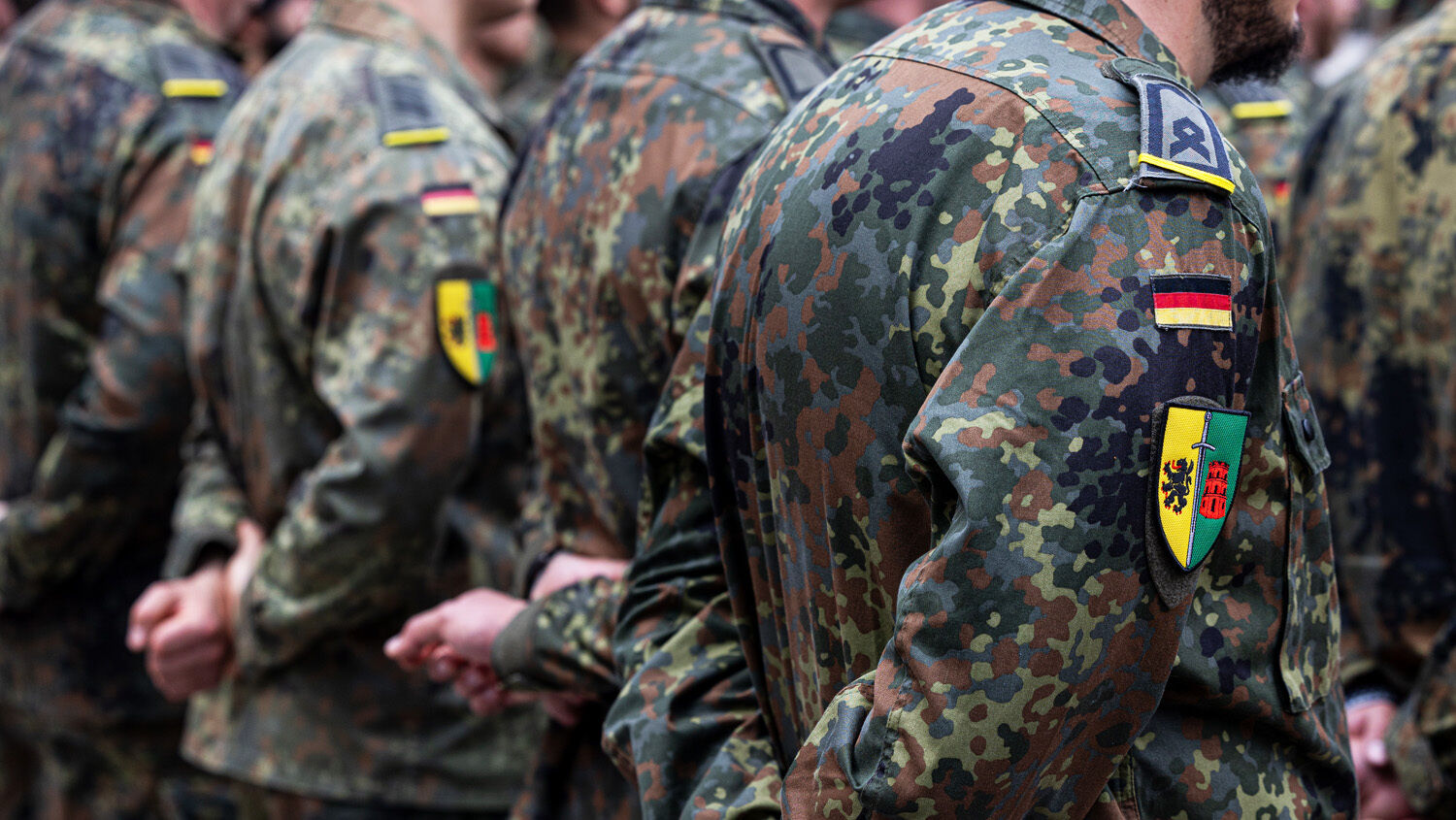
The Bundeswehr Is Coming After Me
As a German citizen living abroad on a temporary visa, I am directly affected by a clause in the new German military conscription law. The law states that men ages 17 to 45 must obtain permission from the German Armed Forces if they wish to stay abroad for more than three months. This change, which took effect on January 1 but had until now gone unnoticed, is part of the German government’s efforts to prepare the country for war.
For now, the government reassures us that the law is not strictly enforced and permissions will be granted automatically. Nevertheless, I can’t help but wonder what would happen if this automatic permission were to be withdrawn. In theory, my ability to live abroad suddenly depends on the permission of the German military.
Around 15 million German men fall into this age category and are affected by the law.
It used to be that such authorization was needed only in a state of tension with an imminent military threat—not in peacetime. But the Military Service Modernization Act, approved on Dec. 5, 2025, by the Bundestag and two weeks later by the Bundesrat, makes it possible to require it at all times.
Some European countries have similar laws in place to ensure military preparedness, including the assessment of military personnel. But it is not just the law itself that has raised suspicion; it is the manner in which the change was introduced. There was no public debate surrounding the new law, and the change was not publicly announced or clarified after it was passed.
After the German media, starting with the Frankfurter Rundschau, reported on the new law on April 3, the Defense Ministry said approval would be automatically granted as long as military service remains voluntary. However, it was later forced to admit that automatic approval has no legal basis yet.
Attempts to de-escalate the situation only made matters worse and fueled speculation that conscription was being planned, regardless of how many volunteers joined the military. Given Russia’s ongoing invasion of Ukraine and the United States’ threat to withdraw its troops from Europe, conscription could quickly become a hard reality.
Constitutional law expert Volker Boehme-Neßler told Bild: “They want to show: We are serious about the Bundeswehr. The screws are being tightened.”
It is unclear how such a law will impact Germany’s defense readiness. But it does send a clear message to the populace: If war is breaking out, you are on our list no matter where you are.
“In an emergency, we need to know who is potentially staying abroad for a longer period,” a ministry spokeswoman told German media.
‘Authoritarianism and Militarization Go Hand in Hand’
War clouds are gathering over Germany, and we are already hearing the occasional clap of thunder.
Conservative German newspaper Welt wrote:
Let’s not kid ourselves. It couldn’t be made any clearer that the situation in Europe is growing increasingly serious. The government wants to know where its young men are again, so it can draft them. That’s the message between the lines. The government is once again thinking in terms of mobilization.
Just imagine a 17-year-old student who wants to study abroad or a 45-year-old man who receives a new job opportunity needing to discuss these plans with the Bundeswehr career center. This may be understandable when war could break out at any moment, but with Germany surrounded by allies and Russia stuck in Ukraine for the last four years, it appears unreasonable.
The left-wing opposition is outraged. Nicole Gohlke, deputy parliamentary group leader of the Left Party, called the rule “a scandal that shows authoritarianism and militarization go hand in hand.”
Over the past 10 years that I have lived abroad, I have witnessed Germany’s transformation through the refugee crisis and the coronavirus pandemic. Both crises left a permanent mark on German society, which I could see every time I returned home. But Germany’s military transformation has far greater implications.
German students are undergoing medical examinations assessing their fitness for the military. Older Germans are being alerted that they may be called on to fight for the country. Businesses have been asked to come up with emergency plans for wartime. Manufacturing lines are being repurposed for death ware. The German government removed the debt brake to release hundreds of billions of euros to drive forward the country’s militarization. France’s president announced that he will station French fighter jets equipped with nuclear weapons in Germany.
Mainstream publications in Germany and around the world are praising these military efforts. Some think it’s not enough. Welt wrote:
The state is re-registering its men to conscript them as soldiers. However, it doesn’t have a functioning army. This creates the fatal impression that there is more resolve in infringing on fundamental rights than in protecting lives. … The same government that suddenly becomes very meticulous when it comes to an 18-year-old with a backpack is surprisingly lax when it comes to itself. The problems with the discredited Bundeswehr Procurement Office continue.
If, in the end, young men and women are equipped with substandard gear, it creates the dangerous impression that while the government readily restricts their fundamental rights, it does not do enough to protect them and puts their lives at risk all too carelessly.
The overall consensus is that Germany needs to spend more, and spend it more efficiently, before it can call its troops to arms.
Almost nobody is concerned about Germany’s past repeating itself. Germany has done a marvelous job presenting itself as a new nation, completely transformed from World War ii. After all, if you ask for permission to leave the country, you don’t have to get the approval of a SS officer with blood on his hands. The German military is for defense, people reason.
But if you look at these facts without this predetermined narrative, you see the developments in a frightening new light. There are many parallels to the events that led up to World War ii. We tend to pride ourselves on being more advanced than previous generations, yet the reality is we aren’t any better. The Bible reveals in 2 Timothy 3 that human nature is only getting worse.
Do I Need to Fear?
So what if a militaristic leader takes charge of this rising German military machine? What if military plans of the past are revived by those in charge? What if new propagandists refashion the narrative? What if the plans of the Nazi underground are successfully worked out today?
Is our society really so advanced that it would not repeat past mistakes? Isn’t the hatred that led to the murder of millions of Jews comparable to the hate shown against the State of Israel today?
The Bible gives clear and direct answers to all these questions. We don’t have to guess where world events are leading. Revelation 17 clearly reveals that the old empire is rising again in our day, as we explain in our literature. To prove these prophecies, request a free copy of Germany and the Holy Roman Empire.
The question remains: Do I need to fear that a changing law in Germany can affect me directly?
In Matthew 10:28, Jesus Christ tells us that even though authorities have the power to take our physical lives, they have no power beyond that. “Fear them not therefore: for there is nothing covered, that shall not be revealed; and hid, that shall not be known” (verse 26).
Our goal should be to say: “The Lord is on my side; I will not fear: what can man do unto me?” (Psalm 118:6).
Right now, it’s easy to say this. There is no imminent threat. The persecution from this world hasn’t set in. But the time will come when our trust in God will be tested. The German Army will come after us one way or another. Are you prepared?


