

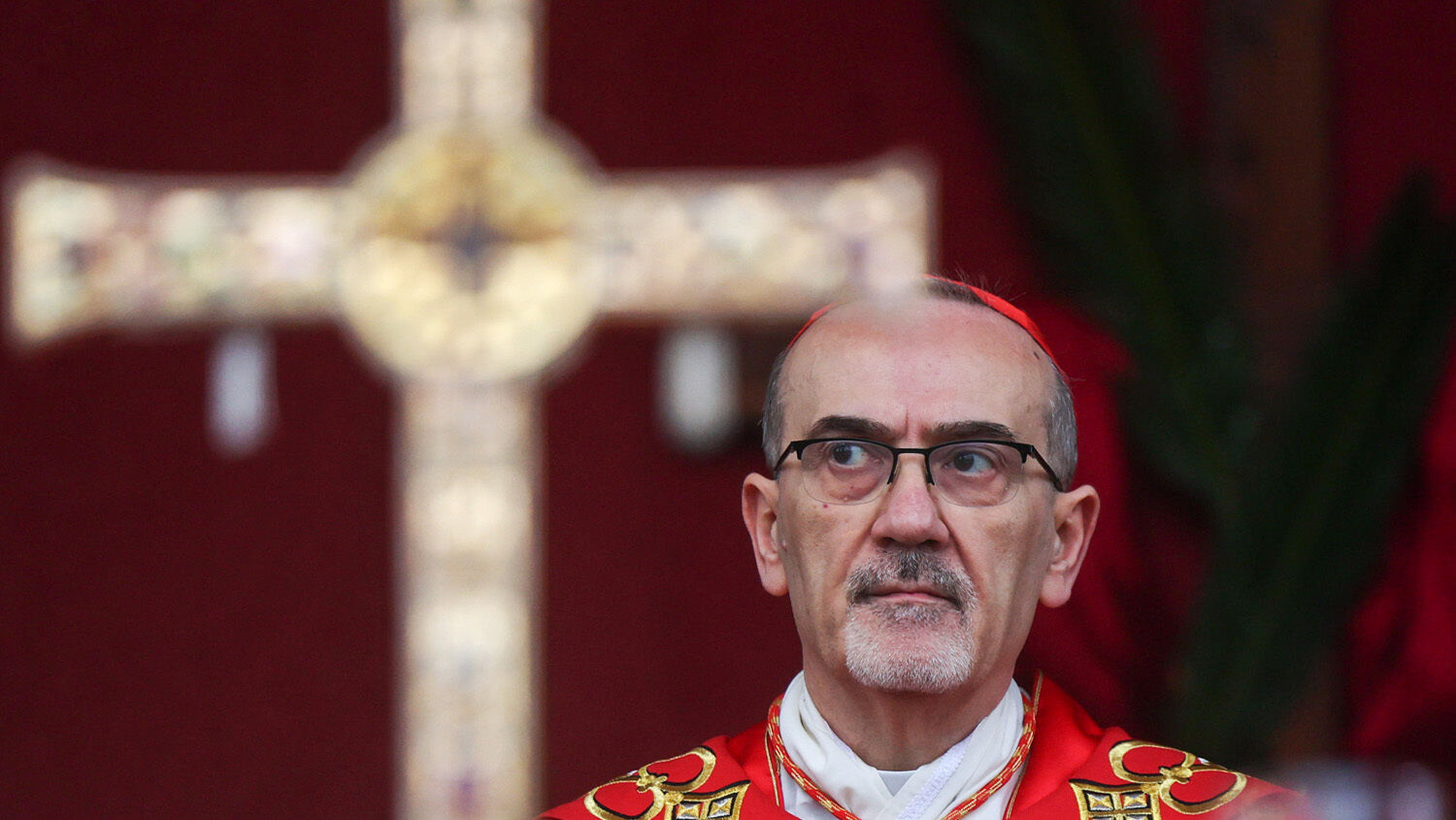
Pizzaballa Gives a Master Class on How to Stir Up a Crusade
Over the weekend, Cardinal Pierbattista Pizzaballa created a stir that received global attention but little to no critical analysis. If our media had a better understanding of the history of the Roman Catholic Church, they would know what Pizzaballa was up to. His office as the Latin patriarch of Jerusalem was founded during the First Crusade, and it appears he is following that history. Before you dismiss this, compare some facts.
Israel is facing constant bombardment from Iran, making it difficult for its air defense system to intercept all the attacks. Consequently, larger gatherings have been banned. It’s simply too difficult to ensure everyone’s safety. Israeli officials have also closed several holy sites in Jerusalem, including the Church of the Holy Sepulchre and al-Aqsa Mosque.
The Old City of Jerusalem wasn’t built with modern shelters and escape routes, so early in the war, Israel closed off access. “The gates of the Old City were closed by Israeli police to everyone but residents,” the Times of Israel wrote on March 1. “A crowd of Hasidic Jews argued with officers, petitioning for entry to pray at the Western Wall, but ultimately gave up and turned back.”
Few people noticed this incident, but a related one made global headlines.
Pizzaballa, knowing that Israel had closed several holy sites in Jerusalem, walked to the Church of the Holy Sepulchre for Palm Sunday and, as expected, was stopped by Israeli police.
Consequently, the Latin Patriarchate of Jerusalem put out the following statement:
This morning, the Israeli Police prevented the Latin patriarch of Jerusalem, … Cardinal Pierbattista Pizzaballa, head of the Catholic Church in the Holy Land, together with the custos of the Holy Land, … Fr. Francesco Ielpo, ofm, the official guardian of the Church of the Holy Sepulchre, from entering the Church of the Holy Sepulchre in Jerusalem, as they made their way to celebrate the Palm Sunday mass.
The two were stopped en route, while proceeding privately and without any characteristics of a procession or ceremonial act, and were compelled to turn back. As a result, and for the first time in centuries, the heads of the church were prevented from celebrating the Palm Sunday mass at the Church of the Holy Sepulchre.
This incident is a grave precedent and disregard the sensibilities of billions of people around the world who, during this week, look to Jerusalem. …
Preventing the entry of the cardinal and the custos, who bear the highest ecclesiastical responsibility for the Catholic Church and the holy places, constitutes a manifestly unreasonable and grossly disproportionate measure.
This hasty and fundamentally flawed decision, tainted by improper considerations, represents an extreme departure from basic principles of reasonableness, freedom of worship and respect for the status quo.
This makes no mention of the Iran war, the security measures, gratitude for Israel’s security forces or anything that explained the situation. Instead, it was an attack against Israel.
“What followed was a textbook example of how social media works today: In the blink of an eye, a global scandal erupted,” Germany’s Jüdische Allgemeine wrote. “Just hours later, it was reported that the cardinal had been denied entry to the Church of the Holy Sepulchre ‘for the first time in centuries’ (which certainly did not refer to the cardinal’s age). In secular Germany, some got the impression that the next crusade was just around the corner.”
Almost no one believes that anything remotely similar to a crusade could ever happen again. But consider that this is allegedly “the first time in centuries” that entry has been denied to the Church of the Holy Sepulchre and that this incident sets “a grave precedent,” as the Patriarchate wrote.
This is an accusation against the authorities in Israel similar to those of the times of the Crusades.
“Cardinal Pizzaballa does not need to ask for permission to go to his own church. That’s his church,” United States political commentator Jack Posobiec wrote to his 3 million followers on X. “Never forget that the Crusades were defensive and justified,” he claimed. “Defend the Church of the Holy Sepulchre.”
Italian Prime Minister Giorgia Meloni said the police action “constitutes an offense not only against believers but against every community that recognizes religious freedom. The Church of the Holy Sepulchre in Jerusalem is a sacred site of Christianity and, as such, must be preserved and protected for the celebration of sacred rites. Preventing the patriarch of Jerusalem and the custos of the Holy Land from entering, especially on a solemnity central to the faith such as Palm Sunday, constitutes an offense not only against believers but against every community that recognizes religious freedom.”
The foreign-policy spokesman of Germany’s Christian Democrats, Armin Laschet, said:
Prohibiting the pope’s representative from visiting the holiest site in Christendom during Holy Week breaks with a centuries-old tradition of free access to the Church of the Holy Sepulchre. … For all those who stand firmly by Israel in the face of the threat to its very existence, the attack on Christianity is a slap in the face.
Jüdische Allgemeine wrote:
The political arena didn’t hold back—whereas Europe’s politicians usually let the weekend pass even when wars break out, this time everyone spoke up—from the Hungarian and Spanish prime ministers to Armin Laschet. All outraged, of course. It leaves a bitter aftertaste: Who is reacting out of conviction—and who is simply seizing an opportunity to lash out at Israel?
This is another point to consider. While the world today is one of widespread secularism, it is also a world of great animosity for the State of Israel. Incidents like these unite the religious world with the secular against Israel.
Some have asked: Why is the Israeli government able to restrict access to one of the Catholic Church’s most holy sites? This doesn’t make sense to them. This allegation is oblivious to historical precedent. The Israeli government has done an extraordinary job of enabling the Catholic Church access to these sites. When the Catholic Church ruled Jerusalem, other religions, including other Christian sects, were not only treated with less tolerance but also killed.
And how did it start? Often with a call for access to Jerusalem’s holy sites.
Fight Over Jerusalem
Urban ii put it this way in a speech at the Council of Clermont in 1095:
Let the holy sepulchre of the Lord our Saviour, which is possessed by unclean nations, especially incite you, and the holy places which are now treated with ignominy and irreverently polluted with their filthiness. … Enter upon the road to the Holy Sepulchre; wrest that land from the wicked race, and subject it to yourselves.
At the time, Jerusalem was under the control of the Seljuk Turks. In 1098, however, the Fatimid Caliphate of Egypt retook the city—by which point the First Crusade was already underway. As a result, when the crusaders reached Jerusalem in 1099, they captured it from the Fatimids.
At the core of the Crusades “was a desire for access to shrines associated with the life and ministry of Jesus, above all the Holy Sepulcher, the church in Jerusalem said to contain the tomb of Christ” (metmuseum.org).
The Crusades are infamous. And high-ranking Catholics, especially those serving in Jerusalem, should be familiar with them.
Some historians debate the extent to which Catholic bishops directly incited crusader violence. In some cases, clergy explicitly endorsed the killing of “infidels” within the framework of holy war. In others, their rhetoric was more ambiguous yet still framed in ways that many contemporaries interpreted as legitimizing, or even encouraging, such action.
Consider that in the context of what Pizzaballa said. He did not call for a crusade. In fact, he has condemned the idea of a crusade led by the U.S. against the murderous Iranian regime. Still, his statements are stirring up hatred against the Israeli government.
Catholics who want to see this city under international rule—read, Catholic rule—will become more fervent and urgent when they see the highest Catholic figures in Jerusalem “suppressed.” They will believe that as long as Israel rules the city, Catholic access will never be assured. They may then reason, like Urban, that they must enter “upon the road to the Holy Sepulchre; wrest that land from the wicked race, and subject it to yourselves”—with whatever means necessary.
Frankfurter Allgemeine Zeitung asked Pizzaballa: “[Y]ou preside over an institution that dates back to the time of the Crusades. When were Christians in the Holy Land last under such pressure as they are today?” He responded: “Aggression against Christians is not new. What is new is the frequency with which they happen—and the fact that they are almost a ‘normal’ phenomenon. I think it started about 20 years ago—and has increased since then. You can no longer call it episodic” (July 13, 2023).
What an accusation!
What Happens When the Catholics Rule?
The Holy Land under Muslim rule was often a relatively safe haven for both Christians and Jews. In fact, as Terry Jones and Alan Ereira write in Crusades, it was safer for some Christian sects to live under Muslim rule than Catholic rule. That changed when the crusaders conquered Jerusalem. Jones and Ereira write:
As the first wave of crusaders swept down from the north wall, the Moslems fell back to the temple area to seek refuge in the Dome of the Rock and the al-Agsa Mosque, but in vain. Tancred and his men pursued them. He desecrated and pillaged the Dome of the Rock and bottled the Moslems up in the al-Aqsa Mosque and on its roof. …
The next day a band of crusaders forced an entry into the al-Aqsa Mosque and—despite the protection of Tancred’s banner flying above the building—slew everyone there, men, women and children, “among them a large number of imams [religious leaders] and Moslem scholars, devout and ascetic men who had left their homelands to live lives of pious seclusion in the holy place.” At the same time, the synagogue in which the Jews had sought shelter was set on fire and everyone in it was burned alive.
Muslims and Jews, who were living in relative peace, were both slaughtered under Catholic rule. And they weren’t the only ones to face the religious persecution. Notice what the authors write next:
Having killed almost the entire population, they were in possession of a large, empty city which was, of course, the biggest tourist center in the world.
It had been in the hands of the Moslems for 461 years. Nonetheless, the majority of the population had remained Christian. During most of that time, the Moslems had protected the rights of the Christians. Of course, the Moslems retained overall control—even today the key to the Church of the Holy Sepulchre remains entrusted to a Moslem. …
With the triumph of the Latin Christians, however, things were going to change. They had come to rid Jerusalem of all other religions and to make it a purely Christian city—and, what’s more, Christian in their terms. The Orthodox Greek Christians, the Georgian Christians, the Armenian Christians, the Jacobite Christians and the Coptic Christians, who had been expelled in the leadup to the siege, quickly discovered that victory had not been on their behalf. Their priests were banished from the Church of the Holy Sepulchre. They were not even allowed to hold services there.
Did you catch that? The Latin Catholic crusaders banned other Christians from the Church of the Holy Sepulchre. The very church that Pizzaballa was temporarily barred from has been a battleground for centuries, and the most brutal suppression came from the Catholics. But this history is even more outrageous and directly connects to Pizzaballa’s office today. Continue:
Meanwhile the ecclesiastical hierarchy of Jerusalem became exclusively Latin. Most insufferable of all was the fact that the new patriarch, Arnulf of Rhodes, proved himself to be quite capable of torturing his fellow Christians in order to find out where they had hidden their portion of the True Cross. Torture appears to have loosened their tongues, but it also hardened attitudes between the Oriental and Western churches.
This is how the Latin Patriarchate of Jerusalem began.
A Prophesied Last Crusade
“They are called the Christian Crusades,” Trumpet editor in chief Gerald Flurry explains in The King of the South. “That label itself is a deception. They were primarily Catholic Crusades. Other Christian denominations have their problems, but let’s not blame them for what the Catholics did—and will do.”
While we can see the seeds of yet another crusade being laid today, Bible prophecy is the only source that can predict the future.
Daniel 11:40-45 prophesy of a great clash over Jerusalem in the “last days”:
And at the time of the end shall the king of the south push at him: and the king of the north shall come against him like a whirlwind, with chariots, and with horsemen, and with many ships; and he shall enter into the countries, and shall overflow and pass over. He shall enter also into the glorious land, and many countries shall be overthrown: but these shall escape out of his hand, even Edom, and Moab, and the chief of the children of Ammon. He shall stretch forth his hand also upon the countries: and the land of Egypt shall not escape. But he shall have power over the treasures of gold and of silver, and over all the precious things of Egypt: and the Libyans and the Ethiopians shall be at his steps. But tidings out of the east and out of the north shall trouble him: therefore he shall go forth with great fury to destroy, and utterly to make away many. And he shall plant the tabernacles of his palace between the seas in the glorious holy mountain; yet he shall come to his end, and none shall help him.
We know that we live in the last days. A nuclear world war threatens the very survival of humanity, as prophesied in Matthew 24. North of Jerusalem is Catholic Europe, where the Holy Roman Empire has ruled for centuries. Revelation 17 describes this empire as a woman, or a church, riding a beast, or an empire.
In the prophecy in Daniel 11, we see this church-state empire fight for Jerusalem.
In The Eternal Has Chosen Jerusalem, Mr. Flurry writes:
The Jews have Jerusalem now, but not for long. Both Muslims and Catholics have long-cherished designs for this city. These two powers are about to clash again—in the final crusade over Jerusalem.
The Bible refers to these two forces as “the king of the north,” led by Germany, and “the king of the south,” led by Iran. “And at the time of the end shall the king of the south push at him: and the king of the north shall come against him …” (Daniel 11:40). This push by the king of the south will probably be directly related to Jerusalem. It could well be the Arabs, incited by Iran, conquering half the city! The Palestinians could—and, I believe, will—conquer the Temple Mount and refuse access to anybody else. This would rapidly unite Europe and the Israeli Jews against them. This “push” could also involve cutting off oil—of which Europe receives more than a third of its supply from the Middle East—to punish the king of the north over a dispute about this city.
Today’s animosities show the Catholic Church’s strong desire to rule Jerusalem. The Bible reveals that it will fight for it and shed much blood. Radical Islam and the Jews will suffer at the Catholics’ hands. As Mr. Flurry writes:
This is the period of “great tribulation” Jesus foretold in Matthew 24:21. It is the bleak darkness that precedes the dawn of a new age. Jerusalem will become a city of unparalleled glory. Its name will resound throughout the nations and reverberate throughout the cosmos for its greatness. Yet sadly, before that occurs, this city will first be baptized in blood. God prophesies of a cataclysmic clash that leads to its subjugation and ruin.
And events today in the Middle East, Europe and elsewhere show that we have never been closer to these earthshaking prophecies being fulfilled!
Read “The Last Crusade” to learn how God will intervene. As you watch world events, you will see prophecy come alive.


