

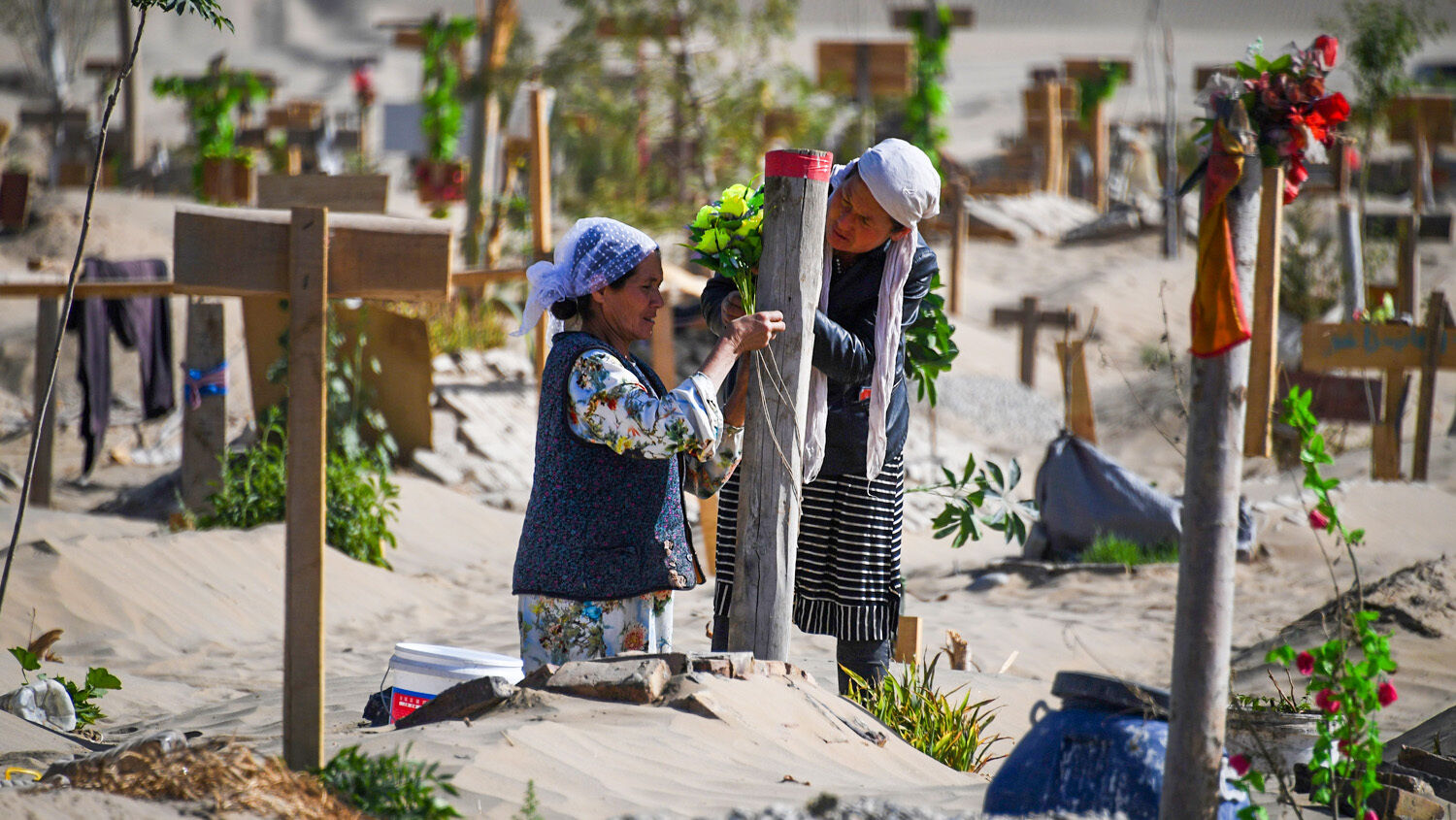
China’s Genocide on Uyghurs: Global Attention Has Moved On—the Brutality Hasn’t
The Uyghur people of northwestern China continue to be “systematically strangled” by the Chinese government, even as the world’s attention has shifted away, Uyghur American diplomat Salih Hudayar told the Trumpet in a recent interview.
The Uyghurs are a Turkic-speaking, predominantly Muslim people indigenous to the Xinjiang region, which they call East Turkistan. They see this area as their rightful homeland and long to make it an independent nation. But the Chinese Communist Party keeps the region firmly in its grip, working to weaken the Uyghur identity and crush the population into obedient instruments of the Chinese state.
This is accomplished through one of the most extensive and brutal crackdowns in modern history. The Chinese have transformed Xinjiang into one of the world’s most tightly controlled surveillance states, marked by hundreds of thousands of security checkpoints and millions of cameras tracking citizens’ every move. “Uyghur cultural, religious and linguistic life is systematically strangled, effectively restricted, or outright banned,” Hudayar said.
Far more nightmarish are hundreds of so-called vocational training facilities and reeducation centers that the Chinese government operates in every district of Xinjiang. Despite their benign labels, these are operated as concentration camps. Inside, authorities use psychological coercion and physical abuse to stamp out religious loyalty and turn detainees into compliant subjects.
Up to 3 million Uyghurs have been held in these facilities, with former detainees describing widespread indoctrination, beatings, forced medication, sterilizations, starvation, forced labor, sexual violence and torture. Those who refuse to abandon their beliefs in favor of what officials portray as “superior” mainstream Han Chinese culture face severe punishment—in some cases, death.
In January 2021, during the final days of United States President Donald Trump’s first term, the U.S. State Department formally designated China’s actions against the Uyghurs as “genocide.”
Hudayar says this designation was well founded. “This is a 21st‑century model of genocide,” he said, “that relies less on immediate mass killing and more on destroying a people’s capacity to exist as a distinct [group] through birth‑prevention policies, family separations, mass enslavement via forced labor, and the destruction or repurposing of mosques, shrines and other cultural sites.”
The U.S. government’s designation led many countries to impose sanctions on goods produced with forced Uyghur labor. At the same time, media outlets and human rights organizations consistently sounded the alarm about the Chinese Communist Party’s mass detention, forced labor and other atrocities.
But five years later, the world’s attention has all but disappeared, with only 0.03 percent of English-language news coverage now about the Uyghurs—a percentage less than one sixth of that seen in the months just after the genocide designation.
“Media attention and activist focus have shifted away,” Huyadar said, “because governments, including the United States, have chosen to de‑prioritize this issue in light of their geopolitical and economic interests.”
“At the same time, other global crises have crowded the international agenda, pushing Uyghur suffering to the margins while governments, media and many activists concentrate on issues they view as more immediate or politically convenient,” he added.
“Compounding this neglect, the Chinese state has mounted an intensive propaganda and disinformation campaign designed to confuse audiences,” he said. This is accomplished by flying in foreign journalists and influencers for carefully managed tours that sanitize reality and depict Xinjiang as peaceful and thriving. They “create the illusion of normalcy and portray manufactured ‘stability’ as progress,” Hudayar said.
For these reasons, the world is no longer watching or decrying the atrocities underway in Xinjiang. But that doesn’t mean the torment and suffering have ended.
“The world must understand that China’s genocide against Uyghurs and other Turkic peoples is continuing,” Hudayar said. “Millions remain imprisoned, confined in concentration camps, or subjected to forced labor in factories linked to global supply chains. Over a million Uyghur children are still forcibly separated from their families ….”
Hudayar believes that until the core issue is dealt with, the suffering will persist. He said:
Crucially, no government and no major international institution has yet addressed the root cause of this genocide: China’s colonization and military occupation of East Turkistan. Appeals for “improved human rights,” “cultural rights” or even “genuine autonomy” under continued Chinese rule ignore the hard lessons of the past 76 years of occupation and 70 years of so‑called autonomy, as well as more than a decade of genocide met with international silence and inaction. The world must understand that only by restoring East Turkistan’s national independence and securing our people’s fundamental right to self‑determination can the human rights, freedom and very existence of the Uyghur and other Turkic peoples be genuinely protected.
“The Climax of Man’s Rule over Man,” by Trumpet editor in chief Gerald Flurry, takes a close look at biblical prophecies about the “times of the Gentiles,” an era when ruthless powers would emerge and spread brutality across the world. He wrote that American and British leadership helped underwrite decades of global stability because of their biblically influenced principles, such as the rule of law and the inherent dignity of the individual.
But that age is ending. In this new epoch, brutal regimes like the one ruling China are growing stronger and increasingly intent on dominating ever more people. Mr. Flurry highlighted the atrocities unfolding in Xinjiang as a stark warning of the darkness this new era will bring. But he also showed that these developments ultimately bring very good news with them.
To understand, read “The Climax of Man’s Rule Over Man.”


