

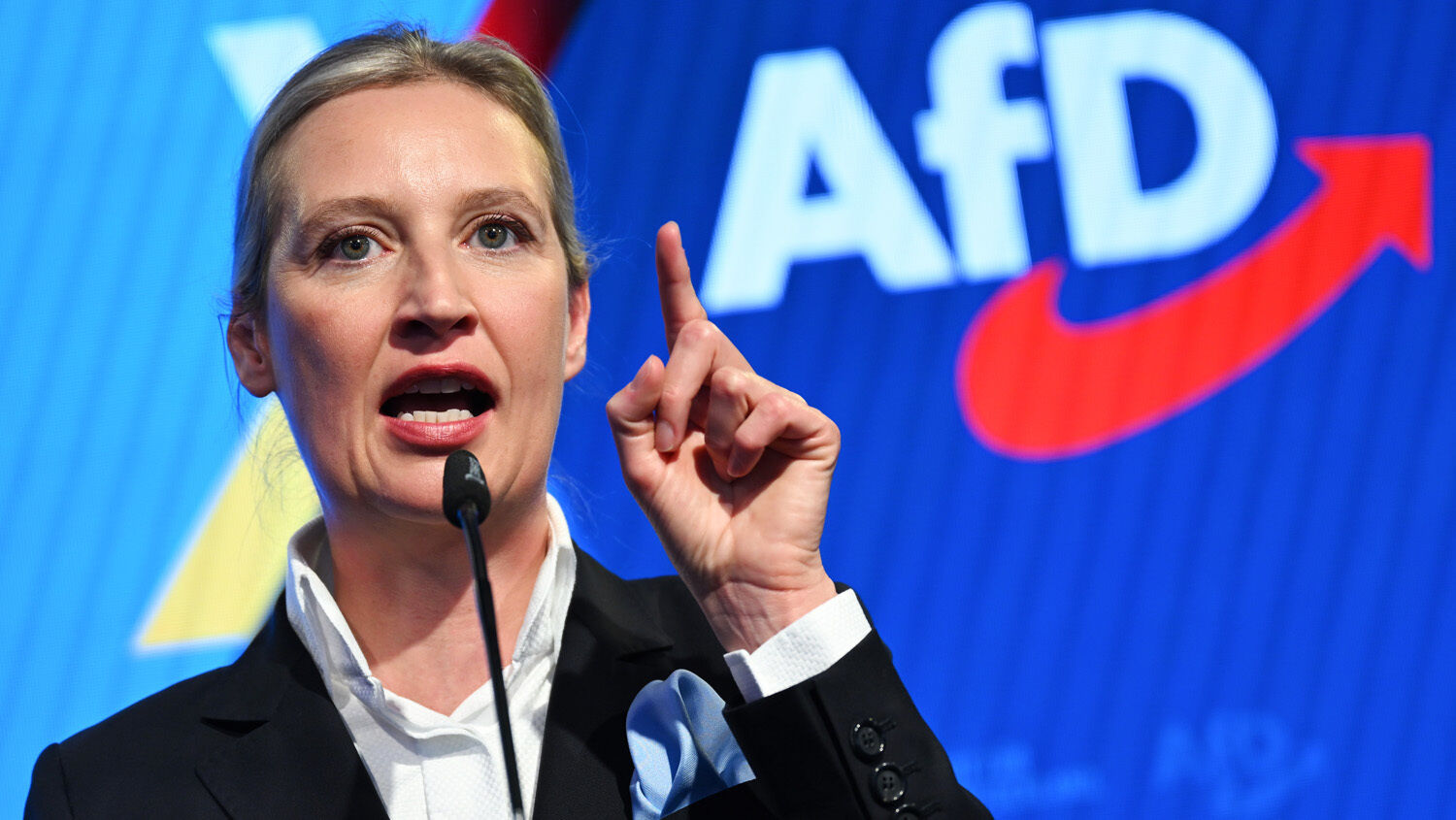
Germany’s AfD Invited to Munich Security Conference
Germany’s political landscape is transforming. For the first time since the founding of the Federal Republic of Germany in 1949, a political party other than the Christian Democratic Union (cdu), the Christian Social Union (csu) or the Social Democratic Party (spd) has become the country’s strongest political force.
A Forsa poll conducted from December 16 to 19 showed that support for the cdu-csu alliance has fallen to 24 percent, while support for the spd has slipped to 13 percent. Meanwhile, support for the nationalist Alternative for Deutschland (AfD) has surged to 26 percent, making it Germany’s most popular party.
Germany’s mainstream parties are still trying to paint the AfD as a radical fringe group. Yet Wolfgang Ischinger, head of the Munich Security Conference, has invited an AfD delegation to the high-profile security policy forum in February. It seems the AfD is becoming mainstream. The Munich Security Conference was founded in 1963 by Ewald-Heinrich von Kleist-Schmenzin, a German monarchist involved in Claus von Stauffenberg’s 1944 attempt to assassinate Adolf Hitler. Its purpose is to prevent conflicts such as World War ii by bringing together security experts to discuss defense policy.
United States Vice President JD Vance complained about the AfD’s exclusion from the last Munich Security Conference; its invitation to the upcoming conference will likely please Vance and the Trump administration. Yet mainstreaming the AfD will upset many people in Ukraine and Eastern Europe.
At a rally in Saxony on January 11, AfD cochair Alice Weidel unveiled a new manifesto for her party that pledged to seal Germany’s border, deport illegal immigrants, take Germany out of the eurozone, and restart the Nord Stream pipeline. The AfD refused to condemn Russia for its invasion of Ukraine in its manifesto, and AfD cochair Tino Chrupalla has even suggested that Poland is as much of a threat to Germany as Russia. If the AfD’s voice grows stronger, expect German opposition to Russia to wane.
AfD leaders have heavily criticized Chancellor Friedrich Merz’s efforts to rearm Germany through record levels of deficit spending. These leaders would rather see Germany make peace with Russia while capping Germany’s structural deficit at 0.35 percent of gross domestic product. The rise of the AfD in the polls puts Germany’s ambitious military buildup in doubt. Weidel is even accusing Merz of being a fake conservative who is selling Germany out to left-wing parties like the spd that want to run up debt.
This accusation could be a problem for Merz. Late csu politician Franz Josef Strauss said there should never be a democratically legitimate party to the right of the cdu-csu alliance. By letting the AfD carve out a place for itself as the fiscal conservatives of Germany, Merz has weakened himself.
In fact, since the cdu-csu alliance has ruled out a coalition with the AfD, Germany is practically ungovernable. No natural political coalition has enough support to rule Germany, so Merz is relying on an unpopular grand coalition between the cdu, csu and spd to keep the AfD out of power.
Eventually, something has to change. The last time German politics were in such a state of gridlock was in the early 1930s, when Hitler cobbled together his Nationalist-Nazi-Catholic coalition. His National Socialist German Workers’ Party was an overtly socialist party that could not get enough support to rule on its own, so Hitler flattered the German industrialists in the pro-monarchy German National People’s Party and the Catholic clerics in the Vatican-friendly Centre Party into supporting him as a chancellor candidate.
This history provides valuable warnings. Notice what Hitler said in 1941: “First, the German nation had to learn to understand its own political struggle, which enabled it to rally Germany’s entire strength, above all its idealistic strength. And this idealistic strength was at the time only to be found in two camps: in the socialist and in the nationalist camps. But these were the camps between which there was the most mortal feud and strife. These two camps had to be fused into a new unit.”
This fusion between the nationalist and socialist camps was particularly devastating for Germany, yet it is in a similar position today. Peter Tauber, the former cdu general secretary under Chancellor Angela Merkel, stated: “We have to stop giving the impression of ‘everybody against AfD.’ We should think about a new policy of red lines which would allow us to make political decisions, which the AfD would agree with. … Otherwise, there is a risk of a parliamentary deadlock.”
Hitler fused nationalism and socialism in the 1930s. It now looks like Germany’s next strongman will have to fuse populism with eurocracy. This will not be an easy task, but the Bible indicates that an end-time European leader will “come in peaceably, and obtain the kingdom by flatteries” (Daniel 11:21). Strong’s Concordance defines the Hebrew word for flatteries as “flattery, slipperiness, fine promises, smoothness.” The indication is that this leader will be able to do something similar to what Hitler did in 1933—promise different parties different things in a bid to gain wide support.
German industrialists have done well for themselves in the European Union and with the euro, so the AfD’s demand to take Germany out of the eurozone is unlikely to go far, even if many working-class people would like to see the eurozone dismantled. Yet AfD demands to seal Germany’s border, deport illegal immigrants, make peace with Russia, and restart the Nord Stream pipeline may be things the cdu-csu will consider in an attempt to stay in power. German politics is currently in flux, so the traditional dividing lines between political parties may change dramatically.
Our free booklet A Strong German Leader Is Imminent explains why God will allow a new German dictator to come to power. Watch this year’s Munich Security Conference. The spirited debates between the AfD and cdu over how best to defend Europe from Russia will reshape Germany and Europe.


