

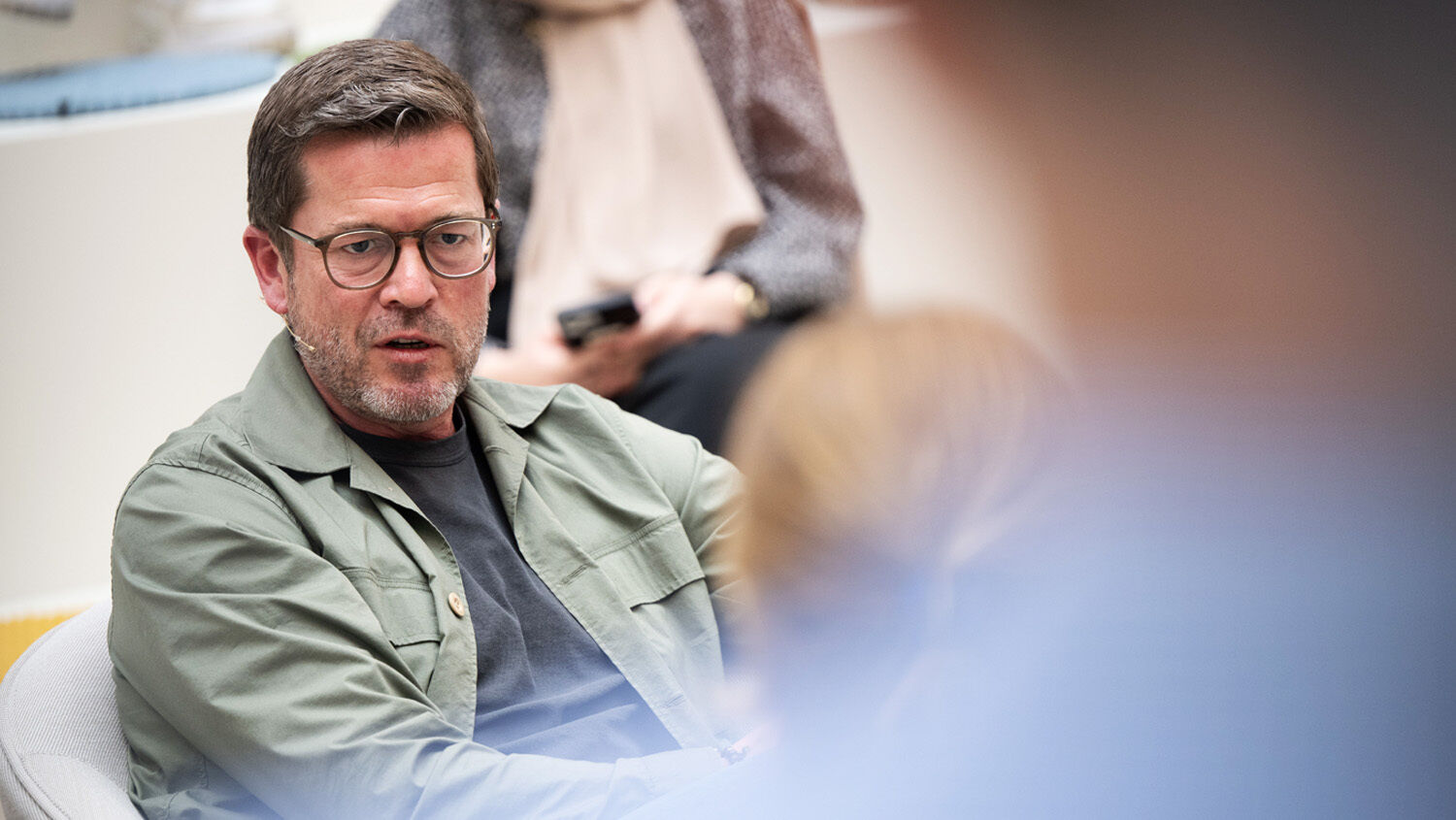
Guttenberg, Reiche and a Mysterious Meeting
What influence does Karl-Theodor zu Guttenberg have on the German government? In recent weeks, this question has been heavily debated in Germany. The former German defense minister was once seen as Germany’s chancellor-in-waiting, until his political career suddenly ended in 2011 due to a plagiarism scandal. Since then, he has been accused of using his connections to the German government to further his economic interests. Now that his girlfriend, Katherina Reiche, is Germany’s economics minister, the topic is fresh once again. But Guttenberg’s alleged influence over German politics goes far beyond economic gains.
His relationship with Reiche has “been the subject of gossip in Berlin for some time. A few days before her inauguration in May, the two announced that they had been a couple ‘for quite some time.’ Since then, Guttenberg has repeatedly turned up wherever Reiche happened to be” (Spiegel, December 3). When she visited Washington in June, Guttenberg was there. One of her meetings was with the Center for Strategic and International Studies, where Guttenberg serves as a distinguished statesman.
Guttenberg is friends with Moritz Schularick, the president of the Kiel Institute for the World Economy, who became an expert adviser to Reiche’s Economic Ministry in July to help make the arms industry more efficient. Another adviser is Jürgen-Joachim von Sandrart, a retired lieutenant general of the German Army whom Guttenberg has also hosted on his podcast.
In early October, Guttenberg and Reiche traveled to Tyrol, Austria, where Guttenberg and former Austrian Chancellor Sebastian Kurz hosted billionaire investors, Arab royals, the son of the Israeli prime minister, the Turkish finance minister, the Greek defense minister and other officials. The four-day meeting was titled “Moving MountAIns,” a name referencing one of the event’s central themes: artificial intelligence.
Furthermore, Reiche’s Economic Ministry is paying hundreds of thousands of euros to a start-up military procurement company. One of its investors is Guttenberg.
On her trip to Israel from December 15 to 17, Reiche was accompanied by a 70-person business delegation, including representatives from defense and defense-adjacent industries. In 2014, Guttenberg cofounded the German branch of Elnet, which facilitates weapons deals between Germany and Israel.
Reiche’s relationship with Guttenberg raises the question “to what extent the minister’s official duties are affected,” Spiegel opined.
In many cases, there is a clear overlap of interest in the policies pursued by the Economics Ministry under Reiche and those advocated for by Guttenberg for a long time. But of all the potential conflicts of interest, the secret meeting in Tyrol has captivated the media’s attention the most.
Moving MountAIns
Reiche claims that she attended the clandestine meeting as a private individual. Yet Spiegel wrote on December 23 that “the event brochure suggests something different.” On page 55 of the 80-page booklet, the brief biography of “Her Excellency Katherina Reiche” is introduced as “Federal Minister for Economic Affairs and Energy,” followed by an outline of her career in politics and the private sector. On the same page is Edi Rama, prime minister of Albania, also with his official title and biography. Before traveling to the summit, Greek Defense Minister Nikos Dendias announced his participation as an official appointment on his ministry’s website.
“This reinforces doubts that Reiche participated in the meeting as a private individual,” Spiegel wrote.
The topics of the meeting “shape our time—from the potential of artificial intelligence to the change in the geopolitical order,” Guttenberg and Kurz wrote in the brochure. This matches what the Greek Defense Ministry wrote about the meeting, stating that it would revolve around “current security challenges” and “the development of innovations and artificial intelligence in dual-use products.”
“These are all topics that also fall within Reiche’s remit as minister of economic affairs,” Spiegel wrote.
Spiegel investigated the matter further and got a reply from Guttenberg’s lawyer, who claimed the meeting was a “purely private event.” “The guests and their families were invited exclusively as private individuals.” The “guest list,” containing the “customary information at private events, including names, professions and brief biographies,” was distributed upon the guests’ arrival and “not communicated in advance.”
“Katherina Reiche lied repeatedly,” Green Party M.P. Andreas Audretsch said. “She deliberately tried to deceive parliament and the public.” Audretsch claims that the evidence proves that Reiche was “officially present in her capacity as a minister” and that such a meeting is “international politics on behalf of Germany and not a pleasant private trip to the mountains by a minister and her partner.”
In an opinion article, Spiegel’s Markus Becker wrote that current lax German transparency rules only work “if the ministers in question are honest about their appointments. If they are not, as in Reiche’s case, a huge loophole opens up: Government members would only have to mark appointments in their calendars as ‘private’ to conceal what is really going on.”
This is the crux of the whole issue. Did Guttenberg and Kurz host a “private” meeting to discuss matters that the public and even certain members of the respective governments are not privy to?
Becker also noted that Guttenberg’s “connections to other investors and politicians serve, at least indirectly, his economic interests.”
Guttenberg has a direct connection to German Chancellor Friedrich Merz. The two have known each other for many years, and in 2020, both were invited by Wolfram Weimer to the economic forum of the Ludwig-Erhard-Gipfel. At the time, Weimer described Merz as the most promising candidate for chancellor; Guttenberg said, “For me, Friedrich Merz is currently the only one of the cdu-csu politicians who I consider to be entirely suitable for this task or who I would vote for.” Merz today is Germany’s chancellor; Weimer is his minister of culture.
But Guttenberg has been using his connections to the government long before Reiche became Germany’s economy minister.
Wirecard
Guttenberg was involved in what some call “the largest financial scandal in the history of the Federal Republic of Germany,” which involved the scandalous financial service provider Wirecard. Before Wirecard’s bank fraud was exposed, Guttenberg helped the company expand globally. His ultimate goal was for Wirecard to take over global dominance in the field of electronic payments, which was and is largely dominated by American firms. In 2019, Guttenberg used his connections to Chancellor Angela Merkel to help the company enter the Chinese market.
In a 2020 article titled “How Merkel Allowed Herself to Be Used by Guttenberg for Wirecard,” Spiegel wrote:
Nearly 600 people work in the Federal Chancellery, including many specialists. But the combined expertise of her office doesn’t always seem to be enough for the chancellor. On Sept. 3, 2019, Angela Merkel turned to the know-how of her former cabinet colleague, Karl-Theodor zu Guttenberg.
On that day, the former defense minister wrote to the head of the economic affairs department in the Chancellery: “The chancellor asked me to send you a few lines to ensure the correct wording.” This letter followed a meeting between Merkel and Guttenberg.
The e-mail, sent at 7:50 p.m., concerned Wirecard, the company that, a few months later, would be responsible for what was arguably the biggest financial scandal in the history of the Federal Republic of Germany. Guttenberg’s firm, Spitzberg Partners, was lobbying for Wirecard at the time and had persuaded the chancellor to promote the company’s market entry in China during her upcoming trip there. Guttenberg’s e-mail was likely intended as preparation for this. …
The chancellor’s intervention on behalf of Wirecard came at a delicate time. When Merkel lobbied the Beijing leadership for the expansion plans of the Aschheim-based company, the media had already reported on allegations of manipulation and links to illegal online casinos.
Guttenberg is a multimillionaire. While some of his investments certainly help his bank account, he has bigger goals than that. In everything he does, he wants to bring Germany ahead.
Guttenberg’s Interests
Guttenberg claims to be “delighted to no longer have to participate in the political arena” (ndr podcast Raus aus der Depression [Out of Depression], 2024). Constant coalition infighting stifles the ambitions of would-be leaders. Democratic oversight restrains bold, transformative action. Investigative journalists hunting for the next scandal might end your career, something Guttenberg is all too familiar with.
He may truly be happy to avoid this side of German politics, but the indications that he just can’t keep his hands off the grip of power are mounting. What’s more, he has a burning desire to see the rise of a European superstate and increased frustration that the German government is unable to bring it about.
“With [Donald] Trump’s election, as it stands now, Europe can no longer lethargically lean back and do nothing; they have to finally take action …. And that applies to Germany in particular,” Guttenberg said in his podcast on Nov. 13, 2024, just after the coalition government of Olaf Scholz collapsed.
Guttenberg advocated for Merz to become Germany’s chancellor. Now that he is, Guttenberg said, “Merz is doing very well in foreign policy. … Domestically, there is a danger that the coalition will fall back into old patterns of conflict and deadlock” (Die Presse, September 6).
It must be extremely frustrating for Guttenberg to see his vision of a German-dominated European empire that can rival the power of the U.S. and China remain unfulfilled.
For more than 15 years, Trumpet editor in chief Gerald Flurry has observed Guttenberg, believing he could be the man to lead Europe out of its deadlock into superpower status. Request A Strong German Leader Is Imminent for a thorough explanation.
The Bible prophesies that Europe will transform into a superpower of 10 nations or groups of nations dominated by Germany and controlled by one man. “And the ten horns which thou sawest are ten kings, which have received no kingdom as yet; but receive power as kings one hour with the beast. These have one mind, and shall give their power and strength unto the beast” (Revelation 17:12-13). This man will be free of all democratic restraints. The late Herbert W. Armstrong long foretold that a great crisis, such as a financial crisis in the United States, could trigger the rise of this European superstate and the overarching strongman.
Guttenberg may well be waiting for such an opportunity to take control of Germany’s and Europe’s rising war machine. In the meantime, he is doing whatever he can to influence the future of Germany and Europe.


