

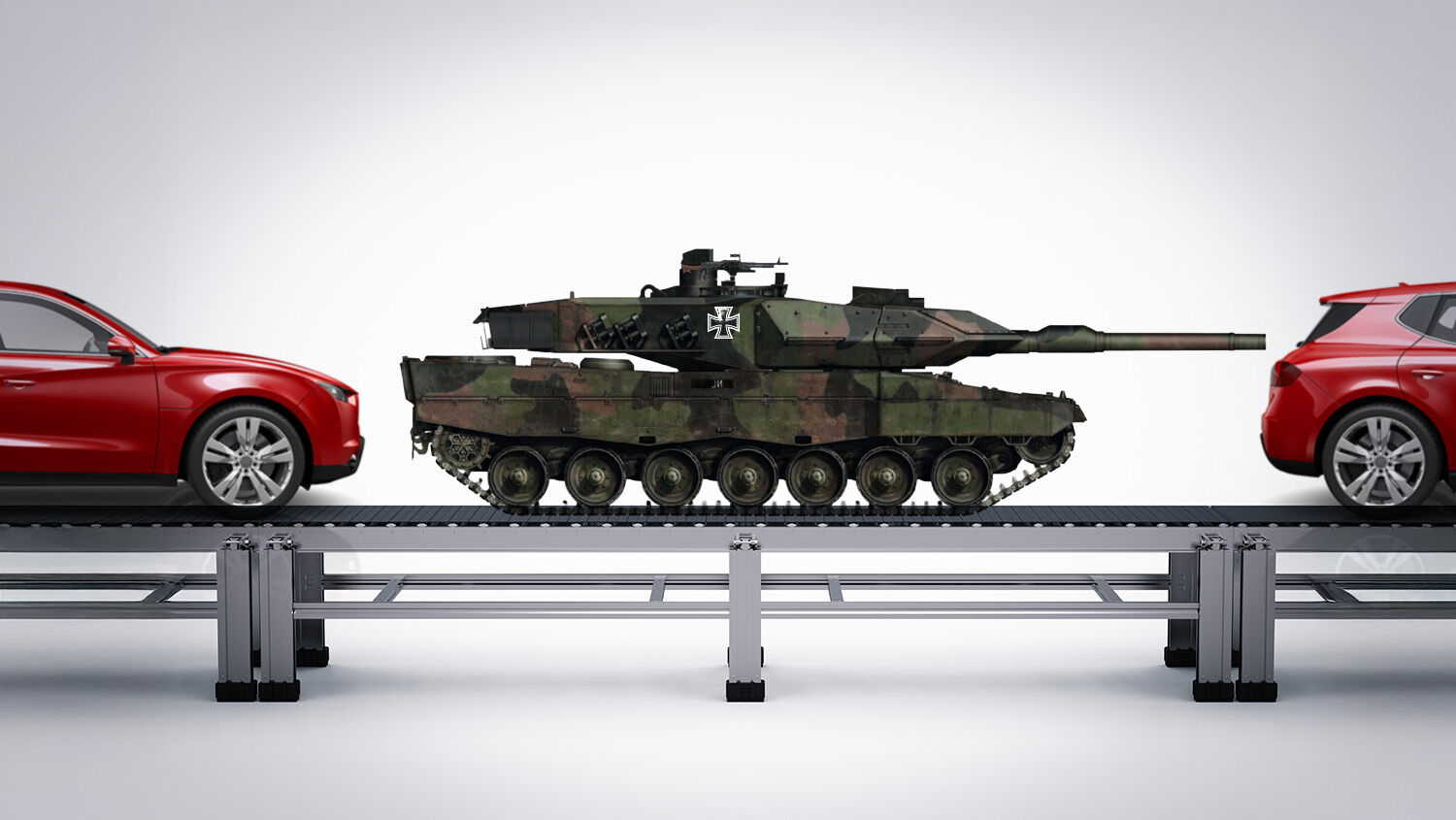
WSJ: ‘In Germany, Everyone Is a Defense Manufacturer Now’
Germany’s young entrepreneurs of the year are the founders of the defense start-up Helsing. That’s according to former Defense Minister Karl-Theodor zu Guttenberg, writing for Germany’s Handelsblatt on December 18. This is part of a massive shift by German manufacturers back to an industry in which they have historically excelled: making weapons.
As of mid-2025, Helsing was valued at $14 billion. It is telling that Germany’s most successful start-up is a weapons producer.
“In Germany, Everyone Is a Defense Manufacturer Now,” the Wall Street Journal wrote on December 19. “Across Germany, railcar factories are being retooled to build military vehicles, auto suppliers are joining with defense contractors, and former soldiers are suddenly hot commodities in the jobs market.”
The shift is encouraged by the government, which plans to nearly triple its annual military spending to $180 billion by 2029.
Everywhere German Economics Minister Katherina Reiche travels, “[o]ne theme follows her: the question of defense capabilities,” Süddeutsche Zeitung wrote on December 16 after her trip to Israel. Welt wrote in July that she is acting “as armaments minister.”
The Wall Street Journal reported that the number of firms in the German defense sector’s main trade association has nearly doubled in the past year, and that growth in this sector is offsetting losses in the vehicles and chemicals sectors.
“Defense spending is so big that it would really be a major game changer in terms of basic and military-applied research,” said Guntram Wolff, professor of economics at Université Libre de Bruxelles. The Journal highlighted:
- German automotive supplier Schaeffler signed a deal with Helsing to produce 10,000 to 20,000 drones a year, with a crisis surge capacity of up to 100,000.
- Mechanical engineering group Trumpf is sharing its laser expertise with a local electronics group to build drone defense systems.
- Automated kitchen manufacturer goodBytz now supplies the U.S. Army in South Korea and expects the defense sector to provide a third of its revenue in the future.
The Journal wrote:
The growth of the defense industry is a return to Germany’s past. Starting in the early 19th century, German industrialization was closely intertwined with the country’s weapons industry. Steelmaker Krupp, founded in 1811, was the largest industrial company in Europe for much of the late 19th and early 20th centuries. It became synonymous with German military power, producing the Big Bertha gun during World War I and later building tanks and U-boat components for the Nazis.
“Germany is, in a sense, returning to old form,” said Timo Graf, a sociologist at the Center for Military History and Social Sciences of the Bundeswehr in Potsdam.
“The shift isn’t as controversial as it once was in a country with a strong post-World War ii tradition of pacifism,” the Journal commented. “… Germany’s defense industry was completely dismantled after World War ii, and military production was banned. But starting in the 1950s, Germany began to slowly rebuild its military and defense industry with U.S. support, acting as a bulwark against the Soviet Union.”
The revival of Germany’s military industry was well organized and planned. The question is not whether Germany will remain pacifist after rebuilding a powerful military, but rather who will be its target. Learn more in Germany’s Conquest of the Balkans.


