

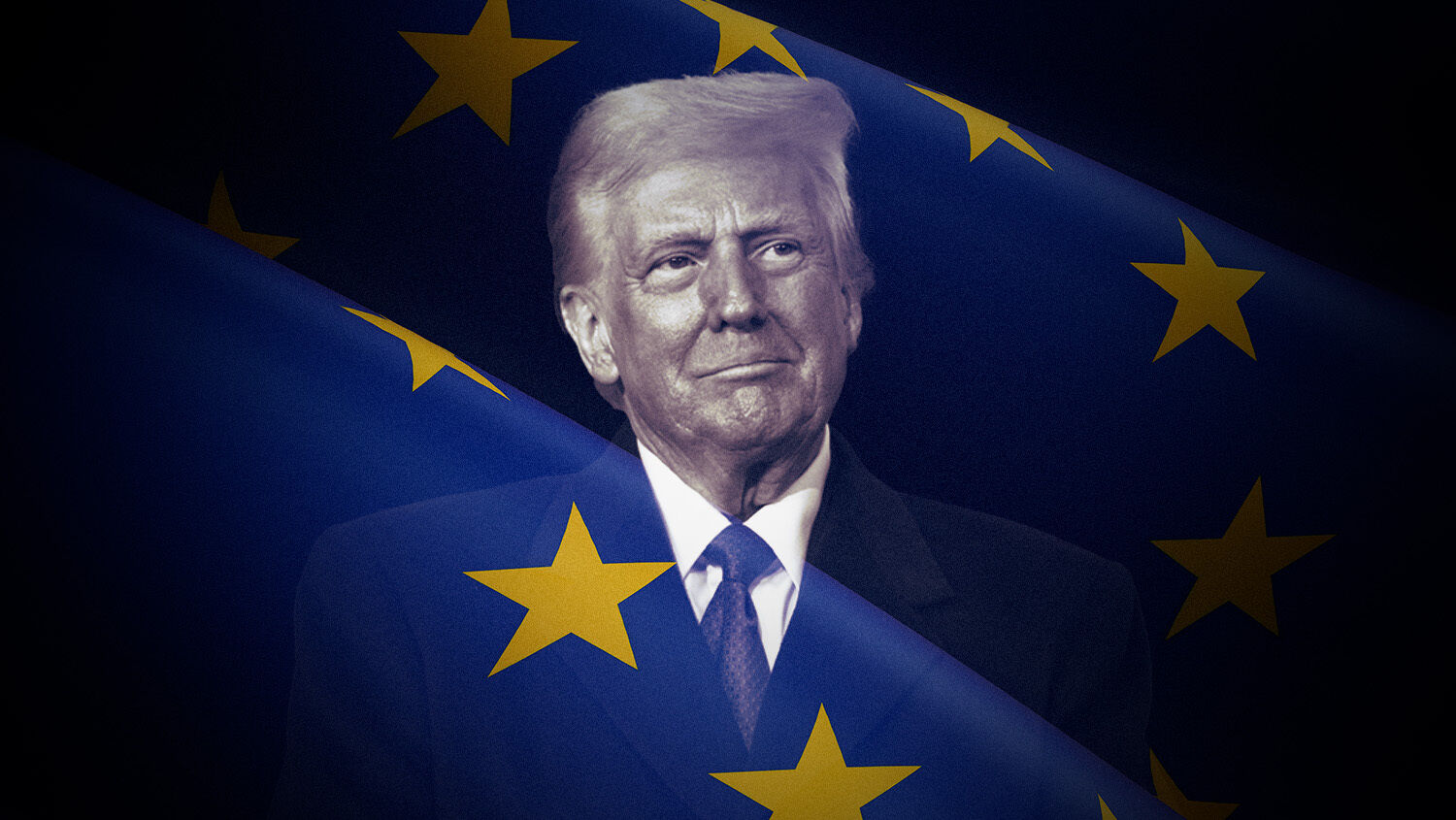
Guttenberg: Trump Is the Best Thing That Could Have Happened to Europe
As the first year of Donald Trump’s presidency comes to a close, the outlines of a radically new Europe are emerging. As the Russian bear rises in the East and the American eagle withdraws its protective wings, Europe is left facing the chilling possibility of war.
The German government is pursuing strategic autonomy, preparing its population for tough times, and plans to nearly triple its defense spending within five years. Other governments seek to follow suit as their budgets allow. For many, the end of the postwar order is frightening. But former German Defense Minister Karl-Theodor zu Guttenberg believes it’s the best thing that could have happened to Europe.
In a podcast posted on December 17, Guttenberg said the situation “could be described as chaos, a catastrophe from a European perspective, or you could say, I’m being a little provocative now, perhaps nothing better could have happened to us than this character sitting over there now.” He continued:
Why am I saying that? Because of Donald Trump, Europe has been forced to finally get its longsuffering, grumpy butt out of the comfortable sofa and do the homework that it has never done, because it has always relied on others and said that cheap oil and gas comes from Russia, security comes from the United States and we can rely on the Chinese when it comes to selling our cars. And suddenly there is someone who turns the world upside down, or the other way around, and we are forced to act. That’s not actually the worst news for Europe.
For all those who have long desired a strong, remilitarized, united Europe, Trump’s presidency is the best thing that could have happened. The U.S. president’s treatment of Ukraine frightens East Europeans who have long relied on the U.S. for protection. They are now willing to look to a united Europe led by Germany to fill that void.
From a German perspective, nothing better could be happening.
We see the same in trade relations. The nations that once relied on the generosity of the U.S. now fear they will lose their livelihood in tough negotiations. As a result, they are seeking to unite and searching for alternatives. Guttenberg said:
Of course you can be outraged by the American president every hour. He really gives us plenty of reason to do so. But at the same time, you can also say that perhaps it’s precisely this momentum that we need in order to fill our own shoes. Something happened last year. We are suddenly starting to pursue customs agreements again with more vigor from a European perspective, because this uncertainty from the U.S.A. has put us in precisely this situation.
But for a European superpower to emerge, Guttenberg noted, “We probably need to shape Europe a little differently in terms of its constitution than is currently the case.” It is impossible for 27 nations to agree on everything. It “only takes a burp from Budapest or Bratislava to get rid of the best conceivable idea; Europe is not capable of acting,” Guttenberg warned.
Europe needs a radical transformation—and Donald Trump is providing the incentive. As Trumpet executive editor Stephen Flurry wrote:
Many people are excited by this development because they see Germany as a force of opposition against both Donald Trump and Vladimir Putin. But a look at Europe’s history reveals that Germany had militaristic ambitions long before Trump and Putin were in power. The Trump administration’s policy of pulling away from Europe and appeasing Russia is providing the perfect cover, but Germany has long wanted to dominate the world. …
Nobody is telling you about these facts, but everything else in the news cycle is practically inconsequential compared to what is happening in Germany right now. People are talking about Hanukkah, Christmas, peace and unity while Germany is building a war machine!
As he pointed out in his article, the late Herbert W. Armstrong prophesied for decades that a German war machine would rise to lead an independent European superpower, as revealed in Daniel 2 and 7 and Revelation 13 and 17.
Daniel 2 prophesies that the last kingdom to govern this world before the return of Jesus Christ will be like a mixture of miry clay and iron: “And as the toes of the feet were part of iron, and part of clay, so the kingdom shall be partly strong, and partly broken” (verse 42). This is a prophecy of 10 nations or groups of nations led by 10 kings uniting as a military superpower. Germany is prophesied to be at the heart of this empire. (Request a free copy of Germany and the Holy Roman Empire for proof.) Due to European rivalries and mixtures of different peoples, the greatest weakness of this military power is its lack of unity.
But in times of crises, these nations will unite for a short time.
“And the ten horns which thou sawest are ten kings, which have received no kingdom as yet; but receive power as kings one hour with the beast. These have one mind, and shall give their power and strength unto the beast” (Revelation 17:12-13).
Europe’s recent urgency is leading to the fulfillment of this prophecy.


