

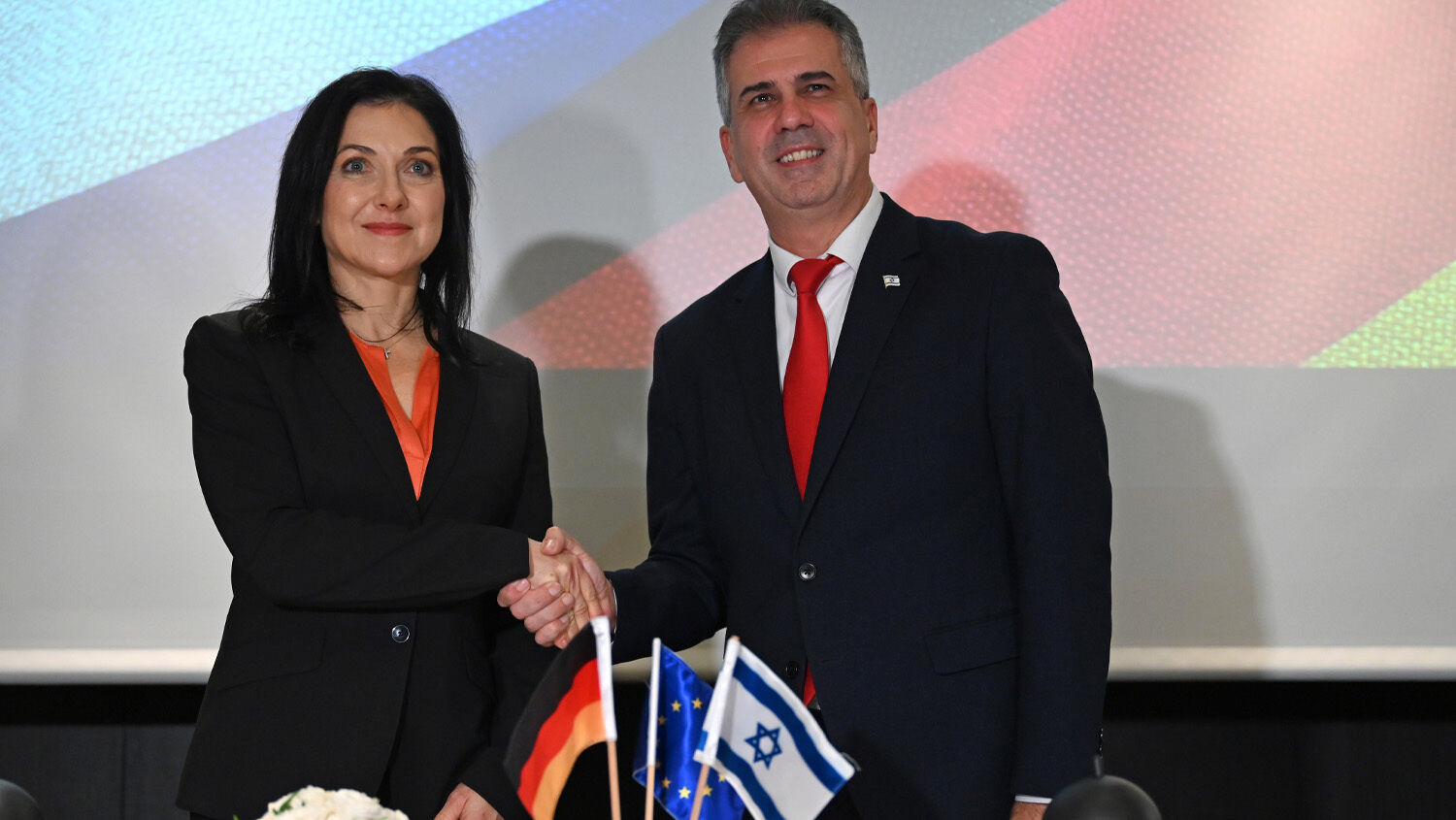
Why Germany Is Eyeing Israel’s Start-up Scene
Israel’s economy has proved resilient in the war against Hamas, Hezbollah, the Houthis and Iran. Its stock market is booming, and its tech industry is flourishing. “Israel has developed into a leading location for innovation and start-ups—a model from which we can learn a great deal,” German Economic Minister Katherina Reiche said during her December 15-17 visit to Israel.
Israel is happy to help. By forging closer ties with Germany, it not only hopes to strengthen its economic standing and military preparedness but also seeks to win a strategic partner.
While Germany is the world’s third-largest economy, Israel is far ahead of any other country when it comes to start-ups per million inhabitants. “The goal of my trip is to bring high-tech companies together with our strong industry,” Reiche explained before departing for Israel. After a meeting with her counterpart, Nir Barkat, in Jerusalem, she said: “Israel has almost perfected the start-up pipeline.”
Closer cooperation with Israel “can further strengthen the competitiveness of our economy by giving us access to groundbreaking technologies, highly qualified specialists and pioneering joint research and development projects,” Reiche added.
Süddeutsche Zeitung commented: “A cooperation with the battle-hardened Israeli industry, her message goes, would be advantageous for Germany in these times.”
Referencing a new German-Israeli energy partnership, Reiche said:
Germany is facing big challenges in the energy sector. We need to dampen energy costs, increase security of supply, and reduce our vulnerability to outside interference. These challenges can only be overcome with technological strength, strategic foresight and reliable partners. Israel is providing just these qualities. Thus it is a great asset to be working together closely, pragmatically and result-oriented in the German-Israeli Energy Partnership—with the common interest to provide concrete answers to the pressing issues of our time.
Barkat also praised the flourishing relationship:
Germany is our largest trading partner in the European Union and a true strategic partner—a country with which we are jointly building a future of growth, innovation and prosperity for both economies. … We will continue to work toward realizing the vision of $1 trillion in exports within two decades.
In the first nine months of this year, German exports to Israel totaled $4.5 billion; Israeli exports to Germany reached $2.3 billion. The fact that Israeli exports increased by 25 percent and German exports remained at roughly the same level shows that the relationship is changing.
This can also be seen in the defense sector. Earlier this month, Israel concluded the export of its Arrow 3 defense system to Germany, valued at roughly $3.5 billion, Israel’s largest arms export to date. On Wednesday, the German Bundestag approved an expansion contract of the system valued at approximately $3.1 billion.
This marked a turning point. “Not only does Germany work in the defense of Israel, but Israel, the Jewish state, 80 years after the Holocaust, works for the defense of Germany,” Israeli Prime Minister Benjamin Netanyahu said on December 7 at a press conference with German Chancellor Friedrich Merz in Israel.
Defense was also a focus of Reiche’s visit. Her 70-person German business delegation, headed by Tobias Meyer, chairman of the global shipping group dhl, included representatives from defense and defense-adjacent industries, including aviation, space and drones.
“Germany is one of Israel’s most important trading partners, and this delegation underscores the mutual interest in expanding cooperation,” a senior Israeli official from the Foreign Trade Administration at the Ministry of Economy said. The Israeli officials expect more than 100 Israeli business delegations to visit Germany next year. “Our focus is on sectors where Israeli technology meets strong demand in German industry,” the official said. “The potential on both sides is far from exhausted.”
Israel’s Minister of Energy and Infrastructure, Eliahu Cohen, said: “Deepening our cooperation will serve the interests of both countries and contribute to prosperity and growth globally, and particularly in the Middle East.”
For many years, Israel has fought against Iranian terrorist proxies in the region and faces increasing international pressure to give in to the terrorists. While governments around the world are increasingly shunning Israel, Germany is deepening its cooperation.
The Trumpet has warned for many years that the so-called peace process would drive Israel to Germany. Biblical Judah, today known as the State of Israel, is prophesied to seek the help of Assyria, modern-day Germany. “When Ephraim saw his sickness, and Judah saw his wound, then went Ephraim to the Assyrian, and sent to king Jareb: yet could he not heal you, nor cure you of your wound” (Hosea 5:13).
Our world today is full of vile evil and hatred for the Jewish people, so much so that Israel turns to the nation that once sought to extinguish all Jewish life. Israel trusts Germany so much that it is enabling its rise to military dominance, while it hopes to prosper from the partnership.
But with all this talk about renewed economic prosperity and military security, God is being left out of the picture.
What does God think when people who have a history with Him turn to a nation that once sought to blot them out? “It seems the Israelis can trust their worst historical enemy, but they can’t trust God to protect them! And God is their only source of help,” Trumpet editor in chief Gerald Flurry writes in Hosea—Reaping the Whirlwind.
This is indeed shameful. Bible prophecy reveals that Germany will develop into a frightening war machine, depicted in Revelation 13 and 17 as a vicious beast. Little Israel is today helping its rise and believes that this beast will be its ally. It couldn’t be more wrong.
Ezekiel 23 reveals that Germany’s cooperation will be a dangerous double cross. In his booklet on Nahum, Mr. Flurry explains:
In verse 4 of Ezekiel 23, Israel is represented by Aholah, and Judah (separated from Israel at that time) is called Aholibah. Israel and Judah (modern-day Israel) become lovers to the Assyrians (verses 4-7). God then delivers Israel (mainly the U.S. and Britain) and Judah into the hands of the Germans. (The word Jew is a shortened version of Judah.) “Wherefore I have delivered her into the hand of her lovers, into the hand of the Assyrians, upon whom she doted. … She doted upon the Assyrians her neighbours, captains and rulers clothed most gorgeously, horsemen riding upon horses, all of them desirable young men” (verses 9, 12).
Doesn’t this describe what Israel is doing today? It sees Germany’s growing war capabilities, falls in love with its strength, and wants to support it.
But what does Germany see when it looks at Israeli start-ups? Some leaders may see a mutual benefit; however, history has shown that this nation is capable of hatred that transcends any logic. Bible prophecy reveals that this hatred is still simmering and will boil over. In a most horrific betrayal, Germany will turn against Israel.
Only when Germany’s warmongering ceases and Judah once again trusts in God will these two nations be able to live in peace with each other.


