

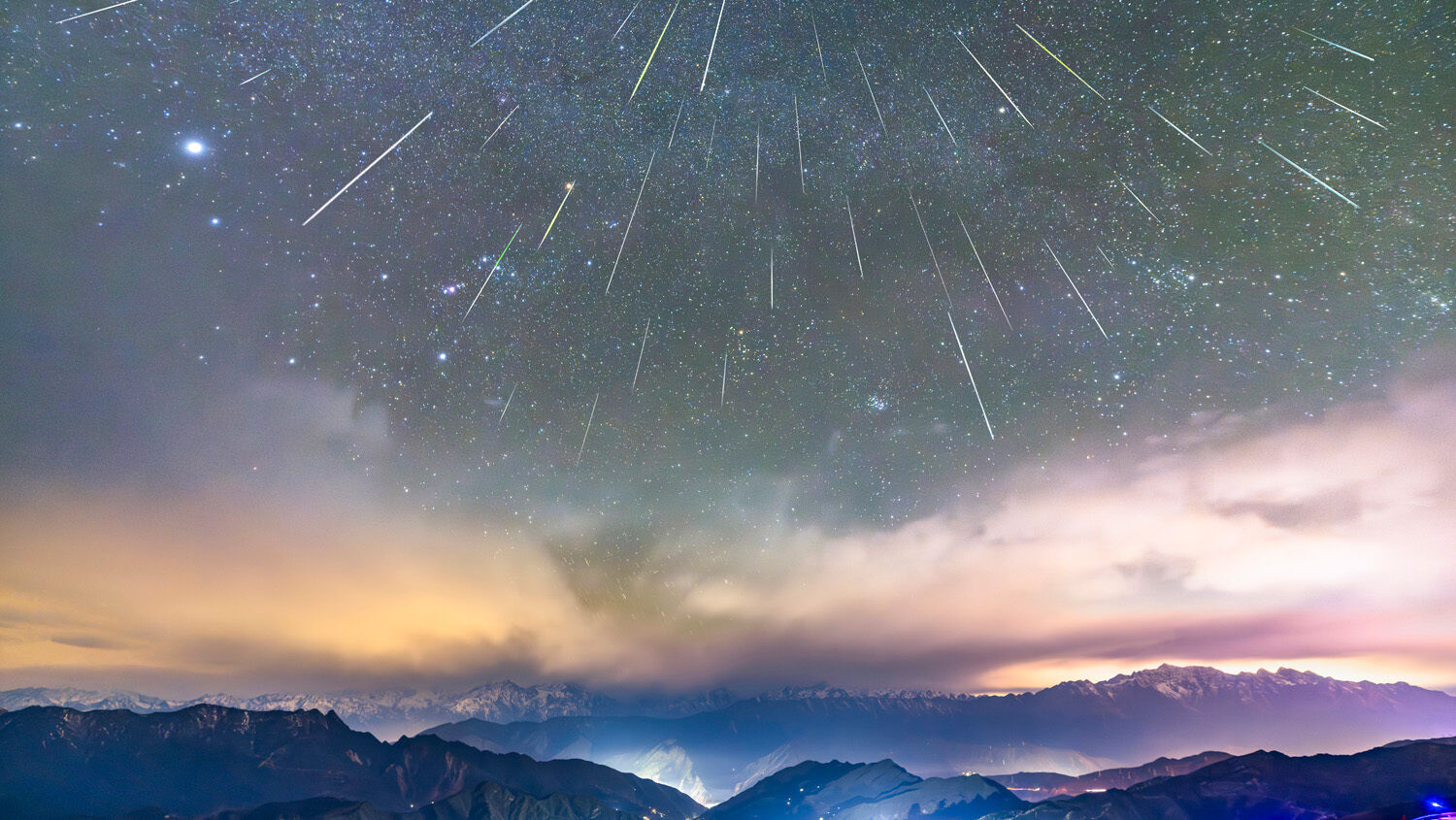
Celebrating the Geminid Meteor Shower
As you read this article, Earth is being bombarded by billions of leftover asteroid bits. Every year in December, Earth passes by a cloud of debris left behind by 3200 Phaethon, an asteroid orbiting the sun. As particles of debris enter Earth’s oxygen-heavy atmosphere, they ignite and burn up as they fly toward the planet’s surface. This creates the Geminid meteor shower, so called because the meteors originate from the part of the night sky home to the constellation Gemini.
If you live in North America or Europe, tomorrow night will be the shower’s peak night, with up to 120 and perhaps even 150 shooting stars visible per hour. Many stargazers consider the Geminids the best meteor shower of the year, augmented by December’s early sunsets. The following is a video from 2023’s shower:
Staying up late to watch the Geminids and the Perseids, another major shower every August, was a family tradition growing up. It was a special experience: sharing a park far away from light pollution with other stargazers, bundled up in a thick coat, sitting on picnic blankets or folding chairs, eyes perpetually gazing at the heavens. If you have clear skies, I highly recommend you take advantage of the evening.
The Geminid meteor shower is one of the great astronomical spectacles of the year. But that wasn’t always so. 3200 Phaethon isn’t constantly shedding debris; scientists estimate the Geminids formed after a giant event caused part of 3200 Phaethon to break off. Today, the Geminids and their parent asteroid are separated by about 12,000 miles. 2024 analysis from Russian astronomer Danila Milanov and colleagues suggests this event may have happened 1,200 to 2,400 years ago. Many astronomers suspect that as the sun’s gravity drew 3200 Phaethon closer, the sun’s heat caused parts of the asteroid to break off.
Even though the Geminids have existed as a cloud of debris potentially for millenniums, science has been aware of them for less than 200 years. The first recorded observation was in 1862. Back then, the annual shower was only 10 to 20 meteors per hour. But through the 19th and 20th centuries, the Geminids have gradually increased their visibility. Scientists suspect the gravitational influence of Jupiter is slowly pushing the path of the Geminids more and more directly into Earth’s orbit every year.
One thing that has stayed relatively constant is the timing. For decades, the Geminids’ peak night has always been either December 13 or 14.
Cosmic Connection
The night sky has been a massive influence on human culture for thousands of years. Ancient astronomers used the planets, stars and constellations to tell stories, test mathematical principles, navigate the oceans, and perform other activities. Yet today, man is more disconnected from the night sky than ever. A 2016 study published in Science Advances estimated that light pollution impacts over 80 percent of the world’s population, with 99 percent of Americans and Europeans living under “light-polluted skies,” defined as “the level of brightness at which artificial light substantially obscures astronomical observations.” Some places like Singapore never even experience true night; the city-state’s lights keep the area in a perpetual artificial twilight.
Special events like the Geminids’ peak night encourage people to escape light-polluted areas, find a patch of unadulterated darkness, and stare up at a starry sky closer to what our ancestors experienced. The Geminids are a relatively recent astronomical phenomenon. It is auspicious that the shower occurs now when we need prodding to search out a pure night sky. The Geminids’ annual predictability makes them even easier to anticipate. It’s as if the Geminids came into existence at just the right time, when we would need them most. It’s as if they communicate a message: “Don’t let your light-polluted world forget about the night sky. Lift up your eyes!”
Israel’s King David was so inspired by what he saw in the heavens that he wrote Psalm 19: “The heavens declare the glory of God; and the firmament sheweth his handywork. Day unto day uttereth speech, and night unto night sheweth knowledge. There is no speech nor language, where their voice is not heard. Their line is gone out through all the earth, and their words to the ends of the world. …” (verses 1-4).
David personified the heavens as sending a message. What is that message?
“[David] celebrated the fact that God has revealed Himself in designing, creating and sustaining the universe!” Trumpet editor in chief Gerald Flurry wrote in “How the Heavens Prophesy!” “God’s glory and handiwork are out there for everybody to see! … The heavens truly do reveal God! The more that science discovers, the more obvious this becomes.”
Divine Connection
God reveals Himself through creation. Romans 1:20 reads: “For the invisible things of him from the creation of the world are clearly seen, being understood by the things that are made, even his eternal power and Godhead; so that they are without excuse.” One of His names is the Creator (verse 25). The very first verse of the Bible shows God created everything on the Earth and in the universe: “In the beginning God created the heavens and the earth” (Genesis 1:1; New King James Version). Later in the chapter, God said: “‘Let there be lights in the firmament of the heavens to divide the day from the night; and let them be for signs and seasons, and for days and years; and let them be for lights in the firmament of the heavens to give light on the earth’; and it was so. Then God made two great lights: the greater light to rule the day, and the lesser light to rule the night. He made the stars also” (verses 14-16; nkjv).
God made the starscape. He made the night sky. And He made it in an orderly fashion, pointing back to intelligent design. When God saw “every thing that he had made,” He pronounced it “very good” (verse 31). And God “is not a God of confusion and disorder but of peace and order” (1 Corinthians 14:33; Amplified Bible).
“Astronomers and cosmologists recognize and accept this order and precision as an article of faith in their studies,” Trumpet managing editor Joel Hilliker writes in Our Awesome Universe Potential. “… But what established those ‘values’ in the beginning? … What is it that ‘arbitrarily set’ these ‘values’? Where did ‘the laws of our universe’ come from? Even evolutionary scientists believe in cause and effect. What caused the universe to come into effect? Isn’t it astonishing that scientists can have such faith in those laws—and yet fail to recognize the Power that set them in motion?”
Job 38 records God’s challenge to the patriarch Job. God had allowed Satan to humble Job to teach him a lesson. A major part of that lesson was realizing God’s greatness compared to insignificant man. God challenged Job: “Can you tie up the cords of the Pleiades or loosen the belt of Orion? Can you lead out the constellations of the zodiac in their season or guide the Great Bear and its cubs? Do you know the laws of the sky? Can you determine how they affect the earth?” (verses 31-33; Complete Jewish Bible).
“These questions overwhelmed Job,” Mr. Flurry wrote. “He had been acting like his building projects were equal with God’s. But he couldn’t guide these stars. He had no power over galaxies. God does! God was impressing on this pitiful man’s mind that the universe does not operate by mere happenstance! There is a great Being behind it all. Lift up your eyes!”
This is the same message the Geminids declare. Think of this: A random pile of space debris hits Earth at almost exactly the same time every year. Even though its parent asteroid is relatively close, and we never miss the Geminids, we never worry about hitting 3200 Phaethon. And the Geminids’ message is getting more vivid with each passing year as Jupiter brings the cloud of debris closer to Earth.
In the 1990s, when the Philadelphia Trumpet was in its infancy, the United States commissioned the Hubble Space Telescope to take vivid, detailed, unparalleled pictures of the universe. As we began our message, so did Hubble. “In our view,” Mr. Hilliker writes, “the alignment of these events suggests that we bear a certain responsibility. The heavens are communicating a message to us—but how many people understand what they are saying? That is something mankind needs to know. God wants all people to better understand what is out there—and, more importantly, why it is out there. He wants His Church to use the revelations from Hubble to give the world true, living hope.”
I wouldn’t put the Geminids’ increased power on the same scale as the Hubble Space Telescope, but the principle still applies: God wants His universe message to get louder and louder as time goes on. And more than merely using the celestial bodies as phenomena to point to creation, as Mr. Hilliker elaborates in Our Awesome Universe Potential, God intends for man to be involved in the future of the universe. The universe points to man’s future.
If you get the chance to stargaze for the Geminids this weekend, remember who made the great universe. Remember that the universe speaks a message God wants man to hear. Remember that this message involves you.
To learn more, request a free copy of Our Awesome Universe Potential.


