

Russia, India and a Bromance That Is Reshaping the World
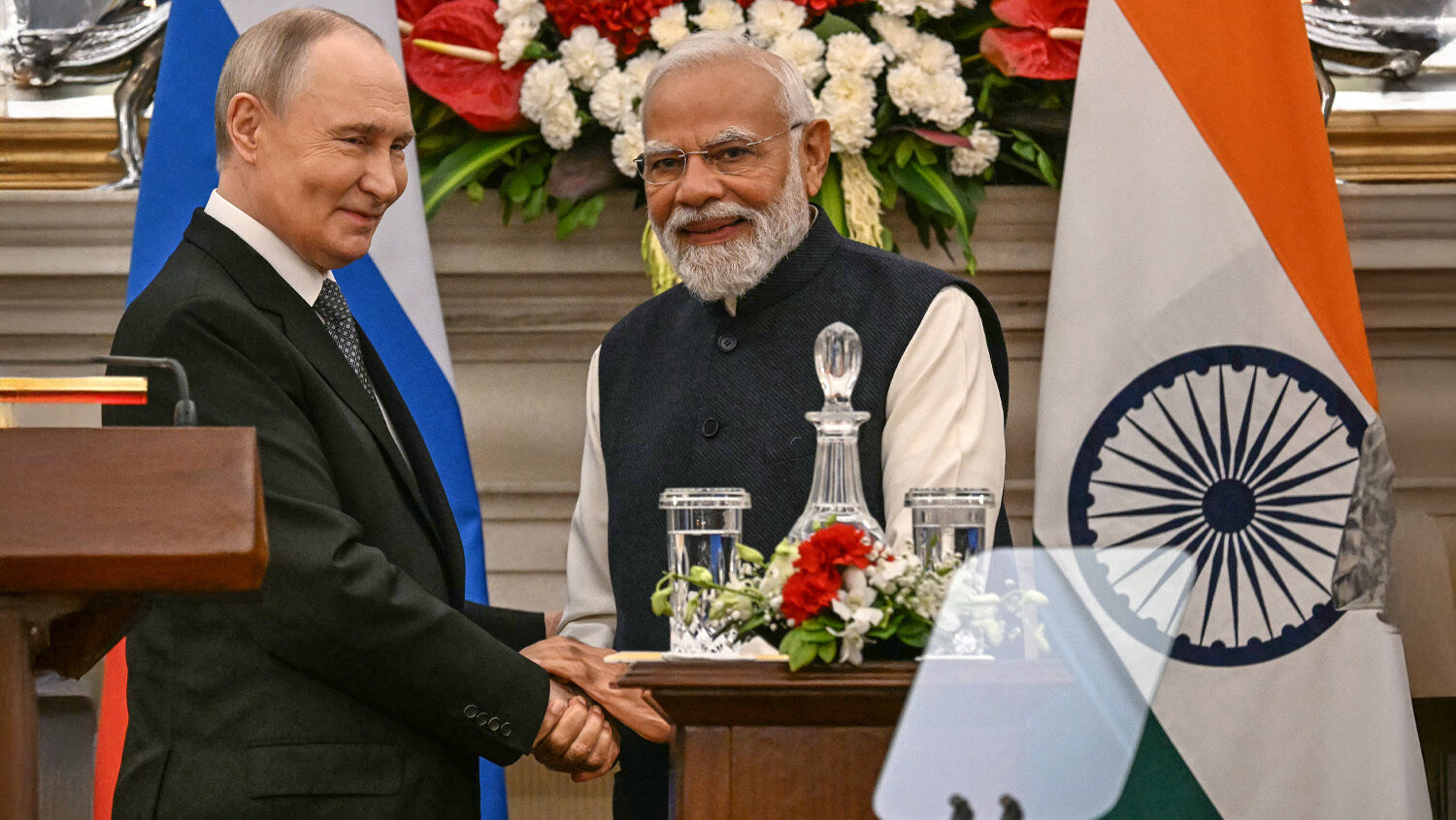
He just couldn’t wait. Instead of allowing time yesterday for Russian President Vladimir Putin to meet him at Panchavati in central New Delhi, Indian Prime Minister Narendra Modi broke protocol. He traveled to Palam Airport so he could personally receive the Russian ruler the moment he stepped off the plane and onto Indian ground.
This was, after all, Putin’s first visit to India since his full-scale war on Ukraine began nearly four years ago. And Modi wanted to make it special. At the airport, a literal red carpet was rolled out for Putin, and Modi greeted him on it with one of his famous bear hugs and a hearty handshake. From there, the two boarded the same vehicle, sharing a rare “car moment” that began what is shaping up to be a historic two-day visit.
During the first several years of Modi’s 11 years at India’s helm, he built a reputation for deftly balancing the nation between Russia and the United States. Since Russia’s war began, he has increasingly tilted it toward Russia and away from America. This has included key diplomatic support and major energy and weapons purchases that are bankrolling the war.
The 1.4 billion people of India are largely supportive of the shift. A Pew Research Center study conducted in mid-2023 found that “Indians stand out on overall favorability of Russia as the only place among the 24 countries surveyed this year where majorities say they have a favorable opinion of Russia and have confidence in Russian President Vladimir Putin.”
In recent months, as the Trump administration has imposed 50 percent tariffs on most Indian goods, what was a cautious tilt toward Russia has shifted to active alignment. Putin’s visit further parallels that alignment.
Among the military matters the two strongmen will discuss are India’s intention to obtain additional Russian S-400 missile defense systems, acquire S-500 systems and nuclear-powered submarines for the first time, and begin joint production of the Su-57 fighter jet. These are among Russia’s most critical weapons systems, and any agreements made regarding them would strengthen Russia’s standing as India’s leading arms supplier.
The two are also expected to shore up trade ties, energy cooperation, financial integration and people-to-people links—which will build on already formidable trends.
- India and Russia’s annual trade exceeded $65 billion in 2024, a fourfold increase since 2021.
- Russia now supplies 35 percent of India’s crude oil imports, up from just 1 percent in 2021.
- Both governments have set a target of $70 billion for bilateral trade for the current year.
- India has invested $13 billion in Russian energy projects, including Sakhalin-1 and Vankorneft, at a time when such investments have become precious to sanction-struck Russia.
- Russian investments worth $18 billion are currently active in India across sectors such as nuclear, steel and defense.
- The two have more than 20 joint projects going in nuclear energy, aerospace, space technology and pharmaceuticals.
- Nine nuclear reactors are operating under India-Russia cooperation.
- Over 1,000 Indians are currently enrolled in Russian medical and engineering universities.
- Integration of RuPay and Russia’s mir payment system is under active discussion to facilitate faster settlements and boost tourism.
- To address labor shortages, India is sending tens of thousands of workers to Russia.
The deepening Russia-India partnership has surprised some analysts; it will come as little surprise to students of Bible prophecy.
The book of Revelation foretells an Asian military power, called the “kings of the east,” of 200 million troops (Revelation 9:16; 16:12). The Scriptures show that this will be a multinational Asian power and one of the primary belligerents in a third world war.
Among the most detailed Bible passages about this future alliance is Ezekiel 38. Verses 1 and 2 show that this gargantuan force will be led by Russia, with China as a junior leader. Verse 5 says this future force will also include “Ethiopia and Libya,” more accurately translated “Cush and Phut,” as versions such as the Young’s Literal Translation render them. Historical records indicate that while some of the peoples of Cush and Phut settled in Africa, the rest established themselves in India.
An examination of the passage’s context reveals that it concerns modern-day Indians rather than African peoples, indicating that India will form part of the end-time 200 million-man army. Given India’s enormous population—which now exceeds even China’s—it is easy to understand how the nation will play a central role in bringing this end-time force up to that extraordinary number of troops.
As we see India today drawing closer to Russia, thanks in large part to the intensifying bromance between Putin and Modi, the stage is being set for India to take its part in this history-altering, Russian-led Asian bloc.
To learn more about India and the end-time Asian military power that is forming, order a free copy of our booklet Russia and China in Prophecy.


