

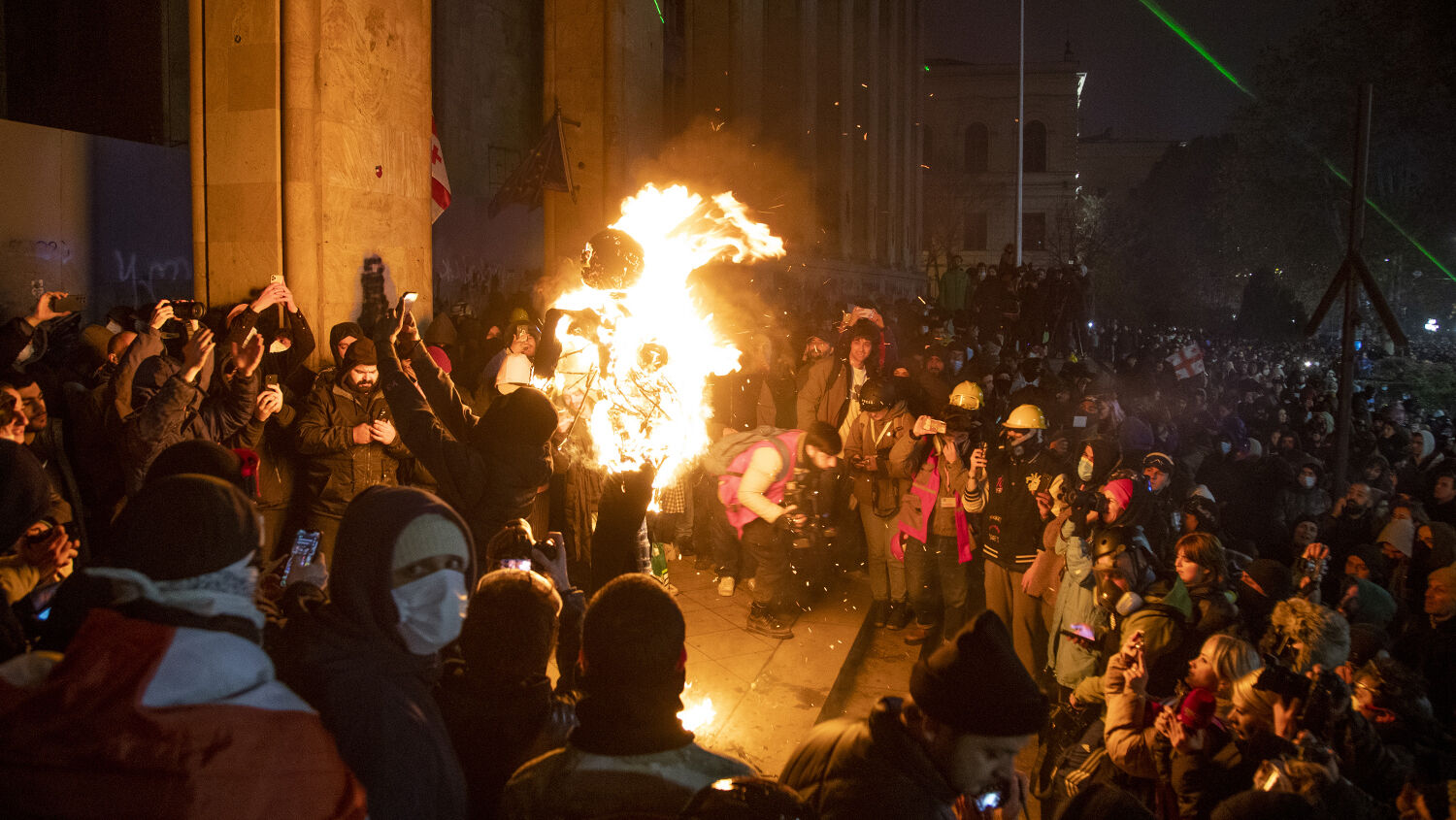
Georgia on Fire
While the world’s attention is on Ukraine, Russia is taking over another former Soviet state. The nation of Georgia in the Caucasus is suffering an almost unprecedented political crisis, as the following recent headlines demonstrate:
- “Georgia Is Dousing the Last Embers of Democracy” (Economist)
- “Georgia Moves Toward One-Party State” (Jamestown Foundation)
- “‘Five Minutes Away From One-Party Dictatorship’: Georgia’s U-turn From Western Path” (Reuters)
What is going on in Europe’s extreme southeast? Will the fledgling democracy lose its freedom? Will this be a danger to the rest of the world? We won’t have long to learn the answers.
The Context
Georgia is a small, Orthodox Christian-majority country sandwiched between Turkey and Russia. It gained its independence from the Soviet Union in 1991. Since a political crisis in 2003, Georgia has been one of the post-Soviet world’s greatest success stories. It has had its fair share of political problems, but until recently, Georgia was a functional democracy with levels of freedom comparable to the West. It even became a European Union candidate country.
Georgia’s pro-Western trajectory seemed all but solidified in 2008. Then Russia invaded the nation to support two separatist regions, Abkhazia and South Ossetia. These two areas hold about 20 percent of Georgia’s territory. Georgia lost the war, but voters seemed determined to resist Russia.
2012 was the pivotal year the Georgian Dream party first attained power. It governs Georgia to this day. Like many former Communist East European countries, Georgia’s ruling class is largely composed of a small clique of wealthy oligarchs. Former Prime Minister Bidzina Ivanishvili, a billionaire who made his fortune while living in Moscow, is the most powerful man in the party and Georgia’s unofficial ruler.
Since 2012, Georgian Dream has been integrating Georgia into Russia’s economy. Today, Georgia might as well be a Russian economic colony. Russia accounts for almost half of Georgia’s oil imports. Nearly a quarter of all tourists visiting the country last year came from Russia. Since 2021, Georgia has imported most of its wheat and flour from Russia. Russian oil was 7 percent of its total imports in 2012. A decade ago, Georgia received much of its wheat from Ukraine and Kazakhstan; this has practically evaporated.
As the war in Ukraine has dragged on, Georgia has been forced to pick a side between Russia and the West. It is clear which side it has chosen. Most of Georgia’s economic integration with Russia has happened since Russia invaded Ukraine.
The country applied for EU membership under Georgian Dream, but this process has stalled. This is not only because of Georgia’s foreign policy; a yearslong domestic political crisis basically means Georgia is no longer a democracy.
The Crisis
In May 2024, Georgia enacted a “foreign agent law” modeled after a similar law in Russia. Organizations that receive at least 20 percent of their funding from abroad are now required to register as “pursuing the interests of a foreign power.” Failing to register means facing fines in the thousands and jail time. Observers view this as the government’s snuffing out opposition ahead of elections. Russia uses its law for the same purpose.
Those elections happened in October that year. The country’s election commission claimed Georgian Dream won 54 percent of the vote, despite exit polls suggesting four opposition parties won, along with widespread allegations of voter intimidation. President Salomé Zourabichvili called the vote a “total falsification.” Georgian Dream’s new prime minister, Irakli Kobakhidze, told the bbc: “Irregularities happen everywhere, in every country.”
The presidency is mainly ceremonial, with most political power held by Parliament. Soon after Zourabichvili’s actions, Parliament amended the Constitution so that the president is no longer elected. Instead, a government-formed committee appoints the president. Zourabichvili ceased being Georgia’s president last year.
Tens of thousands packed the capital city of Tbilisi in response to the growing crisis. These protests lasted for months and are ongoing. The government responded with hundreds of Chinese-made facial-recognition surveillance cameras all over Tbilisi.
Last month, Georgian Dream took its crackdown a step further. It asked Georgia’s Constitutional Court to ban the country’s three major opposition parties. Georgian Dream is accusing the United National Movement, Lelo-Strong Georgia and Coalition for Change of trying to instigate a coup. Georgian Dream has appointed all the court’s members directly or indirectly.
Also last month, the government tightened restrictions on protests. It is now criminal to wear a face covering during a protest (which many people do because of the Chinese cameras) and block a road if the police decide it is unnecessary. Repeated offenders face up to two years in prison.
The Constitutional Court still has to decide on Georgian Dream’s lawsuit. If confirmed, it would be the proverbial nail in the coffin for Georgian democracy. One of the greatest success stories of post-Soviet freedom has become a cautionary tale of how to lose freedom.
This benefits Russia by keeping Western influence away from this border nation and providing a monopolized market for Russian exports. Even more, this is a huge symbolic victory. Russian President Vladimir Putin famously called the collapse of the Soviet Union “the greatest geopolitical catastrophe of the century.” Since gaining power in 1999, arguably his biggest foreign-policy goal has been to resurrect the Soviet empire—not in Communist ideology but in territorial control. That is why he is trying to conquer Ukraine, and that is why in 2008 he took over Georgia’s breakaway regions as puppet states.
The Conquest
Trumpet editor in chief Gerald Flurry wrote that Russia’s 2008 war “marks the beginning of a dangerous new era in history. This was the first military strike of a rising Asian superpower—and there will be more!”
Putin has been chipping away at Ukrainian territory since 2014, culminating in its 2022 full-scale invasion. It has absorbed Belarus as a Russian province in all but name. It put down a violent uprising in Kazakhstan. Now, it is on the verge of taking all of Georgia.
Circumstances are aligning with Mr. Flurry’s forecast, which he based on Bible prophecy.
Ezekiel 38 is a prophecy for the “latter years” (verse 8) about a world ruler called “the prince of Rosh, Meshech, and Tubal” (verse 2; New King James Version). This man comes “out of the north parts” (verse 14), commands a massive, multinational army (verses 4-6), and projects his power “like a storm” (verse 9). He contemplates how to steal his neighbors’ territory at the expense of innocent people (verses 10-12).
Mr. Flurry writes in his booklet The Prophesied ‘Prince of Russia’:
Scholars generally agree that “Gog” is Russia, and that “the land of Magog” includes China. The descendants of Meshech and Tubal have been found together throughout history. In Assyrian and Greek histories, Meshech appears as Musku, Muski or Mushki—all names related to the Russian spelling of Moscow, as you can read in the International Standard Bible Encyclopedia. What about Tubal? On the eastern side of the Ural Mountains lies the city of Tobolsk, named after the Tobol River, a name derived from Tubal. Tobolsk was once the seat of Russian government over Siberia and was basically considered Russia’s Asian capital.
There is also a name for all of the Russian people in Ezekiel 38:2. … Rosh was the ancient name of Russia, once called Rus. Many encyclopedias and commentaries (such as the Jamieson, Fausset and Brown Commentary) recognize this. …
When you study these scriptures alongside current events revealing modern Moscow’s imperialist direction, you see that Russian President Vladimir Putin is the prince of Rosh.
Putting prophecy, history and current events together, Mr. Flurry forecast: “The use of all three names shows that this is an individual ruler of all the peoples of Russia, from the west to the east. The reference to the cities of Moscow and Tobolsk helps us see how vast Russian territory is in these latter days. This giant swath of land indicates the prince will probably conquer more nations of the former Soviet Union.”
This prophecy is being fulfilled right now. Putin’s armies are warring in eastern Ukraine. Belarus has been grafted into Russia. We can now add Georgia to the list.
It would have been easy to brush aside Mr. Flurry’s comments that the 2008 war was the start of “a dangerous new era.” Abkhazia and South Ossetia are tiny. Yet 17 years later, Putin has virtually gotten hold of the entire country—and the rest of the world has barely noticed on account of all the chaos he is sowing everywhere else. True to Mr. Flurry’s prediction, Putin has “conquered more nations of the former Soviet Union.”
If the Bible identifies President Putin as an individual, then his role in end-time events is enormous. Bible prophecy reveals that Putin will be responsible for much more than simply redrawing his neighbors’ borders. He will go on to change the course of civilization. Those who believe the Bible can’t afford to be ignorant of these prophecies.
To learn more, request a free copy of The Prophesied ‘Prince of Russia.’


