

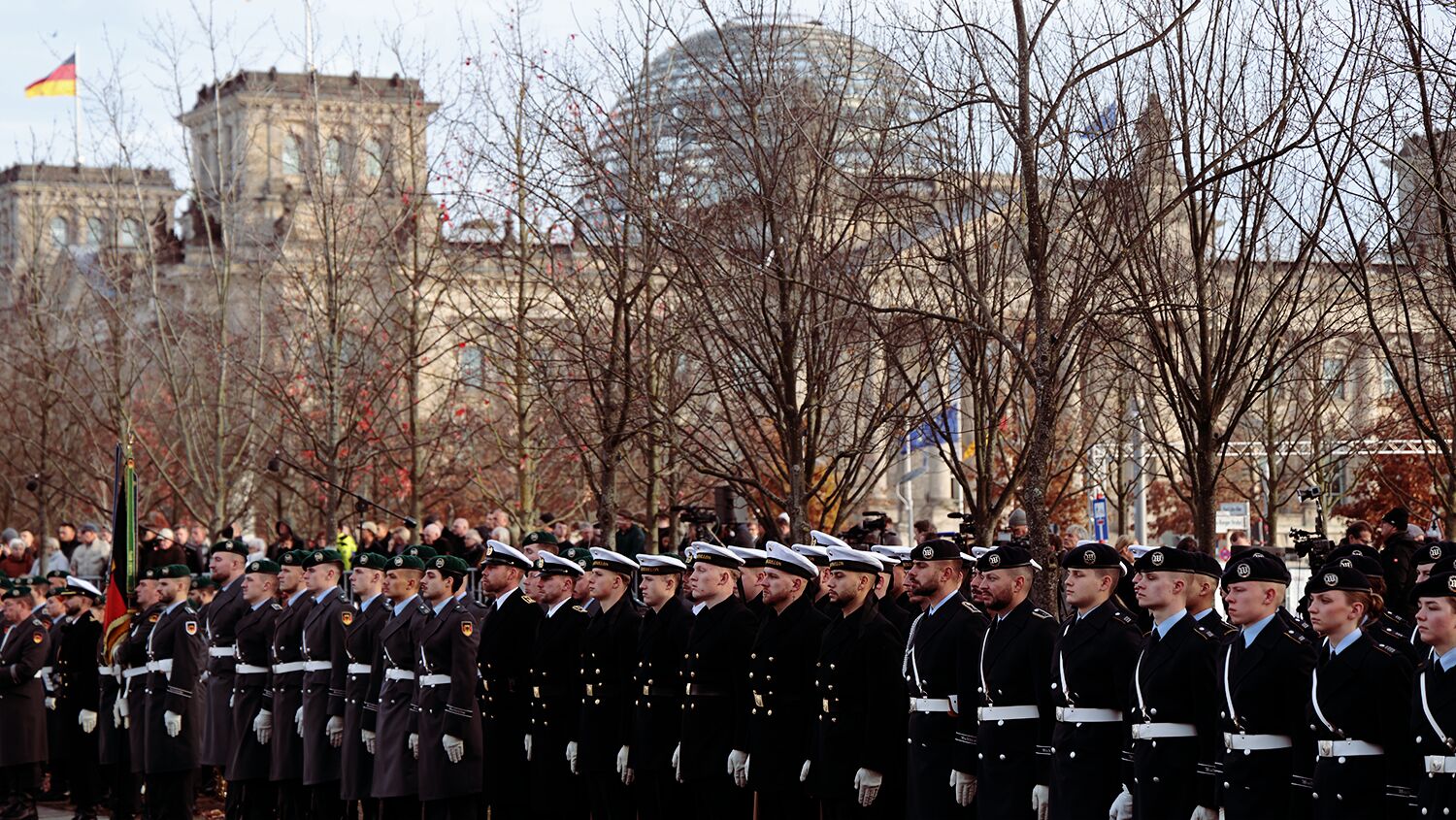
Germany’s Bundeswehr Turns 70
Today marks the 70th anniversary of the founding of the German Bundeswehr, the national military. In a piece commemorating the anniversary, Deutsche Welle wrote:
In 1945, few would have predicted that Germany would reestablish an army just a decade later.
1945 was when World War ii ended—after the German military and society launched the worst conflict in human history and initiated the death of some 60 million people, including 6 million Jews. After paying an unimaginable price to stop German forces, the Allies vowed that Germany would never again be allowed to have a military.
But Herbert W. Armstrong prophesied in 1945 that Germany would not only reestablish a military but that those forces would lead Europe and develop into a superpower.
Ten years later, the German military was indeed reestablished—with U.S. and European support!
Even more astonishing, that same German military is now taking the lead in Europe.
The day after the war ended in Europe, Mr. Armstrong gave a public address citing Bible prophecy and forecasting that Germany would be back and lead a “coming United States of Europe.”
The troubling signs of a reawakening Nazi spirit were there from the Bundeswehr’s founding in 1955: It recruited many officers from Adolf Hitler’s regime.
- The first inspector general of the Bundeswehr was Adolf Heusinger, who served as the chief of the general staff of the army during World War ii. According to German historian Johannes Hürter, Heusinger was one of Hitler’s “most important military advisers.”
- Albert Schnez, a colonel during the war, organized a shadow army afterward with around 2,000 former officers of the German Wehrmacht and Waffen-SS for the purpose of fielding a force of 40,000 troops. He later became a lieutenant general in the Bundeswehr and inspector of the army. He was also closely associated with one of Germany’s strongest postwar defense ministers, European unification advocate Franz Josef Strauss.
Deutsche Welle put it mildly:
Although the Bundeswehr’s political and social orientation was new, personnel continuity remained. Some officers had previously served in the Wehrmacht. With no other pool of experienced military professionals available, their inclusion was unavoidable.
Was it really “unavoidable” to draw on the experience of a mass-murder regime? The thought is ludicrous considering that American forces were protecting Germany at the time and continue to do so to this day.
But it wasn’t just the officers who were longing for a revived militarization. “The Germans were never pacifists,” military historian Sönke Neitzel of the University of Potsdam told DW. “There was a significant minority against rearmament, but a majority supported it. And Adenauer won the 1957 general election with an absolute majority. If Germans had been so opposed to rearmament and the introduction of conscription on April 1, 1957, they wouldn’t have voted for Adenauer.”
Germany reunified in 1990, and its government was allowed to recognize Yugoslavia’s breakaway republics in the early 1990s. By 1998, it got nato to bomb Yugoslavia and German Luftwaffe pilots participated, effectively using one World War ii enemy, the United States, to wreak German revenge on another World War ii enemy, Yugoslavia.
The Bundeswehr started under the rationale that it would be purely a defensive force, but its purpose gradually expanded to include “peacekeeping missions” in Afghanistan and around the world.
Today, Germany is the biggest military spender in the EU and the fourth largest in the world. Chancellor Friedrich Merz now wants to make the Bundeswehr the strongest conventional force in Europe. It has already taken the lead in several multinational military exercises and continues to incorporate Dutch and other European military units under its command. In many ways, a European army already exists, just like Mr. Armstrong forecast based on a prophecy in Revelation 17.
“And there are seven kings: five are fallen, and one is, and the other is not yet come; and when he cometh, he must continue a short space” (verse 10). The “one is” in this prophecy refers to Adolf Hitler, who was active when God revealed this prophecy to Mr. Armstrong (request your free copy of our booklet about these prophecies, He Was Right). The other had “not yet come,” but it is rising now.
This prophecy also shows that there is a strong link between Hitler’s military and this coming resurrection. The Bundeswehr’s founding—and its plans for the future—prove this.


