This Deal Will Not Bring ‘Eternal Peace’
This Deal Will Not Bring ‘Eternal Peace’

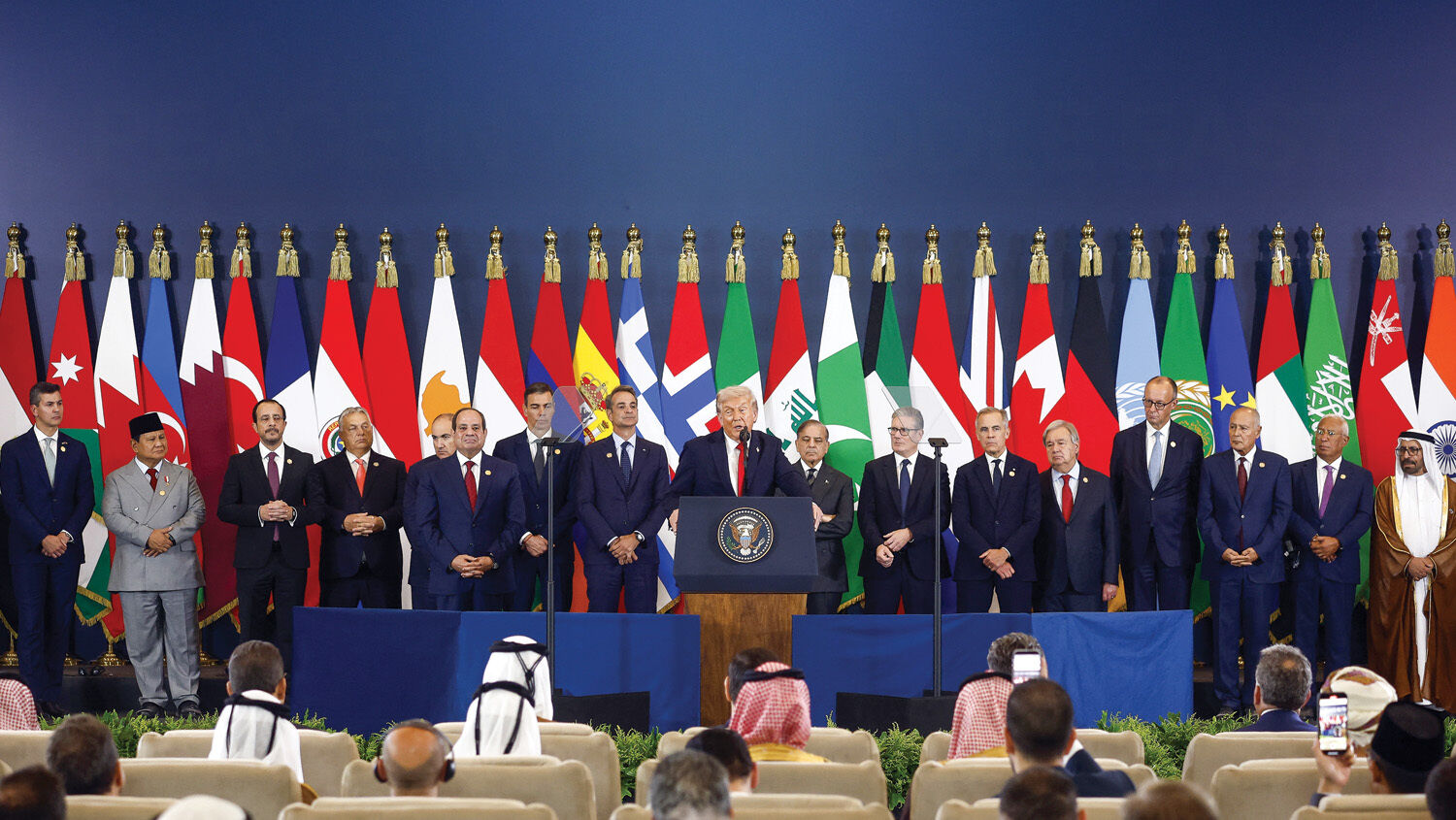
Israel and Hamas agreed to a United States-crafted ceasefire intended to end their war on October 8. President Donald Trump, in his usual hyperbolic style, called the agreement “potentially one of the great days ever in civilization,” promising an “eternal peace in the Middle East.” Israeli President Isaac Herzog called it “a chance to mend, to heal, and to open a new horizon of hope for our region.”
For Israel, it meant the end of the war. Other nations consider it a chance for a two-state solution: a new state of Palestine coexisting peaceably alongside the State of Israel.
Israel has been fighting Hamas and other terrorist groups for two years. The population is war weary. Prime Minister Benjamin Netanyahu is under immense internal and international pressure. With Hamas’s Iranian sponsor continuing to threaten revenge, many see this deal as the respite they have been waiting for. Israel can be a normal country again: It can stop sending its sons on a one-way trip to a den of jihadists; it doesn’t have to suffer the finger-wagging by the rest of the world; and it won’t be haunted by images of emaciated shells of hostages rotting in dark dungeons.
But is an “eternal peace” on “a new horizon of hope” really coming to Israel?
Hamas Hasn’t Surrendered
Under the agreement, Hamas released the last 20 living hostages it had abducted 733 days prior during its Oct. 7, 2023, massacre. It is also supposed to return the remains of the hostages it had killed, but has not done so. The Israel Defense Forces began a gradual withdrawal from the Gaza Strip, and an international peacekeeping force is meant to fill the void. This International Stabilization Force (isf) will be sponsored by “Arab and international partners.” Hamas also agreed to hand power to a “technocratic, apolitical Palestinian committee.”
Israel declared victory with the agreement. So did Hamas. The ceasefire is just that; it is not an unconditional surrender, and Hamas didn’t treat it as such. The agreement hinges on Hamas giving up its weapons in good faith—a condition Hamas has publicly rejected. Hamas wants to keep its weapons because it wants to keep killing Jews.
Meanwhile, the Gazan interim committee is in the process of being formed, and Hamas has thus far given its consent. Diplomatic sources speaking with Israeli media claim Hamas has unofficial veto power over half the committee’s composition to ensure the membership of “individuals aligned with Hamas principles, though not openly affiliated with the organization,” as Ynetnews put it. Hamas reportedly wouldn’t agree to the committee’s formation otherwise.
In other words, Hamas is not leaving Gaza, and the international community putting these interim positions together has accepted that. Hamas is only going underground while it influences Gaza’s future through proxies.
The preamble in Hamas’s founding covenant reads: “Israel will exist and will continue to exist until Islam will obliterate it, just as it obliterated others before it.” Hamas made this declaration at its founding in 1987, and its members stand by this creed to this day. Its emblem depicts Hamas’s characteristic shade of green painted over all of the Holy Land—“from the river to the sea.”
Hamas will never believe in peace or coexistence with Israel. Its goal has always been the annihilation of the Jewish state. Every move it makes aims to advance that grand strategy, even if it means a temporary pause in fighting.
Gazans Still Hate Israel
Most Gazans hate Israel as intensely as Hamas does.
During the October 7 terror attack, many of the Palestinians who poured across the border into Israel were not Hamas members or affiliates. They were “ordinary Gazans.” It was ordinary Gazans who celebrated the parading of hostages, living and dead, through Gaza. It was ordinary Gazans who knowingly took part in propaganda videos falsely portraying Israel’s campaign as genocidal. It was ordinary Gazans who opened their houses to stash hostages. It is from the civilian population that Hamas replenishes its ranks. There is no sign of a change of heart among the people.
“All the living hostages [have] returned to us,” Arab-Israeli journalist Yoseph Haddad wrote, “but not even one of the people abducted on October 7 has said that anyone in Gaza cared about them, helped them, or tried to save or assist them in any way. … On the contrary, the captivity survivors who’ve returned say that there’s no one in Gaza, not a single person from child to the elderly, who didn’t treat them with hatred, contempt and violence.”
Hamas was formed in 1987 by people who thought the existing Palestinian terrorist groups weren’t radical enough. Even if Hamas goes away, new groups have very fertile soil among the population to sprout from. There is little to stop new groups from replacing Hamas as Hamas replaced its predecessors. Hamas’s totalitarian, Islamist vision for the Holy Land is a reflection of what Gazans themselves want.
Prime Minister Netanyahu has stated that he would like a Palestinian group unaffiliated with either Hamas or the Palestinian Authority to govern Gaza. One group Israel has been allegedly sponsoring to such an end is the Popular Forces, a militia led by Yasser Abu Shabab. Officially, they are trying to bring aid to Gazan families and keep it out of the hands of Hamas. But the group might be linked to the Islamic State, which operated in neighboring Egypt for years. One of its prominent leaders took part in the October 7 massacre, independently of Hamas.
Apparently, the best solution Israel can muster up to replace Hamas is the Islamic State.
Conflicts of Interest
Israel isn’t completely alone in trying to stabilize Gaza; other countries are reportedly offering help. But what kind of help is Israel getting?
Despite what President Trump’s peace plan calls for, no “Arab partners” have volunteered to send soldiers as peacekeepers. Trump had indicated that he wanted Saudi Arabia and the United Arab Emirates to play a large part in reconstruction efforts. But both countries have ruled out sending any peacekeepers as long as Hamas is in power. So has Egypt, the other country sharing a border with Gaza. Arab countries sending peacekeepers to help Israel “occupy” Gaza would appear to their own populations to be collaborating with the Zionist “enemy.” No Arab government wants to kick-start a revolution at home for the sake of a few hundred soldiers sent to Gaza.
What about the rest of the Muslim world? Unconfirmed media reports suggest Israel is looking to Azerbaijan, Indonesia and Pakistan to make up the peacekeeping force. Indonesia has publicly offered to send troops. Pakistan is a hotbed of Islamic terrorism that spawned a variant of the Taliban. Azerbaijan has a long history of war with serious and credible allegations of ethnic cleansing and other war crimes. Indonesia, the largest Muslim country, has its own problems with Islamist extremism. Neither Indonesia nor Pakistan have ever had diplomatic relations with Israel.
These are the countries Israel would trust to disarm Hamas, to carry weapons on Israeli soil, be comfortable sharing security secrets with, and not to have individuals in their ranks who want to launch their own terror attacks.
Still, this is not good enough for Trump. He is reportedly trying to pressure Israel to allow Turkey to contribute to the peacekeeping force.
Turkey recently signed up as a guarantor for Trump’s peace deal between Armenia and Azerbaijan. It was the first Islamic country to recognize Israel’s independence and technically still maintains diplomatic relations. But it is also one of Hamas’s biggest sponsors. A year ago, Turkish President Recep Tayyip Erdoğan even let Hamas use Istanbul as a new headquarters. Erdoğan has compared Netanyahu to Hitler and has said that he wants to conquer Jerusalem.
Erdoğan is among the last people one would expect to help bring an “eternal peace” to the Holy Land. Trump’s nomination of Turkey is telling. His formula for peace may have the optics of “the world coming together” and “all the bad guys of the world finally seeing the errors of their ways.” But optics is all it is. Behind the facade are policies of expediency: Simply put, Israel is the easier party to pressure into submission.
There are many worse compromises Netanyahu could have made. He has done an admirable job in standing up to world opinion to keep his people safe. But even he has his limits. In terms of national security, this ceasefire leaves him with no good options. He appears to be simply choosing the option that will hurt Israel the slowest.
A Deadly Wound
The book of Hosea is for the latter days, just before Christ’s Second Coming (Hosea 3:5). With this in mind, note this prophecy: “When Ephraim saw his sickness, and Judah saw his wound, then went Ephraim to the Assyrian, and sent to king Jareb: yet could he not heal you, nor cure you of your wound” (Hosea 5:13).
Judah was the ancestral patriarch of the Jews, who today form the State of Israel. Ephraim is the patriarchal ancestor of the modern British people, while Assyria is modern Germany. (Herbert W. Armstrong’s book The United States and Britain in Prophecy explains this in detail. Request your free copy at theTrumpet.com/library.)
This prophecy says modern Judah would be afflicted with a “wound” so severe that it attracts international attention. No physical remedy can heal it. What is this wound?
Strong’s Concordance defines the word “wound” as “in the sense of binding up: a bandage, i.e. remedy ….” Gesenius’ Hebrew-Chaldee Lexicon explains it as “the pressing together, binding up of a wound; hence used figuratively of a remedy applied to the wounds of the state ….” “In other words,” Trumpet editor in chief Gerald Flurry writes in Jerusalem in Prophecy, “the remedy is the wound!”
Israel has a national wound. It tries to apply a remedy, but the remedy only makes it worse. The wound is so horrendous Israel calls for international assistance, yet the wound worsens even further. Again, what is this wound?
Mr. Flurry continues: “Is the peace pact with the Arabs the Israeli wound that God refers to in Hosea 5:13? There would have been no peace pact if Judah would have trusted God instead of men. The word wound doesn’t necessarily itself refer to some violent act, but it will undoubtedly lead to violence.”
Mr. Flurry first published Jerusalem in Prophecy in 2001, before Israel withdrew from Gaza as an olive branch to the Palestinians, before Hamas took over Gaza and turned it into a totalitarian Islamist state. Israel had major problems with the Palestinians then, but many thought peace was still possible. For years after, most Israelis still thought the two-state solution had a chance.
The situation in 2025 is dramatically different. Hardly any Israelis believe in a two-state solution anymore. Yet nobody has come up with a better option. The best Israel seems to hope for is that Muslim peacekeepers can convince Hamas to give up its land and weapons and convince Gazans to relinquish their deep-seated genocidal hatred for the Jewish people.
Mr. Flurry called the peace process a remedy that is a wound. It’s like a toxic poison with a label misprinted as medicine.
The Solution
God established the ancient nation of Israel to point the world back to him (e.g. Deuteronomy 4:6-7). Through many miracles, God established the modern State of Israel despite its neighbors trying time and time again to destroy it. God expects His people to trust in Him to solve their problems, not in other human beings.
“Thus saith the Lord; Cursed be the man that trusteth in man, and maketh flesh his arm, and whose heart departeth from the Lord. For he shall be like the heath in the desert, and shall not see when good cometh; but shall inhabit the parched places in the wilderness, in a salt land and not inhabited. Blessed is the man that trusteth in the Lord, and whose hope the Lord is. For he shall be as a tree planted by the waters, and that spreadeth out her roots by the river, and shall not see when heat cometh, but her leaf shall be green; and shall not be careful in the year of drought, neither shall cease from yielding fruit” (Jeremiah 17:5-8).
Israel’s only hope is to turn to God in repentance and faith and look to Him and His Word as the solution to its problems. Hosea 5 concludes with God saying, “I will go and return to my place, till they acknowledge their offence, and seek my face: in their affliction they will seek me early” (verse 15).
“The real wound is spiritual—a lack of faith in God,” Mr. Flurry writes in Jerusalem in Prophecy. “The Jews keep trying to heal themselves by making peace pacts. They were strong when they trusted God. Even recent history proves that truth. Just a short time ago they were a terror to the Arabs. Now the Arabs are a terror to the Jews. A complete reversal in such a short time! … Today the Jews only see their wound humanly. But even that understanding comes painfully slow. Before this is over, they will see their wound spiritually—through God’s eyes. Then their wound will be healed, and they will have peace forever.”
There is a big lesson in Hosea 5:13 that can be extrapolated to all individuals God is working with. Trusting in God means trusting in Him to do for us what we cannot do for ourselves. The Apostle Paul wrote that “without faith it is impossible to please him” (Hebrews 11:6). This means seeing God as the real, living God He is, as the literal final authority to bring into our life and to follow. This means relying on His infinite power rather than our own ability as the guiding force in our life. God wants individuals to learn this lesson. But He also wants nations, like the Jewish nation called by His name, to learn this lesson as well.
One of Jesus Christ’s titles is “the Lion of the tribe of Juda” (Revelation 5:5). Even though the tribe of Judah rejected Him at His first coming, He still has a special relationship with them. He considers them “His own” people (John 1:11). God has a plan to save Judah, but first, the people as a whole must learn some hard lessons. The foremost lesson is that national success, in relations with foreign peoples or anything else, depends on how much the nation relies on the one true God.