

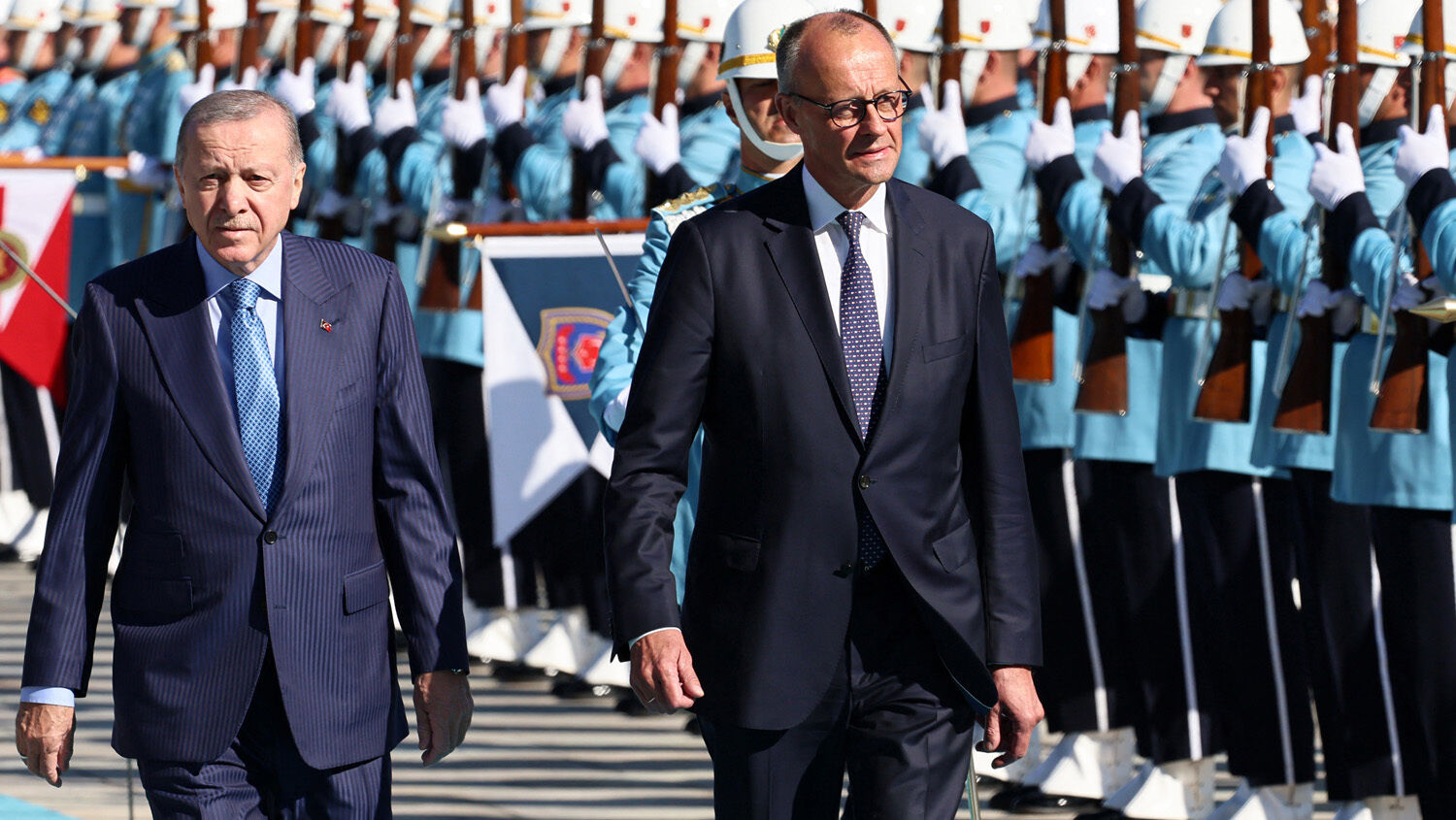
Germany Deepens ‘Friendship’ With Turkey
German Chancellor Friedrich Merz traveled to Turkey on Wednesday. Ahead of the trip, Foreign Minister Johann Wadephul said that Turkey was a “strategic partner in all our foreign-policy matters and a good friend.” At a news conference on Thursday with Turkish President Recep Tayyip Erdoğan, Merz said: “I personally, and the German government, see Turkey as a close partner of the European Union. We want to continue smoothing the way to Europe.”
Germany worked to brush aside all possible disagreements before the meeting, even green-lighting Turkey’s purchase of Eurofighter jets. Frankfurter Allgemeine Zeitung wrote:
It was probably no coincidence that the Eurofighter issue, which had caused irritation between Berlin and Ankara for some time, was resolved shortly before Merz’s visit. On Monday, British Prime Minister Keir Starmer signed an agreement with Erdoğan on the delivery of 20 Eurofighters, which Berlin also approved.
The Eurofighter issue clearly illustrates how Berlin’s view of Turkey has changed since the start of Russia’s war of aggression in Ukraine and in light of Donald Trump’s vacillations. Before Merz’s trip, government circles said that the delivery of Eurofighters to nato ally Turkey would serve as “collective defense.” Turkey has not been as sought after as a nato partner since the Cold War. Until recently, successive German governments had blocked arms deliveries to Turkey for years—due to human rights violations, Turkish military operations in Syria, and out of consideration for Greece. Now, the German government is pushing for Ankara to participate in the EU’s safe armaments program, despite Athens’s concerns. The Turkish press noted favorably that Merz was visiting Ankara before Athens.
“Merz wants to turn the long period of open differences in relations with Turkey back into a genuine strategic partnership,” n-tv.de reported. During his inaugural visit, Merz and Erdoğan discussed peace efforts in Gaza, the war in Ukraine, arms cooperation, and the repatriation of migrants to Turkey and Syria.
But when it comes to peace efforts in Gaza, the two sides have difficulty presenting a united front to the public. After praising German-Turkish cooperation and their future goals, Erdoğan once again accused Israel of genocide and noted that he had raised this concern with the German chancellor in their private discussion.
Merz thanked Erdoğan specifically for his part in the ceasefire negotiations between Israel and Hamas. He noted that without Turkey, Egypt, Qatar and the U.S., no agreement would have been made.
Despite Erdoğan’s accusations against Israel, Merz tried to present a harmonious picture for the press.
Then came a provocative question from a Turkish journalist: Was Germany, with its support for Israel, not “on the wrong side of history” for the second time? An allusion to the Holocaust and World War ii.
Merz was forced to clarify that Germany continues to stand by Israel even if it disagrees with some of its decisions and the suffering in Gaza. He also criticized Hamas as the aggressor—something Erdoğan, a staunch supporter of Hamas, doesn’t like to hear.
By no means can Erdoğan be seen as a trusted partner, as Trumpet editor in chief Gerald Flurry explained in our latest Trumpet issue:
Erdoğan has allied himself with the Muslim Brotherhood in Egypt. This is the terrorist organization that spawned Hamas and al Qaeda and has connections with jihadists around the world, including those in America. Under Erdoğan’s leadership, Turkey has fought the Kurds in Syria, who are America’s allies. And he regularly and publicly expresses his hatred for the Jews and Israel, America’s number one ally in the Middle East.
This raises the question: Why is Germany so eager to deepen its alliance with Turkey while the country’s hatred for Israel grows?
Strategic Importance
Turkey is a strategically important country. It plays a critical role in any conflict in the Middle East and was instrumental in overthrowing the Assad regime in Syria. Recognizing Turkey’s importance in the region, Germany has allowed it to become a top recipient of its weapons exports.
Turkey has also prevented millions of refugees from flooding into Europe. At the same time, millions of Turks have integrated into German society over the past century. Bilateral trade between Germany and Turkey is worth over $50 billion, and Erdoğan has set a target of reaching $60 billion.
German relations with Turkey go back to a 1761 treaty of friendship and trade between the Ottoman Empire and the Kingdom of Prussia. Over the centuries, these countries have grown mutually dependent on one another.
Chancellor Merz now wants to deepen these relations. This means he has to be silent about Erdoğan’s autocratic rule at home and his anti-Semitism. It also means equipping Turkey with high-tech weaponry, such as the Eurofighter.
Erdoğan is also eager to increase cooperation, especially in the military sector. “In light of the changing security conditions in Europe,” he said, “we must leave behind problems in the procurement of defense industry products and focus on joint projects.”
Where are these relations leading?
Prophesied Alliance
The Bible has much to say about these two countries.
Mr. Flurry explains in “Turkey Is Going to Betray America” that Edom in the Bible refers to modern-day Turkey. A prophecy in Psalm 83 outlines an alliance between Edom and Assyria, or modern-day Germany. Mr. Flurry wrote:
The Ottoman Empire ruled Turkey for four centuries (1517–1917). In World War i, it allied with Germany’s emperor, Kaiser Wilhelm ii. Germany lost that war to Britain and America, and the Turks lost their empire. That foreshadowed what is yet to come upon the nation.
Psalm 83 is another prophecy that refers to Edom, or Turkey. This shows that it is in an alliance with “Assur,” the ancient capital city of the Assyrian Empire. Assyria refers to modern-day Germany. (Read “Is Germany in Bible Prophecy?”) Turkey is going to ally with Germany.
Psalm 83 reveals a shocking alliance built on hatred for “Israel”—America, Britain and the Jewish nation in the Middle East. “They have said, Come, and let us cut them off from being a nation; that the name of Israel may be no more in remembrance” (verse 4). This prophecy reveals a plot to blot out the name of Israel. It foretells a terrible betrayal of these nations!
For a detailed explanation of this crucial prophecy, read “Turkey Is Going to Betray America.”


