

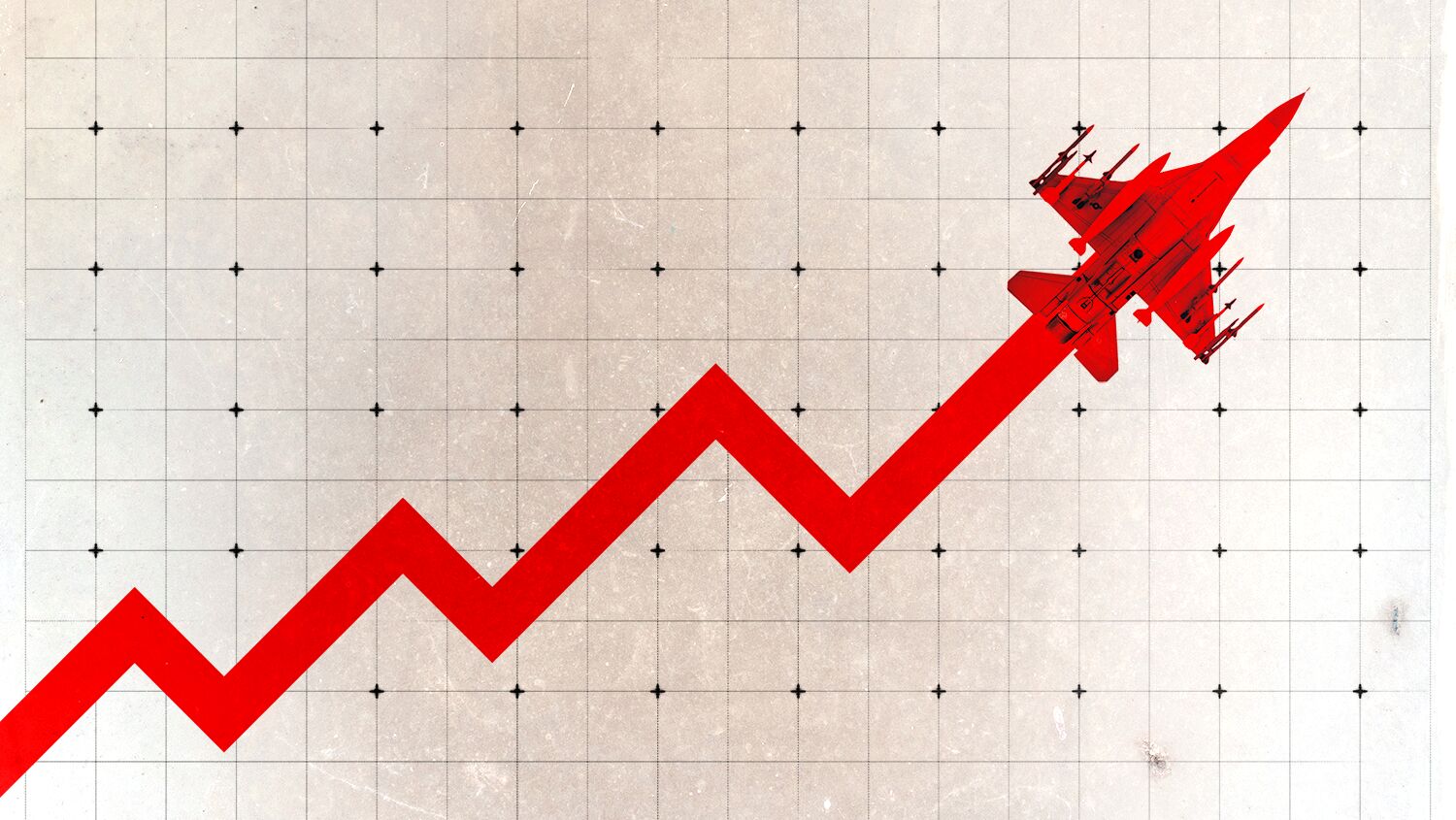
Can Weapons Save Germany’s Economy?
While dark clouds beset Germany’s civil industry, its armaments and defense manufacturers are experiencing a golden age, Spiegel wrote in its October 27 article “Germany’s Economy Pins Its Hopes on the Defense Industry.” But as the article highlights, this potential economic saver revives Germany’s dark past. In many cases, the very companies that fueled Adolf Hitler’s war machine are rising again.
Salzgitter is a case in point. In recent years, the company has been viewed as a relic of history forced to adapt to the changing times. But its investment in the production of armor-grade steel is now proving lucrative and essential for Germany’s arms industry. Yet, Spiegel writes, the company’s move into the defense sector “is not without risk, including for historical reasons. Salzgitter emerged from the Reichswerk AG für Erzbergbau und Eisenhütten ‘Hermann Göring,’ which delivered steel to Nazi Germany’s armaments industry.”
This story should be making headlines around the world. The arms manufacturers of one of the most frightening military regimes in history are making a comeback. It’s not just Salzgitter; Volkswagen, Rheinmetall and other German industry giants enriched themselves on the blood of Germany’s enemies during World War ii. These companies are making a comeback, just as they pledged to do at 1944 meeting with Nazi authorities—and as was prophesied.
This is part of a larger trend of Germany’s civil industry turning to the dark side. Spiegel recounted a few more recent examples:
- Volkswagen is considering a production partnership with defense giant Rheinmetall at its underutilized Osnabrück facility.
- Porsche SE (VW’s parent company) plans to establish a platform for investments in defense technologies.
- Automobile parts supplier Schaeffler is investing in defense production in an effort to keep its business going.
- Heidelberg-based Druckmaschinen AG seeks an alliance with defense supplier Vincorion, which manufactures energy systems for air defense and backup generators for the Eurofighter jet.
- Family-owned Trumpf has amended its articles of association to permit the sale of high-tech lasers for military use.
We also see the rise of some newcomers. Spiegel highlighted how German start-ups with a military focus are thriving. Even the most seemingly peaceful companies, such as the Hamburg-based food-tech start-up goodBytz, entered the military sphere by supplying a fully automated robot kitchen to the United States Army.
Other start-ups are more directly invested in the military, such as arx Robotics, which developed miniature unmanned tank-like ground vehicles. “Because they are quiet, electric or hybrid, troop transporters can leave the danger zone more quickly and go unnoticed by enemy reconnaissance,” said Deutz ceo Sebastian Schulte. arx Robotics collaborates with well-established industrial heavyweights such as Deutz, one of the world’s oldest motor manufacturers.
Since Russia’s invasion of Ukraine, German arms manufacturing is booming. Spiegel’s article includes an illustration depicting:
- Revenue earned through the production of weapons and munitions in Germany rose from roughly €2.5 billion from 2014 to 2019 to over €5 billion in 2024.
- Germany’s stark increase in defense spending and special military funds are expected to rise to €108.2 billion next year.
- Rheinmetall’s skyrocketing stock price far outpaces the meager growth of the German stock market index.
Behind these numbers are dozens of industrialists and thousands of workers whose lives have changed because of the military boom.
A study by the Kiel Institute for the World Economy claims that the European Union’s gross domestic product could grow by 0.9 to 1.5 percent if member states:
- Boost defense spending from 2 percent of gdp to 3.5 percent
- Purchase their high-tech weapons in Europe
- Invest in dual-use research and development.
Some doubt this logic: Investing in military goods tends to lead to war rather than economic prosperity.
Trumpet editor in chief Gerald Flurry wrote: “We are seeing a remarkable shift: Germany’s industrial powerhouse is becoming a military powerhouse. But the nation is not investing as much in old military technology as it is in ‘the future of warfare.‘”
This is not a story about Germany saving its economy; this is about Germany preparing for World War iii.


