

Will a Female Archbishop of Canterbury Make the World More Catholic?
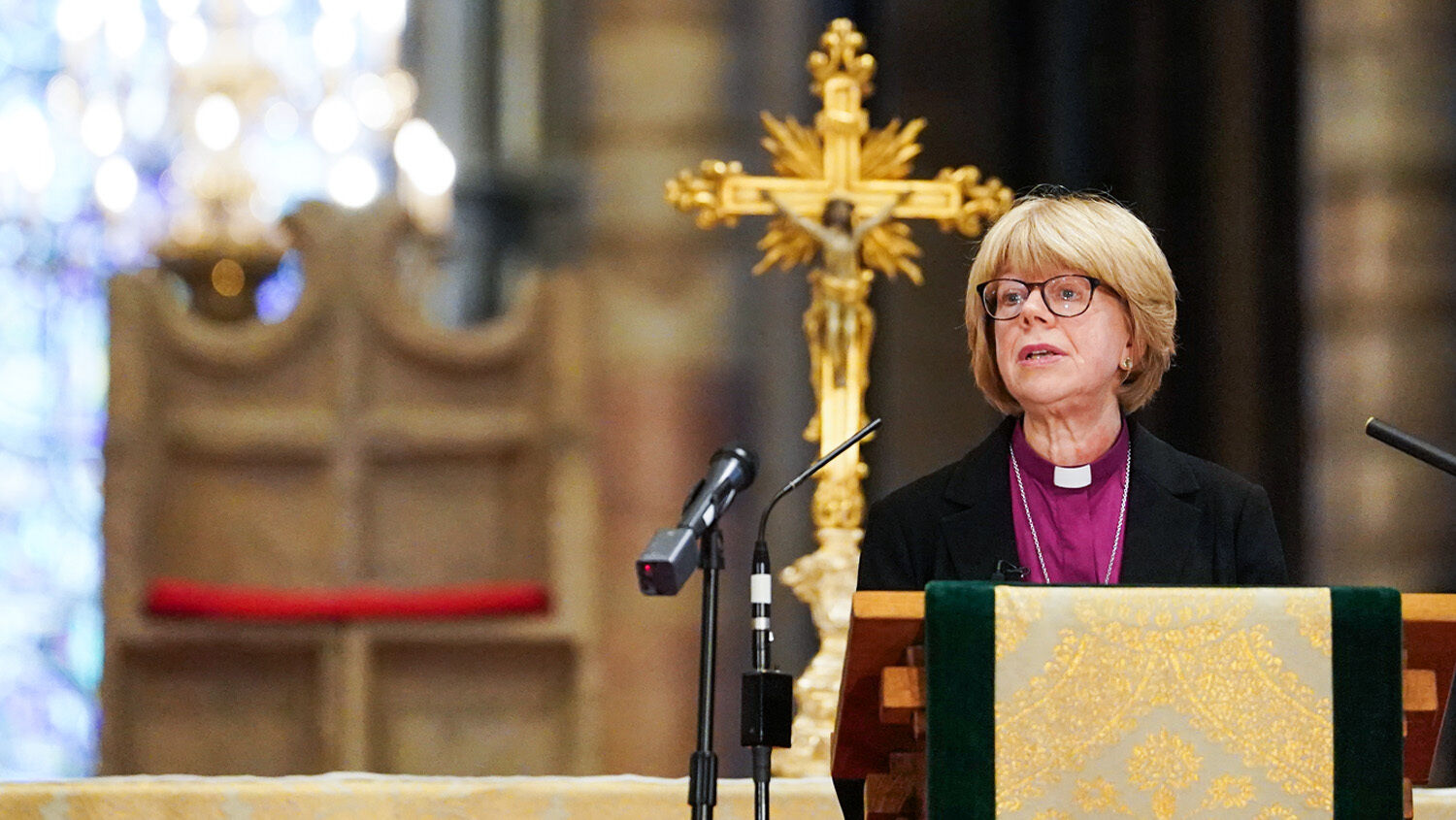
Dame Sarah Mullally will be the next archbishop of Canterbury, the Church of England announced October 3.
People may have different views about women preachers. The Bible’s view is clear and direct: “Let the woman learn in silence with all subjection,” wrote the Apostle Paul. “But I suffer not a woman to teach, nor to usurp authority over the man, but to be in silence” (1 Timothy 2:11-12).
Now the Church of England has appointed one to be its most senior religious leader in the culmination of a decades-long process. The first female priest was ordained in 1994; the first female bishop, in 2015. The church tried to compromise with those who could not turn their backs so quickly on such clear Bible verses by allowing parishes that disagreed with female ordination to be served by “flying bishops”—male bishops who would not ordain women.
The appointment of a female archbishop of Canterbury makes it much harder for those who adhere to the Bible on this issue to remain in the church. It makes it crystal clear that the church fundamentally disagrees with Paul, Jesus Christ and the Bible.
It comes after years of compromise from many so-called Christian denominations. The United Church of Christ began ordaining women in the 19th century: the Methodist Church ordained its first woman in 1956. The Evangelical Lutheran Church in America and the Presbyterian Church both ordain women.
These churches have also abandoned the Bible’s teaching on marriage. The Church of England began blessing same-sex couples in church services in 2023—a compromise and stepping-stone toward allowing homosexuals to marry in church. The following will conduct same-sex “marriages,” though individual priests of congregations may object:
- Episcopal Church (the American branch of the Anglican Communion)
- United Church of Christ
- Presbyterian Church (U.S.A.)
- Evangelical Lutheran Church in America
- American Baptist Churches U.S.A.
Many have gone to ridiculous and blasphemous extremes. God is “a drag queen and transman and genderfluid,” was declared in a prayer at Duke University’s Methodist-affiliated divinity school. “Ms. Penny Cost” is a traveling minister for the United Methodist Church. The Church of England has a transgender priest, Bingo Allison, who dresses as a woman and wants to be referred to as “they.” The Methodist Church of Great Britain has told its ministers to avoid using outdated and divisive terms like “husband” and “wife.”
Yet as these churches liberalize, America is experiencing a religious revival—on the right. In the wake of Charlie Kirk’s assassination, many are realizing their need for God and America’s need for a change in direction. They’ve seen the damage wokeness has caused. Chasing the latest fads has led to almost insane decisions that harm children and the nation alike. They yearn for eternal truths, tradition and a connection with the past.
Even before Kirk’s assassination, there were signs of a revival. A study by the Bible Society earlier this year found the percentage of young adults attending church regularly had risen from just 4 percent in 2018 to 16 percent. Others have pointed to flaws in the study that exaggerate the uptick—but it is there nonetheless.
Over Easter, the Catholic Church in France baptized nearly 18,000 people—the highest number ever recorded. The Catholic diocese in Westminster, at the heart of London, baptized 500. The Diocese of Lansing, Michigan, baptized 633, 30 percent more than the year before and the highest number in a decade. Stephen Foter, rector of the Anglican St. Aldates church in Oxford, which caters to university students, had 1,000 people show up for his Easter morning service—“more people in our building … than any time in the last thousand years,” he said.
“Among the young Christian converts I speak to, an overwhelming theme is a sense of disaffection with and even contempt for the triviality and banality of secular society,” wrote James Marriot in a lengthy Times essay earlier in the year. “A recent convert at St. Barts captures a widespread sentiment when he speaks of a yearning for ‘something huge and beautiful and awe-inspiring … for something bigger.’ At a Catholic church in prosperous west London—another remarkably young congregation, many of whom snap pictures of the high altar before Mass—I spoke to Emma, 23, who converted last year, attracted by the “beauty” of the church. ‘Catholicism,’ she says, ‘has been rooted for so long.’”
The woke churches have nothing to offer these new converts. But there are two clear alternatives: the Catholic Church and the Orthodox Churches.
The Catholic Church has a few priests and parishes that went woke. And Pope Francis alarmed many when he seemed set to move the church in that same direction. But Pope Leo is more cautious and circumspect. Few in the Eastern Orthodox churches have made any moves in this direction.
The new converts are reading Catholic authors like G. K. Chesterton or the more conservative Anglican C. S. Lewis. And J. R. R. Tolkien’s The Lord of the Rings gives a deep, though not immediately obvious, Catholic worldview, serving almost as a gateway drug. These three are probably the most influential modern authors to argue against atheism and secularism—and in today’s world, they generally point toward the Catholic Church.
The Catholic Church has encouraged this trend by making John Henry Newman a saint in 2019. This year he was given an even higher honor, made a doctor of the church, joining an elite group of just 38, including men like Augustine of Hippo, Thomas Aquinas and Hildegard of Bingen. Newman shocked Anglican England with his conversion to the Catholic Church in 1845 and became one of the great Catholic intellectuals of his generation. The priest Francis Xavier Morgan, Tolkien’s guardian after his mother died, was one of his students.
“In an age of instability, people are attracted to ancient traditions; in an age of therapy-speak, there’s something appealing about the tough demands of Catholic doctrine,” said Dan Hitchens, a senior editor at First Things.
The Catholic Church leans into this, while groups like the Church of England, which also has a great architectural heritage and an even richer musical tradition, reject it. The Church of England recently decorated the 1,500-year-old Canterbury Cathedral, effectively its headquarters church, with graffiti. It looks hideous.
https://x.com/phmbaker/status/1976533446307495979
Bishop Robert Barron, a popular Catholic YouTuber, built his following by beginning with the beauty in Catholic traditions and going from there.
Eastern Orthodox preachers also have an online following. “Young, single men are flocking to the Orthodox church after discovering the ‘masculine’ Christian religion through online influencers,” wrote the Telegraph earlier this year. “Some converts said they felt disillusioned with the ‘feminization’ of the Protestant church and were attracted to the ‘authenticity’ of Orthodoxy, which they claim pushes them physically and mentally. Priests are now planning to open new parishes to accommodate the ‘tsunami’ of young men who have converted since the pandemic.”
Others are merely being repelled by the Anglican Communion and other mainstream groups. The Global Anglican Future Conference (gafcon) stated they no longer saw the Church of England as being in communion with the Anglican Church. “We cannot continue to have communion with those who advocate the revisionist agenda, which has abandoned the inerrant Word of God as the final authority,” they wrote.
Many Anglican provinces in Africa align with gafcon, with one study showing they represented 45 percent of all practicing Anglicans. gafcon previously declared it did not recognize Justin Welby’s leadership as archbishop of Canterbury, but now it’s announced a Global Anglican Communion.
There’s been no discussion of gafcon returning to Rome. But splits in Anglicanism hardly strengthen it. In England, Catholics are on course to outnumber Protestants for the first time since the Reformation. In America, the Catholic Church is becoming the established religion, with the majority of Supreme Court justices, the former president and current vice president all in attendance.
The stage is set for what Herbert W. Armstrong called “the greatest revolution in religion the world has witnessed.”
“Europe will go Roman Catholic!” his Plain Truth magazine forecast. “Protestantism will be absorbed into the ‘mother’ church—and totally abolished.”
This revolution will be hailed by many as a return to tradition. But tradition is not enough. Is it a return to the Bible?
In many ways, the Catholic Church, or its Eastern cousin, does look like the solution to America’s sickness.
But the Bible warns of “false apostles, deceitful workers, transforming themselves into the apostles of Christ”—men who look like “ministers of righteousness,” often sincere but deceived, who lead others astray (2 Corinthians 11:13-15). Christ Himself said that “many shall come in my name, saying, I am Christ; and shall deceive many” (Matthew 24:4-5).
To avoid deception, Christians are told: “Prove all things, hold fast that which is good” (1 Thessalonians 5:21). In Acts 17:11, Christians in Berea were praised for showing us how to do this. They “were more noble than those in Thessalonica, in that they received the word with all readiness of mind, and searched the scriptures daily, whether those things were so.”
1 John 4:1 commands us to “believe not every spirit, but try the spirits whether they are of God: because many false prophets are gone out into the world.”
Tradition must be measured against the Bible.
Don’t just look to ancient tradition. Every individual has the responsibility to prove what he or she believes. That is the solution to woke Christianity—a return to the Bible and a reverence for what it says. You can prove which Church is God’s. Our newest free booklet, Can You Prove Which Church Is God’s?, can help you do exactly that.


