

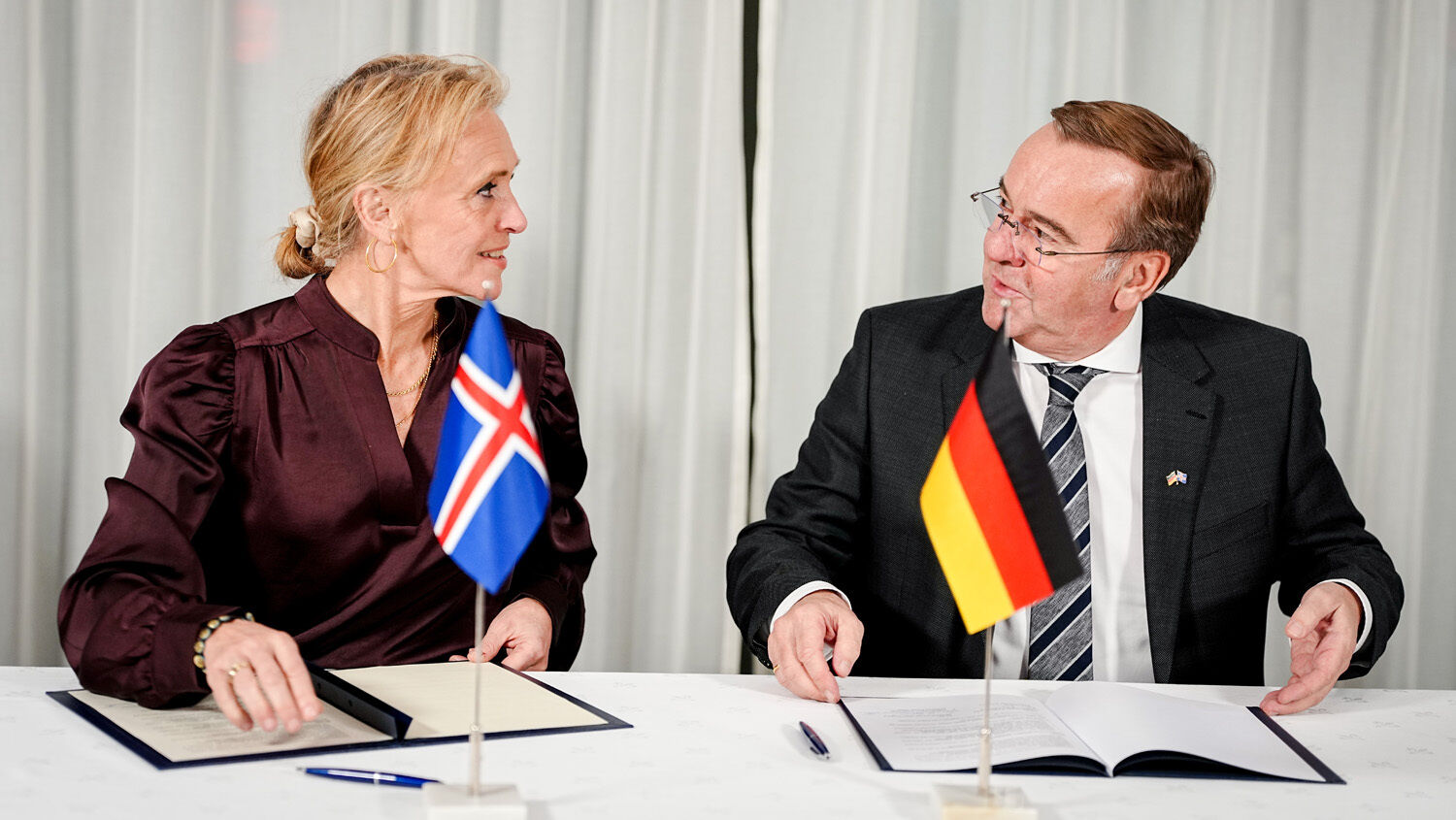
Germany and Iceland Deepen Military Cooperation
Germany is strengthening its military presence in the Arctic. During his first visit to Iceland on October 19, German Defense Minister Boris Pistorius signed a memorandum of understanding to enhance military cooperation between the two countries. Strategically located, Iceland serves as a vital link across the North Atlantic to the United States and Canada, as well as a key gateway to the Arctic.
In Reykjavík, Pistorius and Iceland’s foreign minister, Thorgerdur Katrín Gunnarsdóttir, agreed to deepen cooperation in air and maritime surveillance, critical infrastructure protection and cyberdefense.
“We are prepared to take on more responsibility for stability and security here in the far north,” said Pistorius. “The German Navy will deploy its frigates, submarines and new maritime patrol aircraft to gather intelligence in the North Atlantic.”
The German maritime patrol aircraft, P-8A Poseidon, is designed for submarine hunting and monitoring large areas of the sea. It will be stationed in Iceland temporarily. The increased cooperation “will give the German Armed Forces a strategically important port of call for its combat ships, submarines and supply ships in the far north,” the German Defense Ministry explained.
“These measures are in our common interest. The security situation makes it necessary for us to strengthen our commitment,” Pistorius said. “Russia’s shadow fleet threatens our critical maritime infrastructure every day.”
Although Iceland has been part of nato since 1949, it has no armed forces of its own. Having only a coast guard of about 250 personnel, the island is heavily reliant on nato for its security.
So far, only the U.S. armed forces have a permanent military presence on the island. Gunnarsdottir said increased cooperation with the German Air Force and Navy would protect Iceland against hybrid attacks and disruptions to Internet communications. “In my view, Germany is now the leading force in strengthening security and defense in Europe,” she said.
Germany is increasingly taking the lead militarily. Although some of its contributions remain modest, they significantly extend the country’s global reach and could rapidly expand if needed.
What motivates Germany’s military ambitions?
The most frequently cited cause is Russian aggression. Concerns over Vladimir Putin’s actions have motivated Germany to strengthen its military posture, prompting smaller nations to align more closely with Berlin. Unlike other European countries, Germany has the economic clout and arms industry necessary to address new challenges.
However, it would be foolish to believe that fear of Russia is Germany’s sole impetus for its military endeavors.
Germany has been Russia’s trusted trading partner for decades, and the two countries have helped each other amass immense power. In the early stages of Russia’s invasion of Ukraine, Germany delayed critical arms supplies and blocked meaningful sanctions. If Germany’s sole goal were to counter Russia’s imperialistic ambitions, it would have many more effective ways to do so besides expanding its own military sphere.
But Germany has grander goals that motivate its military strategy.
Germany has a history of conquering territories. In the last century, it lost two world wars. These defeats were a grave humiliation. But they did not end their ambitions. As the founder of the Plain Truth magazine, Herbert W. Armstrong, explained near the end of World War ii, Nazi leaders plotted the third round even before the second was lost. Trumpet editor in chief Gerald Flurry expounded on this in “Who Is Leading Germany?”:
By 1944, these leaders knew that they would lose World War ii, so they were already planning for the next round!
The documentation of their plan is clear—but people ask whether the plan was actually carried out. Well, I can tell you based on the history and backed up by about a hundred Bible prophecies that it was! And the results are facing us right now! Everybody ought to be aware of it.
Mr. Flurry referenced notes from an August 1944 meeting between representatives of major German companies—such as Krupp, Messerschmitt, Volkswagenwerk and Rheinmetall—and senior Nazi officials, where plans for an underground movement were discussed. The U.S. kept the related document classified until 1996, by which time most people had stopped worrying about Germany’s military ambitions. Yet when one compares those wartime plans with developments unfolding today—and with what is prophesied in the Bible—the parallels are striking.
Examine Germany’s military cooperation with Iceland in light of this bigger picture, and we see a potential stepping-stone to not only deter Russia but also gain the advantage over its World War ii enemy, the United States.
This alarming conclusion demands further proof and study. To learn more, read Mr. Flurry’s article “Germany Is Arming for World War III.”


